Home
Class 12
MATHS
Prove, by vector method or otherwise, th...

Prove, by vector method or otherwise, that the point of intersection of the diagonals of a trapezium lies on the line passing through the midpoint of the parallel sides (you may assume that the trapezium is not a parallelogram.)

Text Solution

Verified by Experts
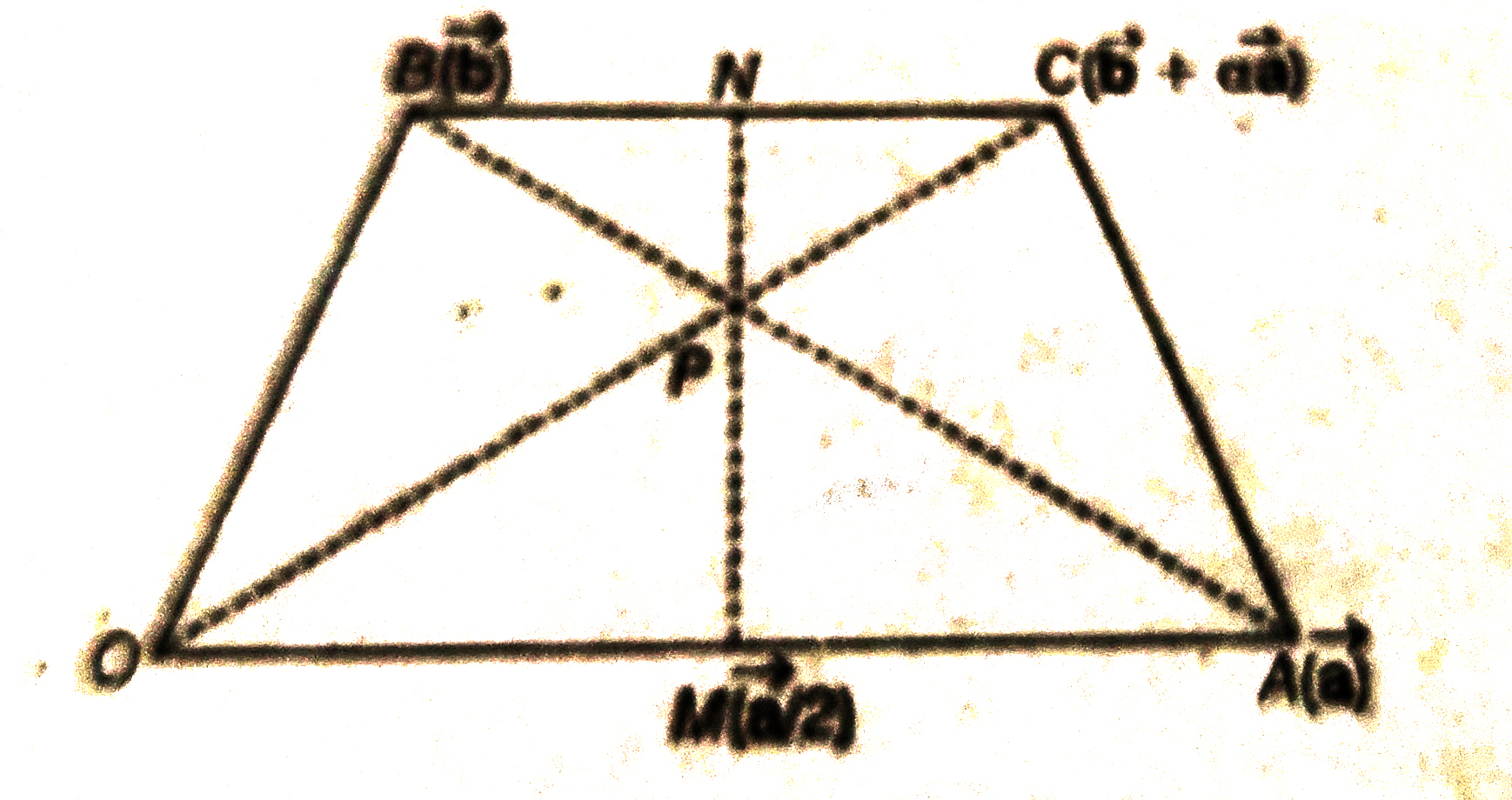
Let O be the origin of reference. Let the position vectors of A and B be `vec(a) " and " vec(b)` respectively.

Since `BC||OA, vec(BA) =alpha vec(OA) =a vec(a)` for some constant `alpha`.
Equation of `OC " is " vec( r) = t (vec(b) +alpha vec(a))` and
equation of `AB " is " vec( r) =vec(a) + lambda (vec(b) - vec(a))`
Let P be the point of intersection of `OC and AB`. Then at point `P, t(vec(b) +alpha vec(a)) =vec(a) +lambda (vec(b)-vec(a))` for some values of t and `lambda`
`rArr (t alpha -1 +lambda ) vec(a) =(lambda-t)vec(b)`
Since `vec(a) " and " vec(b)` are non-parallel vectors we must have
`t alpha = 1+lambda =0 " and " lambda=t rArr t=1 //(alpha +1)`
Thus position vectors of is `vec(r)_(1) =(1,)/(alpha+1) (vec(b)+alphavec(a))`
Equation of MN is `vec(r ) = (1)/(2) vec(a) + k [vec(b) +(1)/(2) (a -1) vec(a)]`
For `k=1//(alpha+1)`{which is the coefficient of `vec(b) " in " vec(r)_(1)`} we get
`vec(r )=(1)/(2) vec(a) +(1)/( alpha +1) [vec(b) +(1)/(2) (alpha-1)vec(a)]`
`=(1)/(alpha+1) vec(b) + (1)/(alpha+1) (alpha-1+alpha+1) vec(a)`
`=(1)/(alpha+1) (vec(b) +alpha vec(a)) =vec(r )_(1) rArr P` lies on MN
Promotional Banner

Similar Questions

Explore conceptually related problems

i. Find the point of intersection of the lines 2x +y-3=0, 3x-y-2=0  ii. Find the equation of the line passing through the above point of intersection and parallel to the line x + y + 1 = 0.

Find the equation of the lines passing through the point of intersection lines 4x-y+3=0 and 5x+2y+7=0 Parallel to x-y+5=0

Find the vector equation of the line passing through the point (2,-1,-1) which is parallel to the line 6x-2=3y+1=2z-2.

Find the equation of the line which passes through the point (1,2,3) and is parallel to the vector 3hati+2hatj-2hatk .

The midpoint of two opposite sides of a quadrilateral and the midpoint of the diagonals are the vertices of a parallelogram. Prove that using vectors.

Prove using vectors the mid-points of two opposite sides of a quadrilateral and the mid-points of the diagonals are the vertices of a parallelogram.

