Home
Class 12
MATHS
From a point P(lambda,lambda,lambda), pe...

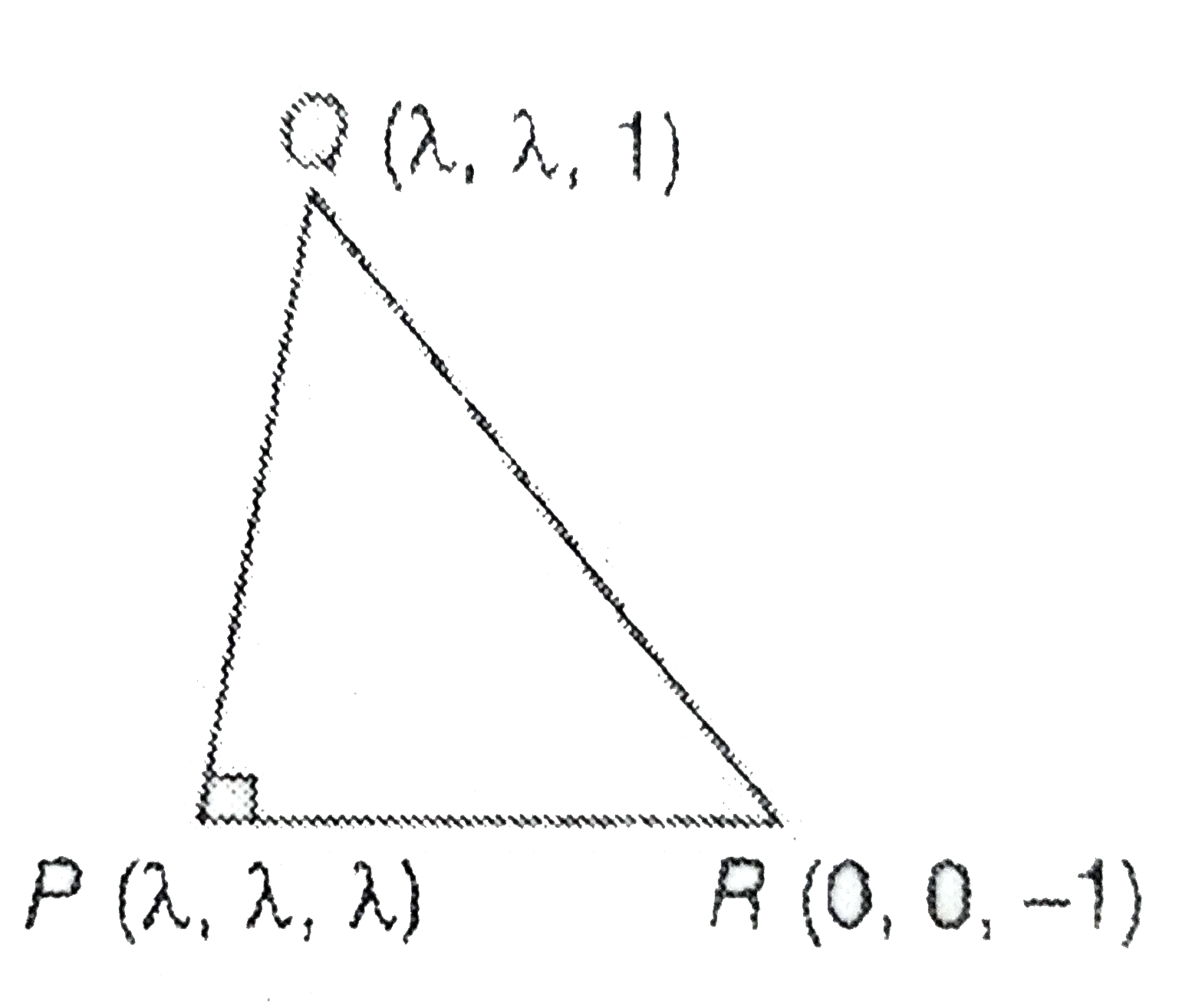
From a point `P(lambda,lambda,lambda)`, perpendicular PQ and PR are drawn respectively on the lines `y=x, z= 1` and `y=-x, z=-1`.If P is such that `angleQPR` is a right angle, then the possible value(s) of `lambda` is/(are)

A

`sqrt(2)`

B

1

C

-1

D

`-sqrt(2)`

Text Solution

Verified by Experts

The correct Answer is:
C

(i) Direction ratios of a line joining two points `(x_(1), y_(1), z_(1))` and `(x_(2), y_(2), z_(2))` are `x_(2)-x_(1), y_(2)-y_(1), z_(2)-z_(1).`
(ii) If the two lines with direction ratios `a_(1),b_(1)c_(1),a_(2),b_(2),c_(2)` are perpendicular, then` a_(1)a_(2)+b_(1)b_(2)+c_(1)c_(2)=0`
Line `L_(1)` is given by y=x,z=1 can be expressed
`L_(1):(x)/(1)=(y)/(1)=(z-1)/(0)=alpha" "["say"]`
`implies" "x=alpha,y=alpha, z=1`
Let the corrdinates of Q on `L_(1)` be `(alpha, alpha,1)`.
Line `L_(2)` given by `y=-x,z=-1` can be expressed as
`L_(2):(x)/(1)=(y)/(-1)=(z+1)/(0)=beta" "["say"]`
`implies" "x=beta,y=-beta,z=-1`
Let the coordinates of R on `L_(2)` be `(beta,-beta,-1)`.
Direction ratios of PQ are `lambda-alpha, lambda-alpha, lambda-1.`
Now, `PQ_|_L_(1)`

`:." "1(lambda-alpha)+1.(lambda-alpha)+0.(lambda-1)=0implieslambda=alpha`
Hence, Q`(lambda, lambda, 1)`
Direction retios of PR are `lambda-beta,lambda+beta,lambda+1.`
Now, `PR_|_L_(2)`
`:." "1(lambda-beta)+(-1)(lambda+beta)+0(lambda+1)=0`
`lambda-beta-lambda=0`
`implies" "beta=0`
Hence, `R(0, 0, -1)`
Now, as `angleQPR=90^(@)`
[as `a_(1)a_(2)+b_(1)b_(2)+c_(1)c_(2)=0`, if two lines with DR's `a_(1),b_(1),c_(1),a_(2),b_(2),c_(2)` are perpendicular]
`:." "(lambda-lambda)(lambda-0)+(lambda-lambda)(lambda-0)+(lambda-1)(lambda+1)=0`
`implies" "(lambda-1)(lambda+1)=0`
`implies" "lambda=1`
or`" "lambda=-1`
`lambda=1`, rejected as P and Q are different points.
`implies" "lambda=-1`
Promotional Banner

Similar Questions

Explore conceptually related problems

From a point P perpendicular tangents PQ and PR are drawn to ellipse x^(2)+4y^(2) =4 , then locus of circumcentre of triangle PQR is

If the line 3x-4y-lambda=0 touches the circle x^2 + y^2-4x-8y- 5=0 at (a, b) then which of the following is not the possible value of lambda+a + b ?

If a circle passes through the point of intersection of the lines lambdax- y +1=0 and x-2y+3=0 with the coordinate axis, then value of lambda is

If roots alpha, beta of the equation (x^(2)-bx)/(ax-c)=(lambda-1)/(lambda+1) are such that alpha+ beta=0 , then the value of lambda is

If the lines 3x^(2)-4xy +y^(2) +8x - 2y- 3 = 0 and 2x - 3y +lambda = 0 are concurrent, then the value of lambda is

If line y-x-1+lambda=0 is equally inclined to axes and equidistant from the point (1,-2) and (3,4) ,the lambda is

From a point P on the normal y=x+c of the circle x^2+y^2-2x-4y+5-lambda^2-0, two tangents are drawn to the same circle touching it at point Ba n dC . If the area of quadrilateral O B P C (where O is the center of the circle) is 36 sq. units, find the possible values of lambdadot It is given that point P is at distance |lambda|(sqrt(2)-1) from the circle.

Find the coordinates of the foot of the perpendicular drawn from the point P(1,-2) on the line y = 2x +1. Also, find the image of P in the line.

If the line (x-2)/-1=(y+2)/1=(z+k)/4 is one of the angle bisector of the lines x/1=y/-2=z/3 and x/-2=y/3=z/1 then the value of k is

