Home
Class 12
MATHS
Let y(x) be a solution of the differe...

Let `y(x)` be a solution of the differential equation `(1+e^x)y^(prime)+y e^x=1.` If `y(0)=2` , then which of the following statements is (are) true? (a) `( b ) (c) y(( d ) (e)-4( f ))=0( g )` (h) (b) `( i ) (j) y(( k ) (l)-2( m ))=0( n )` (o) (c) `( d ) (e) y(( f ) x (g))( h )` (i) has a critical point in the interval `( j ) (k)(( l ) (m)-1,0( n ))( o )` (p) (q) `( r ) (s) y(( t ) x (u))( v )` (w) has no critical point in the interval `( x ) (y)(( z ) (aa)-1,0( b b ))( c c )` (dd)

A

(a) `Y(-4) =0`

B

(b) `Y(-2)=0`

C

(c) y(x) has a critical point in the intervel (-1,0)

D

(d) y(x) has no critical point in the interval (-1,0)

Text Solution

Verified by Experts

The correct Answer is:
(a,c)

Here, `(1+e^(x))y'+ye^(x)=1`
`rArr dy/dx+ e^(x) cdotdy/dx+ye^(x)=1`
`rArr dy+e^(x)dy+ye^(x)dx=dx`
`rArr dy+d(e^(x)y)=dx`
On integrating voth sides, we get
`y+e^(x)y=x+C`
Given, `y(0)=2`
`rArr 2+e^(0) cdot 2=0+C`
`rArr C =4`
`therefore y(1+e^(x))=x+4`
`rArr y=(x+4)/(1+e^(x)`
Now at `x=-4, y=(-4+4)/(1+e^(-4))=0`
`therefore y(-4)=0 ... (i)`
For critical points, `dy/dx= 0`
i.e. `dy/dx=((1+e^(x)) cdot1-(x+4)e^(x))/((1+e^(x))^(2))=0`
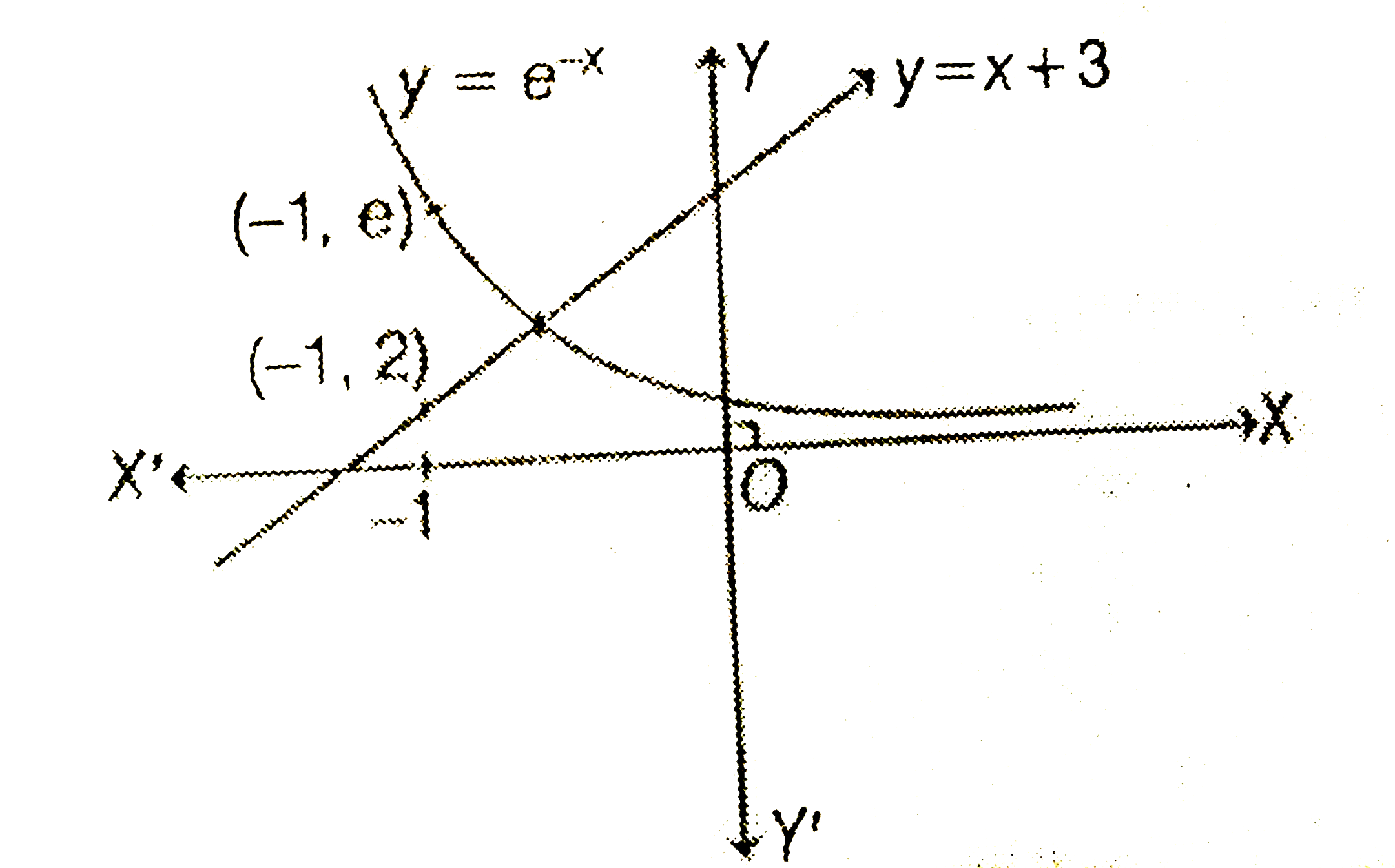
`rArr e^(x) (x+3)-1=0`
or `e^(-x)=(x+3)`
Clearly, the intersection point lies between (-1,0).
`therefore y(x)` has a critical point in the interval (-1,0).
Promotional Banner

Similar Questions

Explore conceptually related problems

The solution to the differential equation ylogy+x y^(prime)=0, where y(1)=e , is

Let y(x) be a solution of the differential equation (1+e^x)y^(prime)+y e^x=1. If y(0)=2 , then which of the following statements is (are) true? (a) y(-4)=0 (b) y(-2)=0 (c) y(x) has a critical point in the interval (-1,0) (d) y(x) has no critical point in the interval (-1,0)

If y(x) satisfies the differential equation y^(prime)-ytanx=2xs e c x and y(0)=0 , then

The solution of the differential equation (e^(x^2)+e^(y^2))y(dy)/(dx)+e^(x^2)(x y^2-x)=0i s

The circumcenter of the triangle formed by the line y=x ,y=2x , and y=3x+4 is (a) ( b ) (c)(( d ) (e)6,8( f ))( g ) (h) (b) ( i ) (j)(( k ) (l)6,8( m ))( n ) (o) (c) ( d ) (e)(( f ) (g)3,4( h ))( i ) (j) (d) ( k ) (l)(( m ) (n)-3,-4( o ))( p ) (q)

The solution of the differential equation (d^2y)/(dx^2)=sin3x+e^x+x^2 when y_1(0)=1 and y(0)=0 is

Let y = y(x) be the solution of the differential equation x dy/dx+y=xlog_ex,(xgt1)." If " 2y(2)=log_e4-1," then "y(e) is equal to

Find the particular solution of the differential equation (1+e^(2x))dy+(1+y^(2))e^(x)dx=0. Given that y=1 when x=0.

Solve the differential equation y e^(x)/(y) dx = (x e^(x)/(y) + y^(2))dy ( y ne 0) .

