Home
Class 12
MATHS
A hemi-spherical tank of radius 2 m is i...

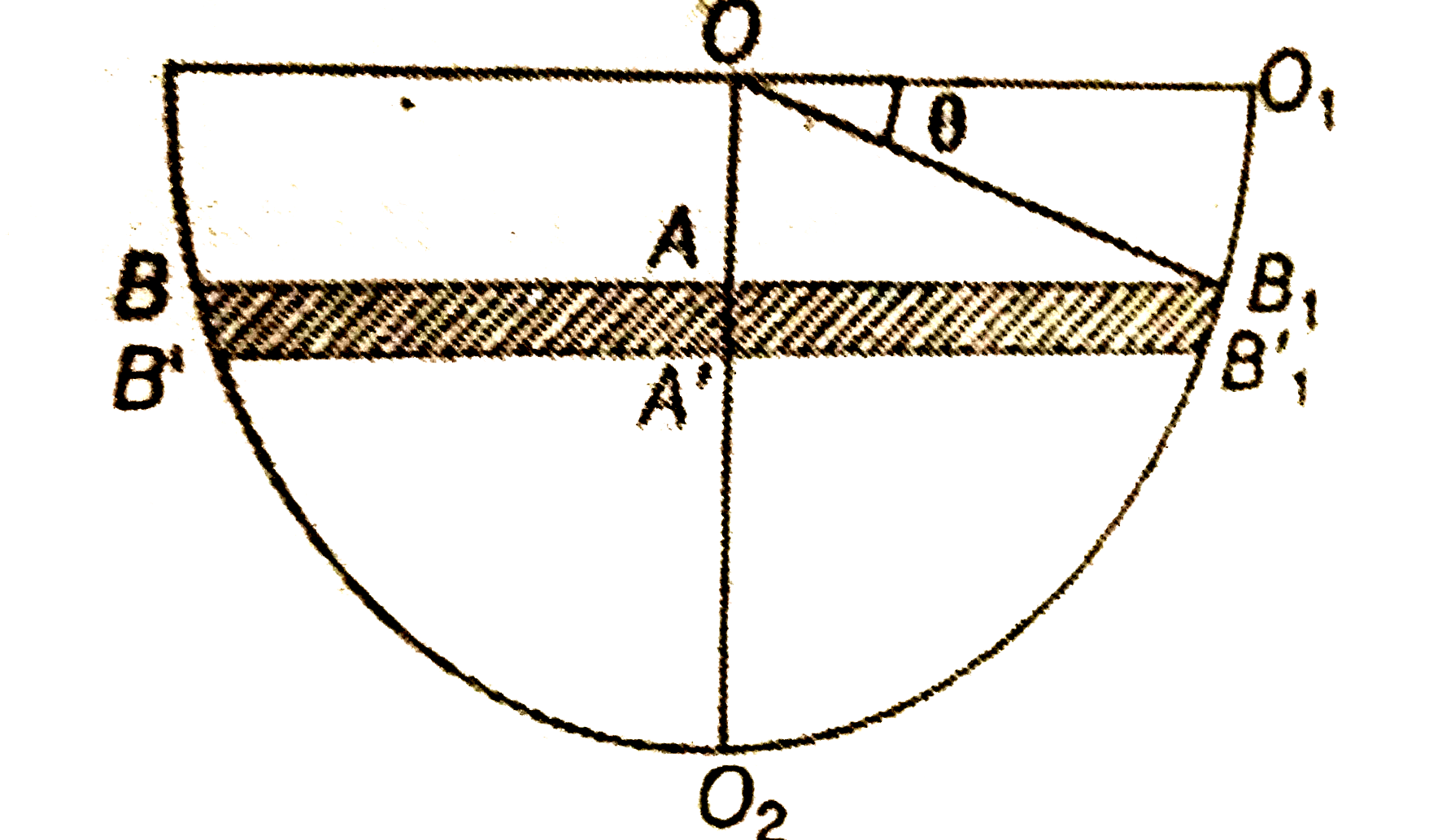
A hemi-spherical tank of radius 2 m is initially full of water and has an outlet of `12c m^2` cross-sectional area at the bottom. The outlet is opened at some instant. The flow through the outlet is according to the law `v(t)=sqrt(0. 62gh(t)),` where `v(t)` and `h(t)` are, respectively, the velocity of the flow through the outlet and the height of water level above the outlet and the height of water level above the outlet at time `t ,` and `g` is the acceleration due to gravity. Find the time it takes to empty the tank.

Text Solution

Verified by Experts

The correct Answer is:
((14pixx10^(5))/(27sqrt(g))unit)`

Let O be the centre of hemispherical tank. Let at any
instant t, water level be `BAB_(1)` and t+dt, water level
is `B'A'B_(1).` Let `lt O_(1)OB_(1)=theta. `
`rArr AB_(1)=r cos theta and OA = r sin theta` decrease in the water
volume in time `di = pi AB_(1) ^(2). d (OA)`
[`pir^(2)` is surface area of water level and d (OA) is depth
of weter level]
`=pir^(2) cdot cos^(2)theta cdot r cos theta d theta`
`=pir^(3) cdot cos^(3)theta d theta`
Also, `h (t)=O_(2)A=r-rsin theta=r (1-sin theta)`
Now, outflow rate `Q=Acdot v(t)=Acdot 0.6sqrt(2gr(-sin theta))` ltbr. Where, A is the area of the outlet.
Thus, volume fliwing out in time dt.
`rArr Q_dt= A cdot (0.6) cdot sqrt (2gr) cdot sqrt (1-sin theta ) dt`
We have, `pir^(3) cos^(3)theta d theta = A (0.6) cdot sqrt (2gr) cdot sqrt (1-sin theta ) dt`
`rArr (pir^(3))/(A(0.6)sqrt(2gr))cdot (cos^(3) theta )/sqrt(1-sin theta ) d theta =dt `
Let the time taken to empty the tank be T.
Then, `T=int_(0)^(pi//2) (pir^(3))/(A(0.6)sqrt(2gr))cdot (cos^(3) theta )/sqrt(1-sin theta ) d theta `
`= (pir^(3))/(A(0.6)sqrt(2gr))int_(0)^(pi//2)(1-sin^(2)theta (-cos theta))/sqrt(1-sin theta )d theta`
Let `t_(1)= sqrt(1-sin theta )`
`rArr dt_(1)=(- cos theta)/(sqrt(1-sin theta ))d theta `
`therefore T=(-2pir^(3))/(A(0.6)sqrt(2gr))int_(1)^(0)[1-(1-t_(1)^(2))^(2)]dt_(1)`
`rArr T=(-2pir^(3))/(A(0.6)sqrt(2gr))int_(1)^(0)[1-(1+t_(1)^(4)-2t_(1)^(2))]dt_(1)`
`rArr T=(-2pir^(3))/(A(0.6)sqrt(2gr))int_(1)^(0)[1-(1-t_(1)^(4)+2t_(1)^(2)]dt_(1)`
`rArr T=(2pir^(3))/(A(0.6)sqrt(2gr))int_(1)^(0)(t_(1)^(4)+2t_(1)^(2))dt_(1)`
`rArr T=(2pir^(3))/(A(0.6)sqrt(2gr))int_(1)^(0)[t_(1)^(5)/5-(2t_(1)^(3))/3]_(1)^(0)`
`rArr T=(2pir cdot r^(5//2))/(A(6/10)sqrt(2gr)) cdot [0-1/5-0+2/3]`
`rArr T=(2pi cdot 2^(5//2)(10^(2))^(5//2))/(12cdot 3/5 cdot sqrt(2) cdot sqrt(g))[2/3-1/5]`
`=(2pixx10^(5) cdot 4 cdot 5)/((12xx3)sqrt(g))[(10-3)/15]`
`=(2pixx10^(5) xx7)/(3 cdot 3 cdot sqrt(g) cdot3 )=(14pixx10^(5))/(27sqrt(g)) unit`
Promotional Banner

Similar Questions

Explore conceptually related problems

A hemi-spherical tank of radius 1.75 m is full of water. It is connected with a pipe which empties the tank at the rate of 7 litre per second. How much time will it take to empty the tank completely ?

A particle moves so that the distance moved is according to the law s(t)=(t^(3))/(3)-t^(2)+3 . At what time the velocity and acceleration are zero respectively ?

A particle moves so that the distance moved is according to the law s(t)=t^3/3-t^2+3 . At what time the velocity and acceleration are zero respectively?

A large cylindrical tank has a hole of area A at its bottom and water is poured into the tank through a tube of cross-sectional area A ejecting water at the speed v . Which of the following is true?

A particle moves along a line according to the law s(t)=2t^(3)-9t^(2)+12t-4 , where tge0 . Find the particle's acceleration each time the velocity is zero.

The area of cross section of a large tank is 0.5m^2 . It has an opening near the bottom having area of cross section 1cm^2 . A load of 20 kg is applied on the water at the top. Find the velocity of the water coming out of the opening at the time when the height of water level is 50 cm above the bottom. Take g=10ms^-2

A current of 2A flows through a 12 V bulb then find resistance.

When current I flows through a wire, the drift velocity of the electrons is v. When current 2I flows through another wire of the same material having double the length and area of cross-section, the drift velocity of the electrons will be

