Home
Class 12
MATHS
Q. Let z1 and z2 be nth roots of unity ...

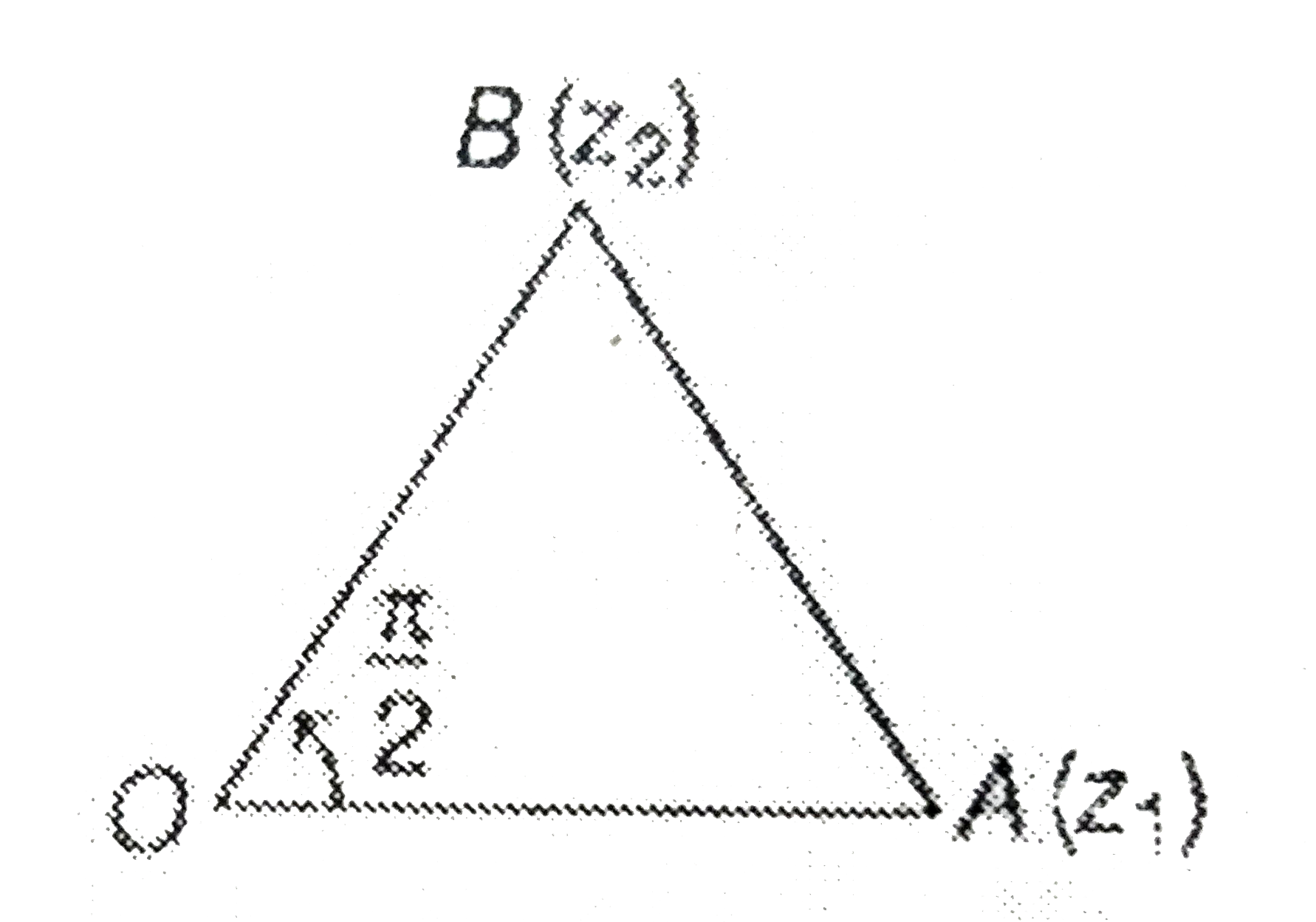
Q. Let `z_1` and `z_2` be nth roots of unity which subtend a right angle at the origin, then n must be the form ``.

A

`4k +1`

B

`4 k +2`

C

`4 k +3`

D

4k

Text Solution

Verified by Experts

The correct Answer is:
D

Since arg`z_1/z_2=pi/2`
`rArr " " z_1/z_2=cos""lpi/2+I sin ""pi/2=i`
`therefore z_1/z_2=cos""pi/2+ I sin ""pi/2=i`
`therefore" "z_1^n=(i)^n rArr i^n =1" "[because |z_2|=|z_1|=1]`
`rArr n=4k `
Alternate Solution
Since arg `z_2/z_1 = pi/2`
`therefore z_2/z_1=|z_2/z_1|e^(ipi/2)`
`rArr z_2/z_1 =i " "[ because |z_1|=|z_2|=1]`
`rArr ((z_2)/(z_1))^n=i^n`
`therefore z_1 " and " z_2` are nth roots of unity
`rArr ((z_2)/(z_1))^(z_1^n=z_2^n=1)`
`rArr i^n=1`
`rArr n =4k` where k is an integer.
Promotional Banner

Similar Questions

Explore conceptually related problems

Statement 1: If the straight line x=8 meets the parabola y^2=8x at Pa n dQ , then P Q substends a right angle at the origin. Statement 2: Double ordinate equal to twice of latus rectum of a parabola subtends a right angle at the vertex.

Let z_(1)" and "z_(2) be two roots of the equation z^(2)+az+b=0 , z being complex number further, assume that the origin, z_(1)" and "z_(2) form an equilateral triangle, then

Let z_(1)" and "z_(2) be the roots of the equation z^(2)+pz+q=0 , where p,q are real. The points represented by z_(1),z_(2) and the origin form an equilateral triangle if

If z=omega,omega^2w h e r eomega is a non-real complex cube root of unity, are two vertices of an equilateral triangle in the Argand plane, then the third vertex z may be represented by (a) z=1 b. z=0 c. z=-2 d. z=-1

Let z_1 and z_2 q, be two complex numbers with alpha and beta as their principal arguments such that alpha+beta then principal arg(z_1z_2) is given by:

z_1, z_2a n dz_3 are the vertices of an isosceles triangle in anticlockwise direction with origin as in center , then prove that z_2, z_1a n d kz_3 are in G.P. where k in R^+dot

Let p and q are complex numbers such that |p|+|q| lt 1 . If z_(1) and z_(2) are the roots of the z^(2)+pz+q=0 , then which one of the following is correct ?

Let z_1a n dz_2 b be toots of the equation z^2+p z+q=0, where he coefficients pa n dq may be complex numbers. Let Aa n dB represent z_1a n dz_2 in the complex plane, respectively. If /_A O B=theta!=0a n dO A=O B ,w h e r eO is the origin, prove that p^2=4q"cos"^2(theta//2)dot

z_1a n dz_2 are the roots of 3z^2+3z+b=0. if O(0),(z_1),(z_2) form an equilateral triangle, then find the value of bdot

If the complex numbers z_(1), z_(2)" and "z_(3) denote the vertices of an isoceles triangle, right angled at z_(1), " then "(z_(1)-z_(2))^(2)+(z_(1)-z_(3))^(2) is equal to

