Home
Class 12
MATHS
A signal which can be green or red with ...

A signal which can be green or red with probability `4/5 and 1/5` respectively, is received by station A and then and 3 transmitted to station B. The probability of each station receiving the signal correctly is `3/4` If the signal received at station B is green, then the probability that the original signal was green is (a) `3/5` (b) `6/7` (c) `20/23` (d) `9/20`

A

`(3)/(5)`

B

`(6)/(7)`

C

`(20)/(23)`

D

`(9)/(20)`

Text Solution

Verified by Experts

The correct Answer is:
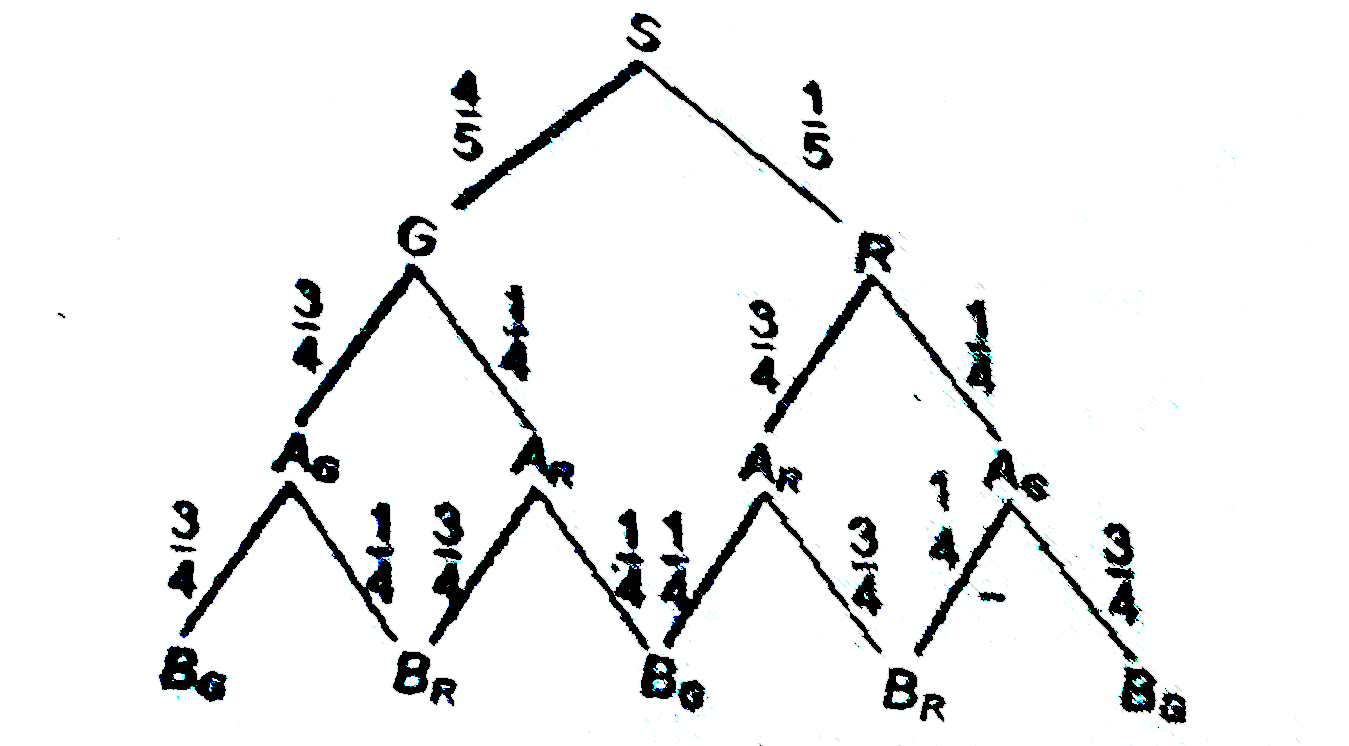
C

From the tree diagram, it follows that

`P(B_(G))=(46)/(80)`
`P(B_(G)|G)=(10)/(16)=(5)/(8)`
`P(B_(G)nnG)=(5)/(8)xx(4)/(5)=(1)/(2)`
`P(G|B_(G))=((1)/(2))/(P(B_(G)))=(1)/(2)xx(80)/(46)=(20)/(23)`
Promotional Banner

Similar Questions

Explore conceptually related problems

If A and B each toss three coins. The probability that both get the same number of heads is (a) 1/9 (b) 3/16 (c) 5/16 (d) 3/8

Five horses are in a race. Mr. A selects two of the horses at random and bets on them. The probability that Mr. A selected the winning horse is (A) 3/5 (B) 1/5 (C) 2/5 (D) 4/5

A a n d B are two candidates seeking admission in ITT. The probability that A is selected is 0.5 and the probability that A a n d B are selected is at most 0.3. Is it possible that the probability of B getting selected is 0.9?

Let S={1,2,...,20} A subset B of S is said to be "nice" , if the sum of the elements of B is 203. Then the probability that a randomly chosen subset of S is "nice" is: (a) 7/(2^20) (b) 5/(2^20) (c) 4/(2^20) (d) 6/(2^20)

A jar contains 54 marbles each of which is blue, green or white. The probability of selecting a blue marbles at random from the jar is (1)/(3) and the probability of selecting a green marble at random is (4)/(9) . How many white marbles does the jar contain ?

An ellipse having foci at (3, 3) and (-4,4) and passing through the origin has eccentricity equal to 3/7 (b) 2/7 (c) 5/7 (d) 3/5

Probability that A speaks truth is 4/5 . A coin is tossed. A reports that a head appears. The probability that actually there was head is (A) 4/5 (B) 1/2 (C) 1/5 (D) 2/5

Three persons work independently on a problem. If the respective probabilities that they will solve it are 1/3, 1/4 and 1/5, then find the probability that not can solve it.

