Home
Class 12
MATHS
Let n(1)and n(2) be the number of red an...

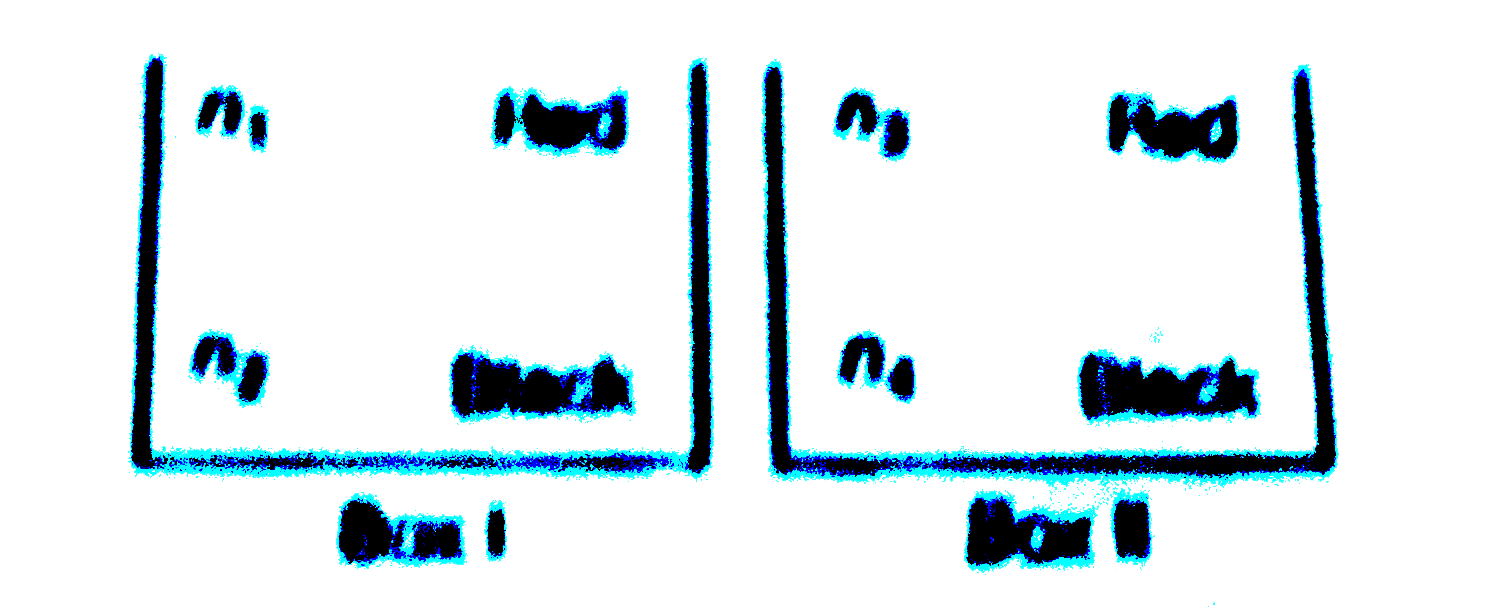
Let `n_(1)and n_(2)` be the number of red and black balls, respectively, in box I. Let `n_(3) and n_(4)` be the numbers of red and black balls, respectively, in the box II.
A ball is drawn at random from box I and transferred to box II. If the probability of drawing a red ball from box I, after this transfer, is 1/3, then the correct options (s) with the possible values of `n_(1) and n_(2)` is (are)

A

`n_(1)=3,n_(2)=3,n_(3)=5,n_(4)=15`

B

`n_(1)=3,n_(2)=6,n_(3)=10,n_(4)=50`

C

`n_(1)=8,n_(2)=6,n_(3)=5,n_(4)=20`

D

`n_(1)=6,n_(2)=12,n_(3)=5,n_(4)=20`

Text Solution

Verified by Experts

The correct Answer is:
B


Let A = Drawing red ball
`therefore " " (A)=P(B_(1))*P(A//B_(1))+P(B_(2))*P(A//B_(2))`
`=(1)/(2)((n_(1))/(n_(1)+n_(2)))+(1)/(2)((n_(3))/(n_(3)+n_(4)))`
Given, `P(B_(2)//A)=(1)/(3)`
`rArr" " (P(B_(2))*P(B_(2)nnA))/(P(A))=(1)/(3)`
`rArr " " ((1)/(2)((n_(3))/(n_(3)+n_(4))))/((1)/(2)((n_(1))/(n_(1)+n_(2)))+(1)/(2)((n_(3))/(n_(3)+n_(4))))=(1)/(3)`
`rArr " " (n_(3)(n_(1)+n_(2)))/(n_(1)(n_(3)+n_(4))+n_(3)(n_(1)+n_(2)))=(1)/(3)`
Now, check options,then clearly options (a) and (b) satisfy.
Promotional Banner

Similar Questions

Explore conceptually related problems

A bag contains 2 red balls and 4 black balls. A ball is drawn at random from the bag. What is the probability that the ball drawn is red?

Bag I contains 3 red and 4 black balls while another Bag II contains 5 red and 6 black balls. One ball is drawn at random from one of the bags and it is found to be red. Find the probability that it was drawn from Bag II.

A bag contains 2 red balls and 6 black balls. A ball is drawn at random from the bag. What is the probability that the ball drawn is not red?

A bag contains 5 red balls and some blue balls. If the probability of drawing a blue ball from the bag is thrice that of drawing a red ball, then find the number of blue balls in the bag.

A bag contains 5 red balls and some blue balls. If the probability of drawing a blue ball is double that of a red ball, determine the number of blue balls in the bag.

A bag contains 5 red balls and some blue balls. If the probability of drawing a blue ball double that of a red ball determine the number of blue balls in the bag.

A bag contains 15 balls, some are red and others are white. If a ball is drawn at random from the bag, the probability that it is red is 1/5 . Find the number of white balls in the bag.

Bag I contains 3 red and 4 black balls and Bag II contains 4 red and 5 black balls. One ball is transferred from Bag I to Bag II and then a ball is drawn from Bag II. The ball so drawn is found to be red in color. Find the probability that the transferred ball is black.

