Home
Class 12
MATHS
C(1) and C(2) are two concentric circles...

`C_(1)` and `C_(2)` are two concentric circles, the radius of `C_(2)` being twice that of `C_(1)`. From a point P on `C_(2)`, tangents PA and PB are drawn to `C_(1)`. Prove that the centroid of triangle PAB lies on `C_(1)`.

Text Solution

Verified by Experts
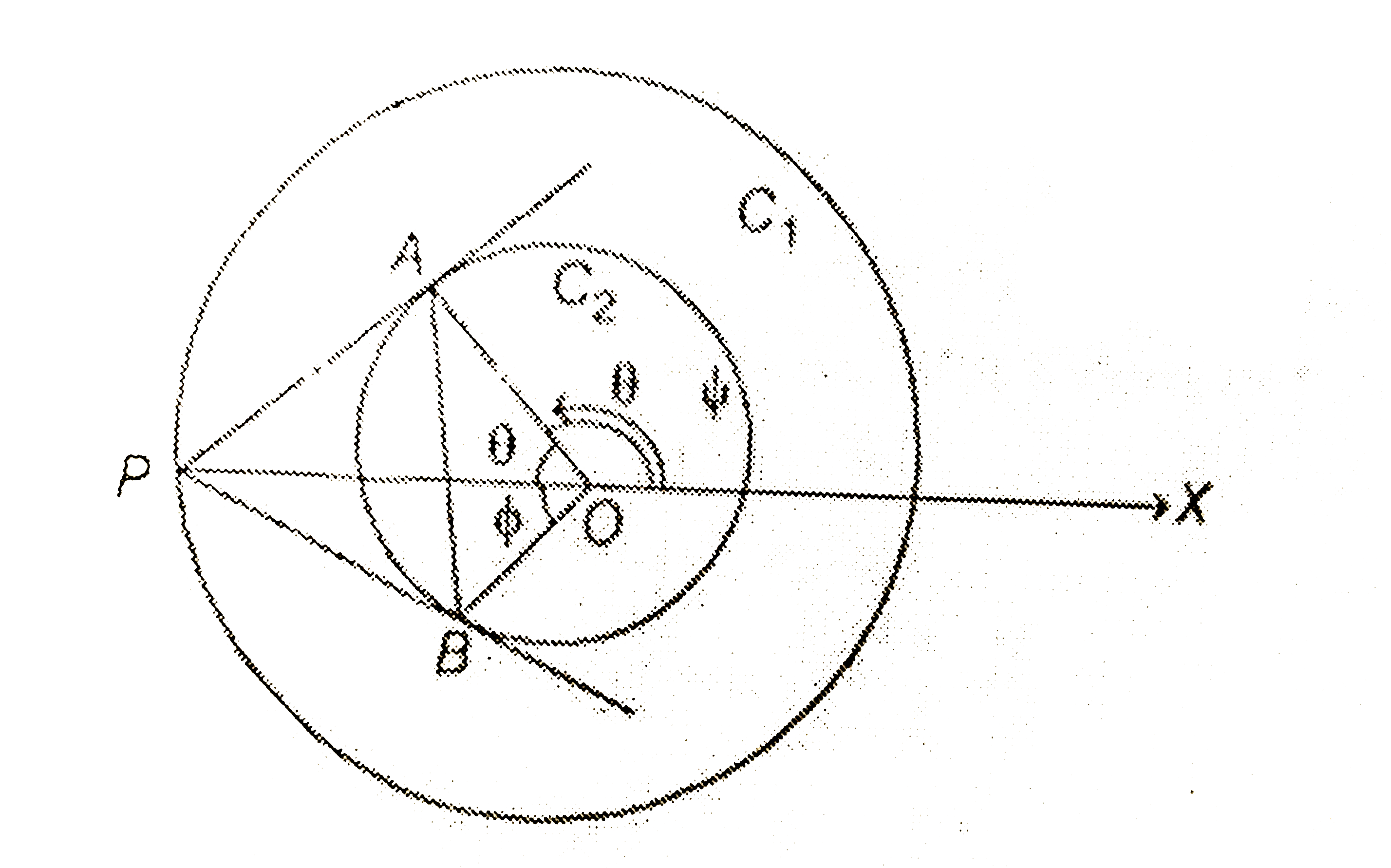
Let the coordinates of point P be `(2r cos theta, 2r sin theta)`
We have , OA = r, OP = 2r
Since, `Delta OAP` is a right angled triangle.

`cosphi=1//2rArr phi=pi//3`
`therefore` Coordinates of A are `{cos(theta-pi//3),rsin(theta-pi//3)}`
If p, q is the centroid of Delta PAB, then
`p=(1)/(3)[rcos(theta-pi//3)+rcos(theta+pi//3)+2rcostheta]`
`=(1)/(3)[r(2"cos"(theta-(pi)/(3)+theta+(pi)/(3))/(2)*"cos"(theta-(pi)/(3)-theta-(pi)/(3))/(2))+2rcostheta]`
`(1)/(3)[r{2costhetapi//3}+2rcostheta]`
`=(1)/(3)[r*costheta+2rcostheta]=rcostheta`
and `q=(1)/(3)[rsin( theta-(pi)/(3))+rsin(theta+(pi)/(3))+2rsintheta]`
`=(1)/(3)[r(2"sin"(theta-(pi)/(3)+theta+(pi)/(3))/(2)*"cos"(theta-(pi)/(3)-theta-(pi)/(3))/(2))+2rsintheta]`
`=(1)/(3)[rsin(2sinthetacospi//3)+2rsintheta]`
`=(1)/(3)[r(sintheta)+2rsintheta]=rsintheta`
Now, (p, q) = `(r cos theta, r sin theta) " lies on " x^(2) + y^(2) = r^(2)` which is called `C_(1)`.
Promotional Banner

Similar Questions

Explore conceptually related problems

C_(1) and C_(2) are two concentrate circles, the radius of C_(2) being twice that of C_(1) . From a point P on C_(2) tangents PA and PB are drawn to C_(1) . Prove that the centroid of the DeltaPAB lies on C_(1)

C1 and C2 are two concentric circles, the radius of C2 being twice that of C1. From a point P on C2, tangents PA and PB are drawn to C1. Then the centroid of the triangle PAB (a) lies on C1 (b) lies outside C1 (c) lies inside C1 (d) may lie inside or outside C1 but never on C1

From a point P outside a circle with centre at C, tangents PA and PB are drawn such that 1/(CA)^2+ 1/(PA)^2=1/16 , then the length of chord AB is

The centres of two circles C_(1) and C_(2) each of unit radius are at a distance of 6 unit from each other. Let P be the mid-point of the line segment joining the centres of C_(1) and C_(2) and C be a circle touching circles C_(1) and C_(2) externally. If a common tangent to C_(1) and C passing through P is also a common tangent to C_(2) and C, then the radius of the circle C, is

Consider three circles C_1, C_2 and C_3 such that C_2 is the director circle of C_1, and C_3 is the director circlé of C_2 . Tangents to C_1 , from any point on C_3 intersect C_2 , at P^2 and Q . Find the angle between the tangents to C_2^2 at P and Q. Also identify the locus of the point of intersec- tion of tangents at P and Q .

Pa n dQ are two points on a circle of centre C and radius alpha . The angle P C Q being 2theta , find the value of sintheta when the radius of the circle inscribed in the triangle C P Q is maximum.

Let C_1, C_2, ,C_n be a sequence of concentric circle. The nth circle has the radius n and it has n openings. A points P starts travelling on the smallest circle C_1 and leaves it at an opening along the normal at the point of opening to reach the next circle C_2 . Then it moves on the second circle C_2 and leaves it likewise to reach the third circle C_3 and so on. Find the total number of different path in which the point can come out of nth circle.

Let C_1 and C_2 be two circles with C_2 lying inside C_1 circle C lying inside C_1 touches C_1 internally andexternally. Identify the locus of the centre of C

Suppose that two circles C_(1) and C_(2) in a plane have no points in common. Then

In the figure given, two circles with centres C_t and C_2 are 35 units apart, i.e. C_1 C_2=35 . The radii of the circles with centres C_1 and C_2 are 12 and 9 respectively. If P is the intersection of C_1 C_2 and a common internal tangent to the circles, then l(C_1 P) equals

