Home
Class 12
MATHS
Find the intervals of the values of a fo...

Find the intervals of the values of `a` for which the line `y+x=0` bisects two chords drawn from the point `((1+sqrt(2)a)/2,(1-sqrt(2)a)/2)` to the circle `2x^2+2y^2-(1+sqrt(2)a)x-(1-sqrt(2)a)=0`

Text Solution

Verified by Experts
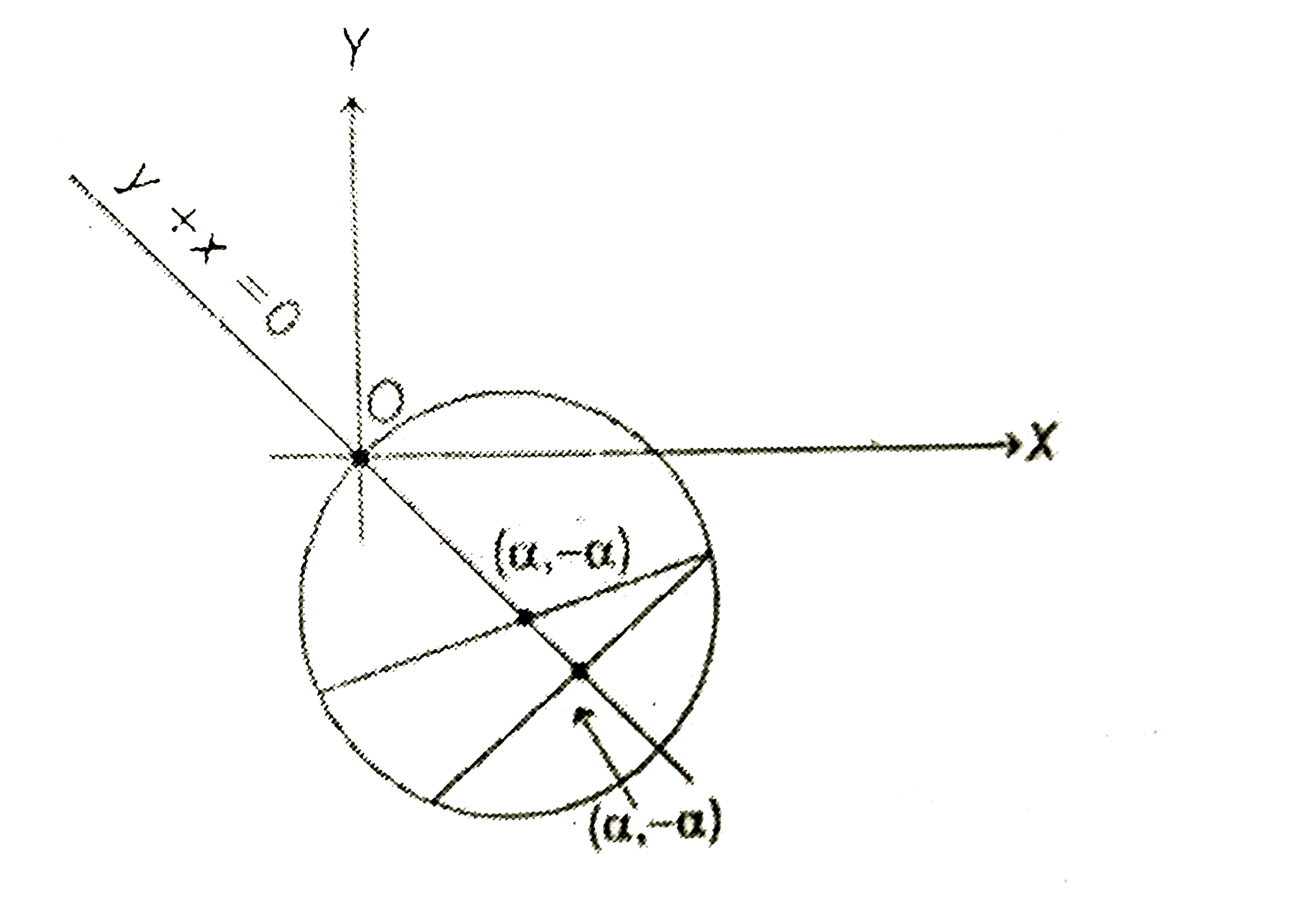
Given, `2x^(2) +2y^(2)-(1+sqrt23a)x-(1-sqrt2a)y=0`
`rArr x^(2)+y^(2)-((1+sqrt2a)/(2))x-((1-sqrt2a)/(2))y=0`
Since, y + x = 0 bisects two chords of this circle, mid points of the chords must be of the form `(alpha, - alpha)`.

Equation of the chord having `(alpha, - alpha)` as mid point is
`T=S_(1)`
`rArr xalpha+y(-alpha)-((1+sqrt2a)/(4))(x+alpha)-((1-sqrt2a)/(4))(y-alpha)`
`a^(2)+(-alpha)^(2)-((1+sqrt2a)/(2))alpha-((1-sqrt2a)/(2))(-alpha)`
`rArr 4xalpha-4yalpha-(1+sqrt2alpha)x-(1+sqrt2a)alpha`
`-(1-sqrt2a)y+(1-sqrt2a)alpha`
`4alpha^(2)+4alpha^(2)-(1+sqrt2a)*2alpha+(1-sqrt2a)*2alpha`
`rArr 4ax-45ay-(1+sqrt2a)x-(1-sqrt2a)y`
`=8alpha^(2)-(1+sqrt2a)alpha+(1-sqrt2a)alpha`
But this chord will pass through the point ,brgt `((1+sqrt2a)/(2))f-4alpha((1-sqrt2a)/(2))-((1+sqrt2a)(1+sqrt2a))/(2)`
`-((1-sqrt2a)(1-sqrt2a))/(2)`
`=8alpha^(2)-2sqrt2aalpha`
`rArr 2alpha[(1+sqrt2a-1+sqrt2a)]=8alpha^(2)-2sqrt2aalpha`
`rArr 4sqrt2alpha-(1)/(2)[2+2sqrt2a)^(2)]=8alpha^(2)-2sqrt2aalpha`
`[therefore(a+b)^(2)+(a-b)^(2)=2a^(2)+2b^(2)]`
`rArr 8 alpha^(2)-6sqrt2alpha+1+2a^(2)=0`
But this quadratic equation will have two distinct roots, if
`(6sqrt2a)^(2)-4(8)(1+2a^(2))gt0`
`rArr 72a^(2)-32(1+2a^(2))gt0`
`rArr 8a^(2)-32gt0`
`rArr a^(2)-4gt0`
`rArr a lt-2uuagt2`
Therefore, `a in (-oo, -2)uu(2, oo)`.
Promotional Banner

Similar Questions

Explore conceptually related problems

If P(1+t/(sqrt(2)),2+t/sqrt(2)) is any point on a line, then the range of the values of t for which the point P lies between the parallel lines x+2y=1a n d2x+4y=15. is (a) (4sqrt(2))/3lttlt5(sqrt(2)) 6 (b) 0lttlt(5sqrt(2)) (c) 4sqrt(2)lttlt0 (d) none of these

Find the values of a for which three distinct chords drawn from (a ,0) to the ellipse x^2+2y^2=1 are bisected by the parabola y^2=4xdot

Find the equation of the normal to the circle x^2+y^2=9 at the point (1/(sqrt(2)),1/(sqrt(2)))

Find the equation of the plane containing the lines 2x-y+z-3=0,3x+y+z=5 and a t a distance of 1/sqrt6 from the point (2,1,-1).

Prove that the product of the lengths of the perpendiculars drawn from the points (sqrt(a^(2)-b^(2)), 0) and (-sqrt(a^(2)-b^(2)), 0) to the line (x)/(a)cos theta+(y)/(b)sin theta=1 is b^(2)

Find the roots of x^(2) + x/sqrt(2)+1=0

Find the equation of the normal to the circle x^(2)+y^(2)=9 at the point (1//sqrt(2), 1// sqrt(2)) .

The length of the chord of the parabola y^2=x which is bisected at the point (2, 1) is (a) 2sqrt(3) (b) 4sqrt(3) (c) 3sqrt(2) (d) 2sqrt(5)

The coordinates (2, 3) and (1, 5) are the foci of an ellipse which passes through the origin. Then the equation of the (a)tangent at the origin is (3sqrt(2)-5)x+(1-2sqrt(2))y=0 (b)tangent at the origin is (3sqrt(2)+5)x+(1+2sqrt(2)y)=0 (c)tangent at the origin is (3sqrt(2)+5)x-(2sqrt(2)+1))y=0 (d)tangent at the origin is (3sqrt(2)-5)x-y(1-2sqrt(2))=0

The coordinates (2, 3) and (1, 5) are the foci of an ellipse which passes through the origin. Then the equation of the (a)tangent at the origin is (3sqrt(2)-5)x+(1-2sqrt(2))y=0 (b)tangent at the origin is (3sqrt(2)+5)x+(1+2sqrt(2)y)=0 (c)tangent at the origin is (3sqrt(2)+5)x-(2sqrt(2+1))y=0 (d)tangent at the origin is (3sqrt(2)-5)-y(1-2sqrt(2))=0

