Given, `(x^(2) + xy + 4x + 2y + 4) (dy)/(dx) - y^(2) = 0`
`implies [(x^(2) + 4x + 4) + y (x + 2)] (dy)/(dx) - y^(2) = 0`
`implies [(x + 2)^(2) + y (x + 2)] (dy)/(dx) - y^(2) = 0`
Put x + 2 = X and y = Y, then
`(X^(2) + XY) (dY)/(dX) - Y^(2) = 0`
`implies `X(2) dY + XYdY - Y^(2) dX = 0`
`implies `X^(2) dY + Y (XdY - YdX) = 0`
`implies - (dY)/(Y) = (XdY - YdX)/(X^(2))`
`implies - d (log |Y|) = d ((Y)/(X))`
On integrating both sides, we get
`- log |Y| = (Y)/(X) + C`, where `x + 2 = X`
and `y = Y`
`implies - log |y| = (y) = (y)/(x + 2) + C`
Since, it passes through the point (1,3)
`:. - log 3 = 1 + C`
`implies C = - 1 - log 3 = -(log e + log 3) = - log 3e`
`:.` Eq (i) becomes
`log |y| + (y)/(x + 2) - log (3e) = 0`
`implies log ((|y|)/(3e)) + (Y)/(x + 2) = 0`
Now, to check option (a), y = x + 2 intersects the curve.
`implies log ((|x + 2|)/(3e)) + (x + 2)/(x + 2) = 0`
`implies log ((|x + 2|)/(3e)) = - 1`
`implies (|x + 2|)/(3e) = e^(-1) = (1)/(e)`
`implies |x + 2|= 3` or `x + 2 = +-3`
`:. x = 1`, -5 (rejected) =, as `x gt 0`
`:. x = 1` only one solution.
Thus, (a) is the correct answer.
To check option (c ), we have
`y = (x + 2)^(2)` and `log .((|y|)/(3e)) + (y)/(x + 2) = 0`
`implies log [(|x + 2|^(2))/(3e)] + ((x + 2)^(2))/(x + 2) = 0`
`implies log [(|x _ 2|^(2))/(3e)] = - ( x + 2)`
`implies ((x + 2^(2)))/(3e) = e^(-(x + 2))` or `(x + 2)^(2) e^(x + 2) = 3e`
`implies e^(x + 2) = (3e)/((x + 2)^(3))`
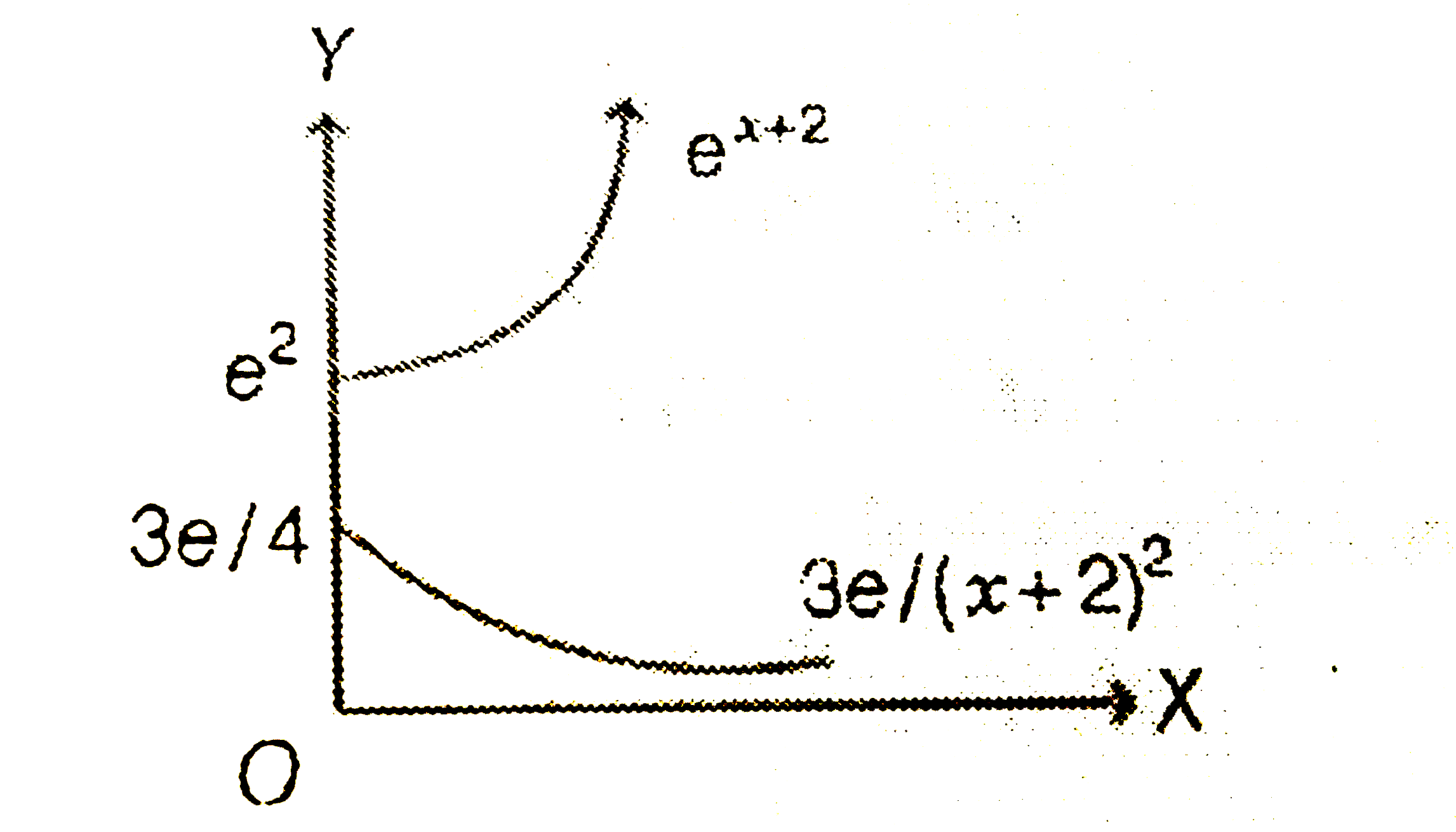
Clearly, they have no solution.
To check option (d), `y = (x + 3)^(2)`
i.e., `log [(|x + 3|^(2))/(3e)] + ((x + 3)^(2))/((x + 2)) = 0`
To check the number of solutions.
Let `g (x) = 2 log (x + 3) + ((x + 3)^(2))/((x + 2)) - log (3e)` ltbr `:. g' (x) = (2)/(x + 3) + (((x + 2) . 2 (x + 3) - (x + 3)^(2).1)/((x + 2)^(2)) - 0`
`= (2)/(x + 3) + ((x + 3) (x + 1))/((x + 2)^(2))`
Clearly, when `x gt 0`, then `g' (x) gt 0`
`:.` g (x) in increasing, when `x gt 0`
Thus, when `x gt 0`, then g (x) `gt` g (0)
`g(x) gt log ((3)/(e)) + (9)/(4) gt 0`
Hence, there is no solution
Thus, option (d) is true.


