Home
Class 12
CHEMISTRY
Decomposition of NH(4)NO(2)(aq into N(2)...

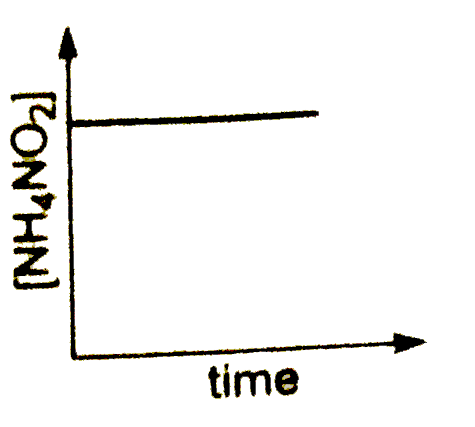
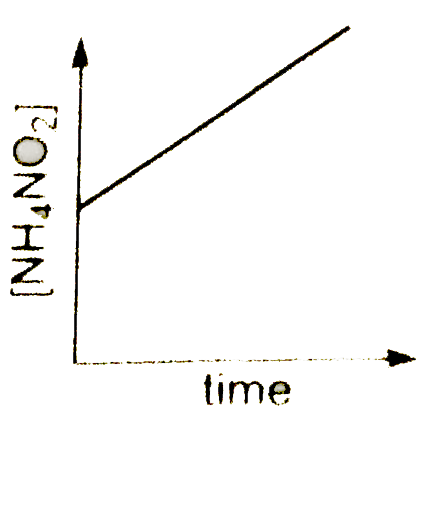
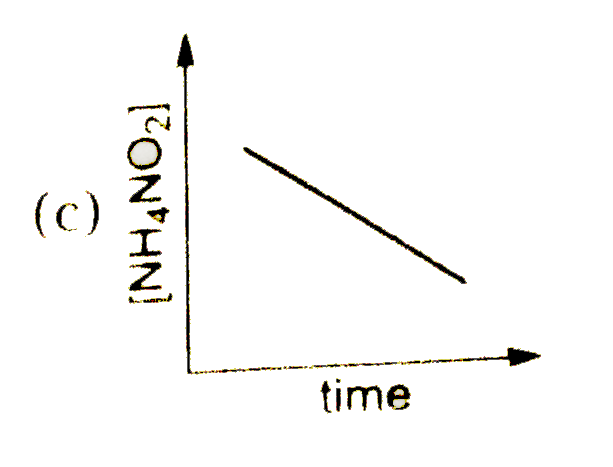
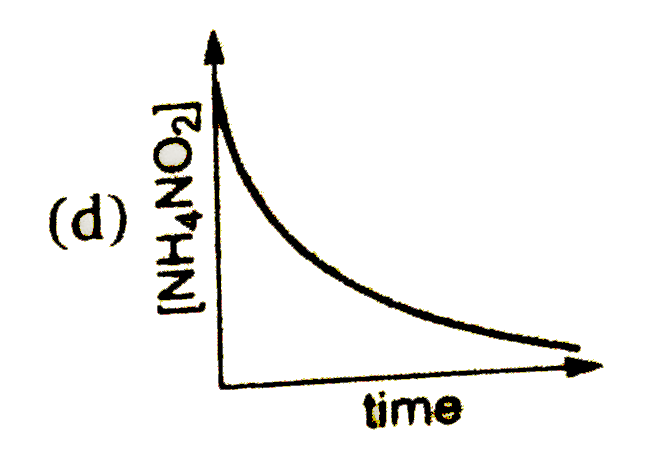
Decomposition of `NH_(4)NO_(2)(aq` into `N_(2)(g)` and `2H_(2)O(l)` is first order reaction.

A

B

C

D

Text Solution

Verified by Experts

The correct Answer is:

D
Promotional Banner

Topper's Solved these Questions

  • CHEMICAL KINETIC & NUCLEAR CHEMISTRY

    NARENDRA AWASTHI|Exercise Level 1 (Q.3 To Q.32)|1 Videos
  • CHEMICAL KINETIC & NUCLEAR CHEMISTRY

    NARENDRA AWASTHI|Exercise Level 1 (Q.33 To Q.62)|2 Videos
  • SURFACE CHEMISTRY

    NARENDRA AWASTHI|Exercise Level -2|1 Videos

Similar Questions

Explore conceptually related problems

Nitrogen pentoxide decomposes according to equation : 2N_2O_5(g) rarr 4NO_2(g) + O_2(g) This first order reaction was allowed to proceed at 40^@ C and the data below were collected : What will be the concentration of N_2O_5 after 100 minutes ?

The decomposition of N_2O_5 according to the equation, 2N_2O_5(g) harr 4NO_2(g) + O_2(g) is a first order reaction. After 30 min from the start of the decomposition in a closed vessel, the total pressure developed is found to be 284.5 mm of Hg and on complete decomposition, the total pressure is 584.5 mm of Hg. Calculate the rate constant of the reaction.

The half-life of first order decomposition of NH_(4)NO_(3) is 2.10 hr at 288 K temperature NH_(4)NO_(3)(aq)toN_(2)O(g)+2H_(2)O(l) . If 6.2 of NH_(4)NO_(3) is allowed to decompose, the required for NH_(4)NO_(3) to decompose 90 % is :

N_(2)O_(3) is an unstable oxide of nitrogen and it decomposes into NO (g) and NO_(2)(g) where NO_(2)(g) is further dimerise dimerise into N_(2)O_(4) as N_(2)O_(3)(g)hArrNO_(2)(g)+NO(g)" ",K_(p_(1)=2.5 bar 2NO_(2)(g)hArrN_(2)O_(4)(g)" ": K_(P2) A flask is initially filled with pure N_(2)O_(3)(g) having pressure 2 bar and equilibria was established. At equilibrium partial pressure of NO (g) was found to be 1.5 ber. The equilibrium partial presure of NO_(2)(g) is:

N_(2)O_(3) is an unstable oxide of nitrogen and it decomposes into NO (g) and NO_(2)(g) where NO_(2)(g) is further dimerise dimerise into N_(2)O_(4) as N_(2)O_(3)(g)hArrNO_(2)(g)+NO(g)" ",K_(p_(1)=2.5 bar 2NO_(2)(g)hArrN_(2)O_(4)(g)" ": K_(P2) A flask is initially filled with pure N_(2)O_(3)(g) having pressure 2 bar and equilibria was established. At equilibrium partial pressure of NO (g) was found to be 1.5 ber. The equilibrium partial pressure of N_(2)O_(3)(g) is :

Consider the chemical reaction, N _(2) (g) + 3 H _(2)(g) to 2 NH _(3) (g). The rate of this reaction can be expressed in terms of time derivative of concentration of N _(2) (g), H _(2) (g) or NH _(3) (g). Identify the correct relationship amongest the rate expression.

N_(2)O_(3) is an unstable oxide of nitrogen and it decomposes into NO (g) and NO_(2)(g) where NO_(2)(g) is further dimerise dimerise into N_(2)O_(4) as N_(2)O_(3)(g)hArrNO_(2)(g)+NO(g)" ",K_(p_(1)=2.5 bar 2NO_(2)(g)hArrN_(2)O_(4)(g)" ": K_(P2) A flask is initially filled with pure N_(2)O_(3)(g) having pressure 2 bar and equilibria was established. At equilibrium partial pressure of NO (g) was found to be 1.5 ber. The value of K_(P2) is

For the reaction : C_(3)H_(8)(g) + 5O_(2) (g) to 3 CO_(2) (g) + 4H_(2) O (l) at constant temperature Delta H - Delta U

Decomposition of H_2O_2 follows a first order reaction. In fifty minutes the concentration of H_2O_2 decreases from 0.5 to 0.125 M in one such decomposition. When the concentration of H_2O_2 reaches 0.05 M, the rate of formation of O_2 will be
