Home
Class 11
CHEMISTRY
Calculate DeltaS for following process :...

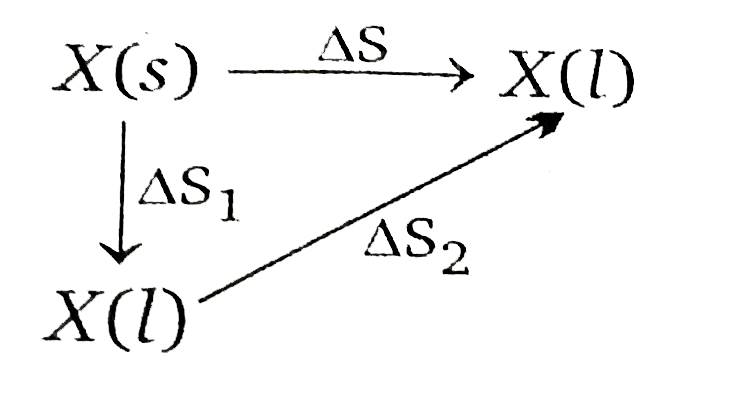
Calculate `DeltaS` for following process :
`underset("at" 100K)(X(s)) underset("at" 200 K)(rarrX(l))`
Given : Melting point of `X_(s)=100K,DeltaH_("Fusion")=20kJ//"mol",C_(p.m)(X,l)=10J//"mol".K`

A

`26.93 J//K`

B

`206.93 J//K`

C

`203 J//K`

D

`206.93 kJ//K`

Text Solution

Verified by Experts

The correct Answer is:
B


`DeltaS=(20xx1000)/(100)+1xxunderset(100)overset(200)intC_(p m)(dT)/(T)`
`DeltaS=200+10ln2=200+10xx0.693`,
`DeltaS=206.93 " JK"^(-1)`
Promotional Banner

Topper's Solved these Questions

  • THERMODYNAMICS

    NARENDRA AWASTHI|Exercise Level 3 - One Or More Answers Are Correct|1 Videos
  • THERMODYNAMICS

    NARENDRA AWASTHI|Exercise Level 3 - Match The Column|2 Videos
  • THERMODYNAMICS

    NARENDRA AWASTHI|Exercise Level 2 (Q.1 To Q.30)|1 Videos
  • STOICHIOMETRY

    NARENDRA AWASTHI|Exercise Level 3 - Subjective Problems|20 Videos

Similar Questions

Explore conceptually related problems

What is the melting point of benzene if DeltaH_("fusion")= 9.95kJ//mol and DeltaS_("fusion")= 35.7J//K-"mol"

Evaluate the following: underset(0)overset(k)int(dx)/(2+8x^2)= pi/16 , find the value of 'k'.

What is the normal boiling point of mercury? Given : DeltaH _(f)^(@)(Hg,l)=0,S^(@)(Hg,l)=77.4 J//K-"mol" DeltaH _(f)^(@)(Hg,g)= 60.8 kJ//"mol", S^(@)(Hg, g)=174.4 J//K-"mol"

Standard Gibb's energy of reaction (Delta_(r )G^(@)) at a certain temperature can be computed Delta_(r )G^(@)=Delta_(r)H^(@)-T.Delta_(r )S^(@) and the change in the value of Delta_(r)H^(@) and Delta_(r)S^(@) for a reaction with temperature can be computed as follows : Delta_(r )H_(T_(2))^(@)-Delta_(r )H_(T_(1))^(@)=Delta_(r )C_(p)^(@)(T_(2)-T_(1)) Delta_(r )S_(T_(2))^(@)-Delta_(r )S_(T_(1))^(@)=Delta_(r )C_(p)^(@)ln.(T_(2)/T_(1)) " "Delta_(r )G^(@)=Delta_(r)H^(@)-T.Delta_(r)S^(@) and " by "Delta_(r )G^(@)=-"RT " ln K_(eq) . Consider the following reaction : CO(g)+2H_(2)(g)iffCH_(3)OH(g) Given : Delta_(f)H^(@)(CH_(3)OH,g)=-201 " kJ"//"mol", " "Delta_(f)H^(@)(CO,g)=-114" kJ"//"mol" S^(@)(CH_(3)OH,g)=240" J"//"K-mol, "S^(@)(H_(2),g)=29" JK"^(-1)" mol"^(-1) S^(@)(CO,g)=198 " J"//"mol-K, "C_(p,m)^(@)(H_(2))=28.8 " J"//"mol-K" C_(p,m)^(@)(CO)=29.4 " J"//"mol-K, "C_(p,m)^(@)(CH_(3)OH)=44 " J"//"mol-K" and " "ln ((320)/(300))=0.06 , all data at 300 K Delta_(r )G^(@) at 320 K is :

Standard Gibb's energy of reaction (Delta_(r )G^(@)) at a certain temperature can be computed Delta_(r )G^(@)=Delta_(r)H^(@)-T.Delta_(r )S^(@) and the change in the value of Delta_(r)H^(@) and Delta_(r)S^(@) for a reaction with temperature can be computed as follows : Delta_(r )H_(T_(2))^(@)-Delta_(r )H_(T_(1))^(@)=Delta_(r )C_(p)^(@)(T_(2)-T_(1)) Delta_(r )S_(T_(2))^(@)-Delta_(r )S_(T_(1))^(@)=Delta_(r )C_(p)^(@)ln.(T_(2)/T_(1)) " "Delta_(r )G^(@)=Delta_(r)H^(@)-T.Delta_(r)S^(@) and " by "Delta_(r )G^(@)=-"RT " ln K_(eq) . Consider the following reaction : CO(g)+2H_(2)(g)iffCH_(3)OH(g) Given : Delta_(f)H^(@)(CH_(3)OH,g)=-201 " kJ"//"mol", " "Delta_(f)H^(@)(CO,g)=-114" kJ"//"mol" S^(@)(CH_(3)OH,g)=240" J"//"K-mol, "S^(@)(H_(2),g)=29" JK"^(-1)" mol"^(-1) S^(@)(CO,g)=198 " J"//"mol-K, "C_(p,m)^(@)(H_(2))=28.8 " J"//"mol-K" C_(p,m)^(@)(CO)=29.4 " J"//"mol-K, "C_(p,m)^(@)(CH_(3)OH)=44 " J"//"mol-K" and " "ln ((320)/(300))=0.06 , all data at 300 K Delta_(r )H^(@) at 300 K for the reaction is :

The normal boiling point of a liquid X is 400 K. DeltaH_("vap") at normal boiling point is 40 kJ/mol. Select correct statement(s) :

Calculate DeltaH_(f)^(@) for Ubr_(4) from the DeltaG^(@) of reaction and the S^(@) values at 298 K. U(s)+2Br_(2)(l)rarrUBr_(4)(s), DeltaG^(@)=-788.6 kJ. " "S^(@)(J//K-"mol")50.3, 152.3, 242.6

Calculate the osmotic pressure at 273K of a 5% solution of compound A. (molecular mass-60) (Given R= 0.0821 L atm K^-1mol^-1 )

Calculate DeltaS for 3 mole of a diatomic ideal gas which is heated and compressed from 298 K and 1 bar to 596 K and 4 bar: [Given: C_(v,m)(gas)=(5)/(2)R,"ln"(2)=0.70,R=2"cal K^(-1)mol^(-1) ]

Calculate DeltaG^(@) (kJ/mol) at 127^(@)C for a reaction with K_("equilibrium")=10^(5) :

NARENDRA AWASTHI-THERMODYNAMICS-Exercise
  1. The entropy if vaporisation of benzene is 85JK^(-1) mol^(-1). When 117...

    Text Solution

    |

  2. Identify the correct statement regarding entropy

    Text Solution

    |

  3. Calculate DeltaS for following process : underset("at" 100K)(X(s)) ...

    Text Solution

    |

  4. For a perfectly crystalline solid C(p.m.)=aT^(3), where ais constant. ...

    Text Solution

    |

  5. Consider the following spontaneous reaction 3X(2)(g)rarr2X(3)(g). What...

    Text Solution

    |

  6. For the reaction 2H(g)rarr H(2)(g), the sign of DeltaH and DeltaS resp...

    Text Solution

    |

  7. Consider the following reaction. C(6)H(6)(l)+(15)/(2)O(2)(g)rarr6CO(...

    Text Solution

    |

  8. Consider the following reaction at temperature T : CH(2)=CH(2)(g) +...

    Text Solution

    |

  9. For a process to be spontaneous, DeltaG must be………… .

    Text Solution

    |

  10. For a reaction to occur spontaneously

    Text Solution

    |

  11. Which of the following conditions reagarding a chemical process ensure...

    Text Solution

    |

  12. The free energy change DeltaG = 0, when

    Text Solution

    |

  13. Which of the following conditions regarding a chemical process ensures...

    Text Solution

    |

  14. Suppose that a reaction has DeltaH=-40kJ and DeltaS =- 50J//K. At what...

    Text Solution

    |

  15. For isothermal expansion in case of an ideal gas :

    Text Solution

    |

  16. What is the normal boiling point of mercury? Given : DeltaH (f)^(@)...

    Text Solution

    |

  17. 19 gm of ice is converted into water at 0^(@)C and 1 atm. The entropie...

    Text Solution

    |

  18. Using the listed [DeltaG(f)^(@) values] calculate DeltaG^(@) for the r...

    Text Solution

    |

  19. From the following DeltaH^(@) and DeltaS^(@) values, predict which of ...

    Text Solution

    |

  20. Calculate DeltaH(f)^(@) for Ubr(4) from the DeltaG^(@) of reaction and...

    Text Solution

    |

