Home
Class 12
BIOLOGY
(a) Draw a diagrammatic sectional view o...

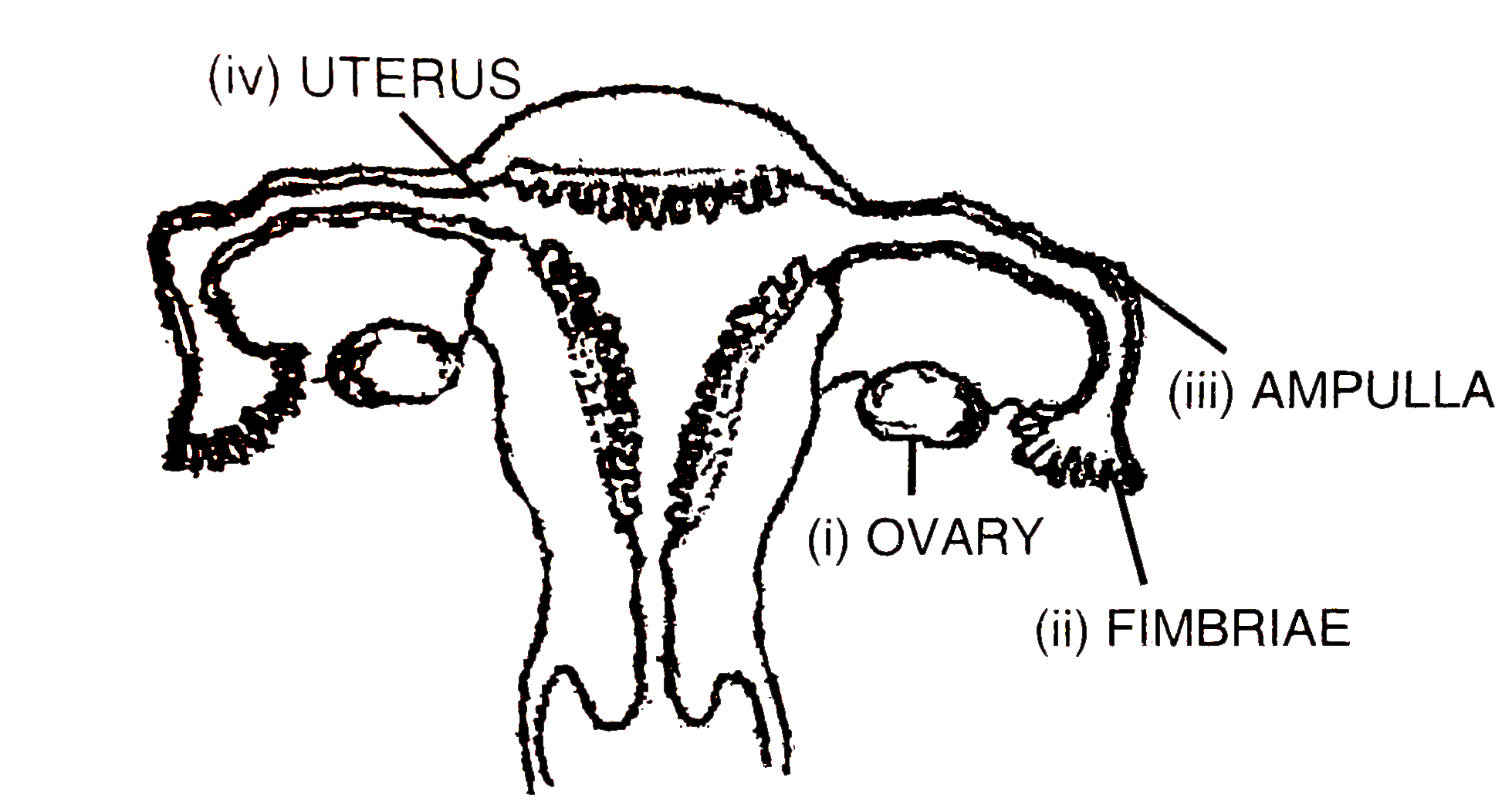
(a) Draw a diagrammatic sectional view of the female reproductive system of human and label the parts
(i) where the secondary oocytes develop
(ii) which helps in collection of ovum after ovulation
(iii) where fertilization occurs
(iv) where implantation of embryo occurs.

Text Solution

Verified by Experts

(b) Role of pituitary hormones in menstrual cycle. The secretion of gonadotropins (LH and FSH) stimulates follicular development as well as secretion of estrogens by the growing ovarian follicles. Both LH and FSH attain a peak level in the middle of the cycle (about 14 day). Rapid secretion of LH leading to its maximum level during the mid-cycle called LH surge induces rupture of Graafian follicle and thereby the release of ovum (ovulation) The ovulation is followed by the luteal phase during which the remaining parts of Graafian follicle transform as the corpus luteum. LH maintains the corpus luteum as well as secretion of progesterone by the corpus luteum.
Promotional Banner

Topper's Solved these Questions

  • REPRODUCTION

    TRUEMAN BIOLOGY|Exercise SECTION -C|22 Videos
  • Protista

    TRUEMAN BIOLOGY|Exercise ASSERTION AND REASON|6 Videos
  • Reproduction In Organisms

    TRUEMAN BIOLOGY|Exercise MULTIPLE CHOICE QUESTION|131 Videos

Similar Questions

Explore conceptually related problems

The figure given below depists a diagramatic sectional view of the female reproduction system f humans. Which one set of three parts out of I-VI have been correctly identified?

(a) Draw a diagrammatic sectional view of a mature anatropous ovule and label the following parts in it : (i) that develops into seed coat. (ii) that develops into an embryo after fertilization. (iii) that develops into an endosperm in an albuminous seed. (iv) through which the pollen tube gains entry into the embryo sac. (v) that attaches the ovule to the placenta.

In the human female reproductive system where does fertilization occur?

(a) Draw a sectional view of human female reproductive system and label the part where (i) eggs develop. (ii) fertilization take place. (iii) fertilized egg gets implanted. (b) Describe, in brief, the changes the uterus undergoes (i) to receive the zygote. (ii) if zygote is not formed.

Draw a diagram of cross - section of the human heart and label the following parts : (i) Right ventricle (ii) Aorta (iii) Left atrium (iv) Pulmonary arteries.

Draw a diagram of human excretory system and label the following parts on it : (i) Right renal artery (ii) Vena cava. (iii) Urinary bladder (iv) Left kidney

(i) Name a sexually transmitted disease and a method to avoid it. (ii) Draw a neat diagram of human male reproductive system and label the parts performing the following functions : (a) Production of sperms, (b) Gland which provide fluid, (c) Provides low temperature for the formation of sperms. (d) Common passage for sperm and urine.

a] Draw a well labelled diagram of human female reproductive system and label the following parts. i] Produces eggs ii] Part where fusion of sperm and egg takes place iii] Part where zygote is implanted iv] Part where sperms enter. b] What happens to human egg when it is not fertilised?

(a) Name the human male reproductive organ that produces sperms and also secretes a hormone. Write the functions of the secreted hormone. (b) Name the parts of the human female reproductive system where- (i) Fertilisation takes place (ii) Implantation of the fertilised egg occurs. (c) Explain how the embryo gets nourishment inside the mother's body.

TRUEMAN BIOLOGY-REPRODUCTION-SECTION-D
  1. Define Oogenesis. When and where in the body is oogenesis completed?

    Text Solution

    |

  2. Mention any two sexually transmitted diseases in human and its causiti...

    Text Solution

    |

  3. Give reasons why: (i) Most zygotes in angiosperms divide only afte...

    Text Solution

    |

  4. Describe in sequence the events that lead to the development of a 3-ce...

    Text Solution

    |

  5. (a ) Trace the development ofmegaspore mother cell up to the formation...

    Text Solution

    |

  6. (a ) Draw a labelled longisectional view of an albuminous 'seed'· (b...

    Text Solution

    |

  7. Describe the post-zygotic events leading to implantation and placenta ...

    Text Solution

    |

  8. Although sexual reproduction is a long drawn, energy-intensive complex...

    Text Solution

    |

  9. Embryo sacs of some apomictic species appear normal but contain diploi...

    Text Solution

    |

  10. Describe oestrous cycle. In which group of animals is it observed.

    Text Solution

    |

  11. Give examples for physical and surgical contraceptive methods.

    Text Solution

    |

  12. The following is the illustration of the sequence of ovarian events (a...

    Text Solution

    |

  13. Mention the function of Synergids and polar nuclei in embryo sac.

    Text Solution

    |

  14. Describe the structure of blastula.

    Text Solution

    |

  15. Mention the fate of all the components of the embryo sac after fertili...

    Text Solution

    |

  16. (a) Draw a diagrammatic sectional view of a mature anatropous ovule an...

    Text Solution

    |

  17. (a) Draw a diagrammatic sectional view of the female reproductive syst...

    Text Solution

    |

  18. Mention examples for: a. Insect pollinated flower. b. Wind pollina...

    Text Solution

    |

  19. Mention two types of gametogenesis.

    Text Solution

    |

  20. (a) Draw a diagram of a mature embryo sac of an angiosperm and label t...

    Text Solution

    |

