

Home
Class 11
CHEMISTRY
The following data are obtained when din...

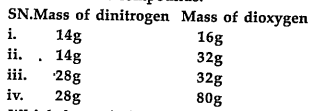
The following data are obtained when dinitrogen and dioxygen react together to form different compounds:

Which law of chemical combination is obeyed by the above experimental data?
Give its statements.

Promotional Banner

Similar Questions

Explore conceptually related problems

Answer the following questions: Two samples 'm' and 'n' of slaked lime were obtained form two different reactions. The details about their compostion are as follows: 'Sample m' mass: 7g Mass of constituent oxygen: 2g Mass of constituent calcium :5g 'sample n' mass: 1.4g Mass of consittuent oxygen: 0.4 Mass of constituent calcium : 1.0g Which law of chemical combination does this prove ? Explain.

Read the following paragraph and answer the questions based on it. Rhizobium produce nitrogenous compounds from atmospheric nitrogen. However, for this process of nitrogen fixation, they need leguminous plants like beans, sweet pea, soyabean, etc. as ‘host’. Rhizobium living in root nodules supply nitrates, nitrites and amino acids to that plant and in exchange get energy in the form of carbohydrates from it. Such a mutually beneficial relationship is called symbiosis. Beans and pulses are rich in proteins due to the nitrogenous compounds made available by Rhizobium. After harvesting a leguminous crop, the left-over roots and other plant parts are deliberately dumped in farm soil to maintain its bacterial population. The use of Rhizobium has helped to reduce the use of chemical fertilizers and thereby their adverse effects. It has also helped to reduce expenses on fertilizers and thus works to the benefit of farmers. Which plants act as a host to Rhizobium bacteria?

Carbon forms a large number of compounds because of its two unique properties formed many have long straight chains of carbon, branched chains of carbon or rings of carbon. In these compounds, carbon atoms may form single, double or triple covalent bonds. Compounds in which the carbon atoms are linked to each other by single bonds are called saturated carbon compounds whereas compounds having at least one carbon-carbon double or triple bond are called unsaturated carbon compounds. Compounds containing only carbon and hydrogen are known as hydrocarbons. Based on the above information, answer the following questions. ii. Give two examples of carbon compounds which have ring structure.

Carbon forms a large number of compounds because of its two unique properties formed many have long straight chains of carbon, branched chains of carbon or rings of carbon. In these compounds, carbon atoms may form single, double or triple covalent bonds. Compounds in which the carbon atoms are linked to each other by single bonds are called saturated carbon compounds whereas compounds having at least one carbon-carbon double or triple bond are called unsaturated carbon compounds. Compounds containing only carbon and hydrogen are known as hydrocarbons. Based on the above information, answer the following questions. iii. What are saturated hydrocarbons? Give one example.

Carbon forms a large number of compounds because of its two unique properties formed many have long straight chains of carbon, branched chains of carbon or rings of carbon. In these compounds, carbon atoms may form single, double or triple covalent bonds. Compounds in which the carbon atoms are linked to each other by single bonds are called saturated carbon compounds whereas compounds having at least one carbon-carbon double or triple bond are called unsaturated carbon compounds. Compounds containing only carbon and hydrogen are known as hydrocarbons. Based on the above information, answer the following questions. v. What is common name and molecular formula of ethyne?

Carbon forms a large number of compounds because of its two unique properties formed many have long straight chains of carbon, branched chains of carbon or rings of carbon. In these compounds, carbon atoms may form single, double or triple covalent bonds. Compounds in which the carbon atoms are linked to each other by single bonds are called saturated carbon compounds whereas compounds having at least one carbon-carbon double or triple bond are called unsaturated carbon compounds. Compounds containing only carbon and hydrogen are known as hydrocarbons. Based on the above information, answer the following questions. iv. Give IUPAC names of first two members of hydrocarbon which contain carbon-carbon double bonds.

When ethanol is heated at 170^(@)C with conc. H_(2)SO_(4) , it forms an organic compound 'A' and water. The compound 'A' reacts with hydrogen in the presence of nickel to form 'B'. iii. Name the products formed when 'B' undergoes combustion in presence of sufficient amount of oxygen. Write its chemical equation.