Home
Class 12
CHEMISTRY
Consider the change in oxidation state o...

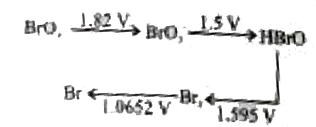
Consider the change in oxidation state of Bromine corresponding to different emf values as shown in the diagram. Below

Then, the species undergoing disproportionation is

A

`BrO_(3)^(-)`

B

`BrO_(4)^(-)`

C

HBrO

D

`Br_(2)`

Text Solution

Verified by Experts

The correct Answer is:

C

`E_("cell")^(@)` for the disproportionation of HBrO,
`E_("cell")^(@) = E_(HBrO)//(Br_(2))^(@) - E_(BrO_(3)^(-)//(HBrO)^(@)`
`=1.595 - 1.5`
`=0.095 V = +ve`
Hence, option ( c) is correct answer.
Promotional Banner

Topper's Solved these Questions

  • ELECTROCHEMISTRY

    PHYSICS WALLAH|Exercise LEVEL-2|60 Videos
  • COORDINATION COMPOUNDS

    PHYSICS WALLAH|Exercise NEET PAST 5 YEARS QUESTIONS |8 Videos
  • ENVIRONMENTAL CHEMISTRY

    PHYSICS WALLAH|Exercise NEET Past 5 Years Questions |4 Videos

Similar Questions

Explore conceptually related problems

Consider the change in oxidation state of Bromine corredponding to different emf values as shown in the diagram below : . The the species undergoing dispropprtionation is .

A gas undergoes change in its state from position A to position B via three different path as shown in Fig. Select the correct alternatives :

How can we show that change in oxidation state is different from variable oxidation state for non transition element ?

The variation of anode current in a triode corresponding to a change in grid potential at three different values of the plate potential is shown in the diagram. The mutual conductance of the triode is

An ideal gas undergoes a four step cycle as shown in the P-V diagram below. During this cycle heat is absorbed by the gas in

One of the nicest application of reduction potential is the prediction of the products of reaction involving elements having several oxidation staes. Consider the reaction of iodine with permanganate in acid sollution. The pertinent diagram is shown below What are species which are unstable towards disproportion

PHYSICS WALLAH-ELECTROCHEMISTRY-NEET PAST 5 YEARS QUESTIONS
  1. The number of electrons delivered at the cathode during electrolysis b...

    Text Solution

    |

  2. If the E^(@) for a given reaction has a negative value, then which of ...

    Text Solution

    |

  3. The molar conductivity of a 0.5 mol dm^(-1) solution with electrolytic...

    Text Solution

    |

  4. The pressure of H(2) required to make the potential of H(2)-electrode ...

    Text Solution

    |

  5. On elctrolysis of dil sulphuric acid using Platinum (Pt) electrode the...

    Text Solution

    |

  6. The number of Faraday.s (F) required to produce 20 g of calcium from C...

    Text Solution

    |

  7. Identify the reaction from following having top position is EMF series...

    Text Solution

    |

  8. In a typical fuel cell, the reactants (R) and product (P) are:

    Text Solution

    |

  9. For a cell involving one electron E(cell)^(0)=0.59V and 298K, the equi...

    Text Solution

    |

  10. For the cell reaction 2Fe^(2+)(aq) + 2I^(-)(aq) to 2Fe^(2+)(aq) + I(...

    Text Solution

    |

  11. Consider the change in oxidation state of Bromine corresponding to dif...

    Text Solution

    |

  12. In the electrochemical cell: Zn|ZnSO(4)(0.01 M)||CuSO(4)(1.0 M)|Cu, ...

    Text Solution

    |

  13. Given that wedge(m)^(@) = 133.45 cm^(2) mol^(-1) (AgNO(3)) wedge(m)^(@...

    Text Solution

    |

  14. The zinc/silver oxide cell is used in electric current reaction is as ...

    Text Solution

    |

  15. During the electrolysis of molten sodium chloride, the time required t...

    Text Solution

    |

  16. Zinc can be coated on iron to produce galvanometer is reverse is not p...

    Text Solution

    |

  17. The number of electrons delivered at the cathode during electrolysis b...

    Text Solution

    |

  18. if the E^(@) cell for a given reaction has a negative value of the fol...

    Text Solution

    |

  19. The molar conductivity of a 0.5 mol dm^(-1) solution with electrolytic...

    Text Solution

    |

  20. The pressure of H(2) required to make the potential of H(2) zero in pu...

    Text Solution

    |
