

Home
Class 11
PHYSICS
A 3.0 cm slabe has formed on an outdoor ...

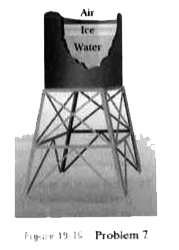
A 3.0 cm slabe has formed on an outdoor tank of water . The air is at `-14^(@)C`. Find the rate of ice formation (centimeters per hour). The ice has thermal conductivity 0.0040 cal`//s.cm.""^(@)C` and density `0.92g //cm^(3)`.Assume there is no energy transfer through the walls or bottom.

Promotional Banner

Similar Questions

Explore conceptually related problems

A lake is covered with ice 5 cm thick and the atmospheric temperature above the ice is – 10^(@)C . At what rate (in cm/hour) will the ice layer thicken? Thermal conductivity of ice = 0.005 cgs unit, density of ice = 0.9 g//cc and latent heat of fusion of ice = 80 cal/g.

Time in which a layer of ice of thickness 10 cm will increase by 5 cm on te surface of a pond when temperature of the surrounding is -10^(@)C coefficient of thermal conductivity of ice K=0.005((Cal)/(cm-sec-.^(@)C)) and density rho=0.9gram//cm^(3) (L=80cal/g)

A 5 cm thick ice block is there on the surface of water in a lake. The tmeperature of air - 10^(@)C , how muct time it will take to double the thickness of the block? (L = 80 cal//g, K_(ice) = 0.004 cal//s-K, d_(ice) = 0.92 g cm^(-3))

A lake surface is exposed to an atmosphere where the temperature is lt 0^(@)C . If the thickness of the ice layer formed on the surface grows form 2cm to 4cm in 1 hour. The atmospheric temperature, T_(a) will be- (Thermal conductivity of ice K = 4 xx 10^(-3) cal//cm//s//.^(@)C , density of ice = 0.9 gm//ice. Latent heat of fustion of ice = 80 cal//m . Neglect the change of density during the state change. Assume that the water below the ice has 0^(@) temperature every where)

The thickness of ice in a lake is 5cm and the atmospheric temperature is 10^(@)C Calculate the time rquired for the thickness of ice to grow to 7cm Therml conductivity for ice =4 xx 10^(-3) cal cm^(-1) s^(-1) c^(-10 density of ice =0.92 g //cm^(3) and latent heat of fusion of ice =80 cal//g .

There is ice formation on a tank of water of thickness 10 cm.How much time it will take to have a layer of 0.1 cm below it ?The outer temperature is -5^(@)C , the thermal conductivity of ice is 0.005 calcm^(-1) ""^(@)C^(-1) and latent heat of ice is 80cal//g and the density of ice is 0.91 gcm^(-3) :

When the air temperature is -10^(@)C , the ice on a large shallow lake in creases by 1cm in 12 minutes . Find the thermal conductivity of ice. (Density of ice =900kgm^(-3) and L=330xx10^(3)Jkg^(-1) )

A refrigerator converts 100 g of water at 25^(@)C into ice at -10^(@)C in one hour and 50 minutes. The quantity of heat removed per minute is (specific heat of ice = 0.5 "cal"//g^(@)C , latent heat of fusion = 80 "cal"//g )

Ice has formed on a shallow pond, and a steady state has been reached, with the air above the ice at -5.0^(@)C and the bottom of the pond at 40^(@)C . If the total depth of ice + water is 1.4 m , (Assume that the thermal conductivities of ice and water are 0.40 and 0.12 cal//m C^(@)s , respectively.) The thickness of ice layer is

Ice has formed on a shallow pond, and a steady state has been reached, with the air above the ice at - 5.0^(@)C and the bottom of the pond at 4.0^(@)C . If the total depth of ice + water is 2.0m, how thick is the ice ? (Assume that the thermal conductivity of ice and water are 0.40 and 0.12 cal//m.""^(@)C.s , respectively. )