Home
Class 12
CHEMISTRY
Explain why: On being slowly passed ...

Explain why:
On being slowly passed through water, `PH_(3)` forms bubbles but `NH_(3)` dissolves.

Text Solution

Verified by Experts
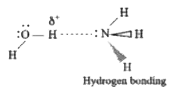
On passing through water ammonia `(NH_(3))` molecules form hydrogen bonds with water and hence get dissolved in water, whereas phosphine `(PH_(3))` molecules are not able to form hydrogen bonds with water due to large atomic size of phosphorous.
Promotional Banner

Topper's Solved these Questions

  • CHEMISTRY-2019

    ICSE|Exercise Question (Answer the following questions) |5 Videos
  • CHEMISTRY-2018

    ICSE|Exercise Question (Answer the following question) |5 Videos
  • CHEMISTRY-2020

    ICSE|Exercise Question (Answer the following question) |4 Videos

Similar Questions

Explore conceptually related problems

On being slowly passed through water, PH_3 forms bubbles but NH_3 dissolves. Why is it so ?

PH_(3) forms bubbles when passed slowly in water but NH_(3) dissolves. Explain why?

PH3 forms bubbles when passed slowly in water but NH3 dissolves. (T or F)

Explain why : NH_3 has a bond angle equal to 107^@ ?

PH_(3) can be formed in

Why does NH_3 form hydrogen bond but PH_3 does not?

Explain why carbon tetrachloride does not dissolve in water.

Explain why Carbon tetrachloride does not dissolve in water.

A colourless crystalline salt, on being heated, gives a coloured gas with a pungent smell. On being passed through an AgNO_(3) solution, this gas forms a white precipitate insoluble in HNO_(3) but readily soluble in an NH_(3) solution. Which of the following reaction can lead to the above observation?

PH_3 is less basic than NH_3 .

