

Home
Class 12
PHYSICS
A system goes from P to Q by two differe...

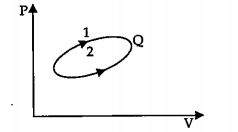
A system goes from P to Q by two different paths in the P.V. diagram as shown in figure. Heat given to the system in path 1 is `1000 J`. The work done by the system along path 1 is more than path 2 by `100 J ` What is the heat exchanged by the system in path 2 ?

Promotional Banner

Similar Questions

Explore conceptually related problems

A system changes from the state ( P_1,V_1 ) to ( P_2,V_2 ) as shown in the figure, what is the work done by the system?

A given mass of a gas expands from state A to state B by three paths 1, 2 and 3 as shown in the figure. If W_1 , W_2 and W_3 respectively are the work done by the gas along the three paths, then. br>

A system is taken to its final state from initial state in hypothetical paths as shown in the figure. Calculate the work done in each case.

Figure below shows two paths that may be taken by a gas to go from a state A to a state C. In process AB, 400 J of heat is added to the system and in process BC, 100 J of heat is added to the system. The heat absorbed by the system in the process AC will be

A gas in a closed container is heated with 10 J of energy , causing the lid of the container to rise 2 m with 3 N of force. What is the total change in energy of the system ?

In a process 701J of heat is absorbed by a system & 394J of work is done by the system What is the change in internal energy for the process

What is non- cyclic process ? Show that the area under the P-V diagram gives the work done by a system in a non- cyclic process.

A spherical shell is cut into two pieces along a chord as shown in the figure. P is a point on the plane of the chord. The gravitational field at P due to the upper part is I_(1) , and that due to the lower part is I_(2) . What is the relation between them?