Home
Class 12
PHYSICS
Figure shows a standard two slit arrange...

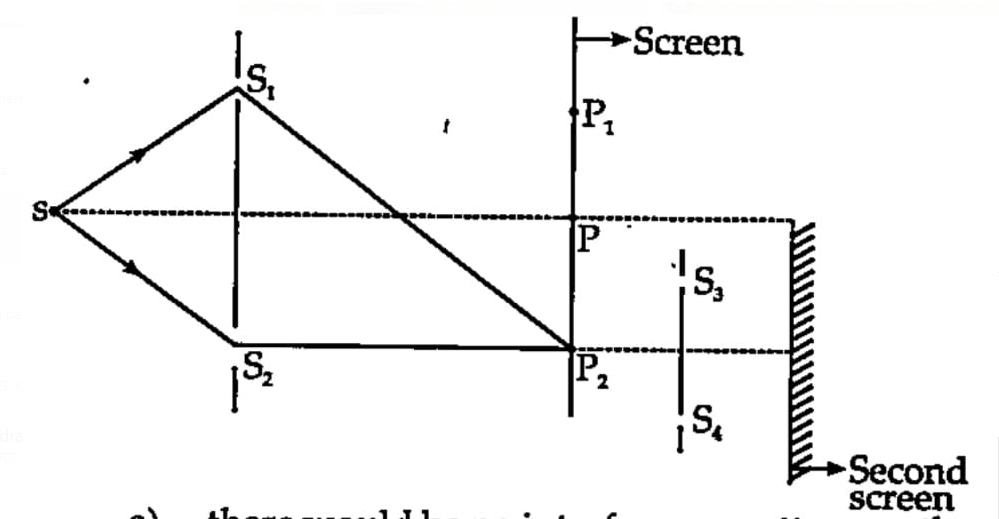
Figure shows a standard two slit arrangement with slits S_1,S_2. Now, P_1,P_2 are the two minima points on either side of P. At P_2 on the screen, there is a hole and behind P_2 is a second 2-slit arrangement with slits S_3,S_4 and a second screen behind them .

A

there would be no interference pattern on the second screen but it would be lighted

B

the second screen would be totally dark

C

there would be a single bright point on the second screen

D

there would be a regular two slit pattern on the second screen

Text Solution

Verified by Experts

Promotional Banner

Similar Questions

Explore conceptually related problems

In a young's double slit experiment, the difference in optical path length between the rays starting from the slits S_1 and S_2 and reaching a point A, on the screen in 0.0075mm and reaching another point B on the screen, on the other side of the central fringes is 0.0015 mm. How many bright and dark fringes are observed between A and B if the wavelength of light used is 6000 A^@

In a single slit diffraction pattern, the distance between the 1st minima on the right and the 1st minima on the left is 5.2 mm. The screen on which the pattern is displayed is 80 cm from the slit. If lambda= 5460 overset@A . Calculate the slit width.

Draw shapes of 2s and 2p orbitals.

In Young's experiment, the distance between two slits is 0.8mm and the distance of the screen from the slit is1.2 m. If the fringe width is 0.79 mm, the wavelength of light used is

In the figure is shown Young’s double slit experiment. Q is the position of the first bright fringe on the right side of O. P is the 11th fringe on the other side, as measured from Q. If the wavelength of the light used is 6000xx10^-10m , then S_l B will be equal to

What are the atomic numbers of elements whose outermost electrons are represented by a) 3s^1 b) 2p^3 c) 3p^5

If two power of a thick lense is P_(1) and that of a thin lens is P_(2) then

If S_1 , S_2 and S_3 are respectively the sum of n, 2n and 3n terms of a G.P., then prove that S_1(S_3 - S_2) = (S_2 - S_1)^2 .

