Home
Class 12
PHYSICS
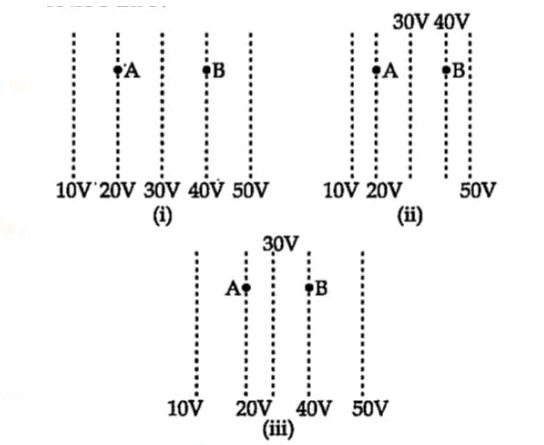
Figure shows some equipotential lines di...

Figure shows some equipotential lines distributed in space . A charged object is moved from point A to point B .

A

the work done in figure (i) is the greatest

B

the work done in figure (ii) is the least

C

the work done is the same in figure (i),(ii) and (iii)

D

the work done in figure (iii) is greater than figure (ii) but equal to that in figure (i)

Text Solution

Verified by Experts

Promotional Banner

Similar Questions

Explore conceptually related problems

Sketch two equipotential surfaces for a point charge.

Draw equipotential surfaces for the following:- single point charge,

What is the shape of the equipotential surfaces for an isolated point charge ?

Derive an expression for the electric intensity due to an electric dipole at a point on the axis of dipole. When a point charge of 5 xx 10^-9 C is taken from point A to point B, the work done is 10^-6 J. Find the potential difference between points A and points B.

What is the nature of equipotential surfaces around a point charge ?

A circle with centre P.Line AB and line AC are tangents from point A at point B and C respectively.Which of the following is/are true?

The figure shows the elliptical orbit of a planet about the sun S. An ellipse is the curve obtained when a cone is cut by an inclined plane. It has two focal points. The sum of the distances to the two focal points from every point on the curve is constant. F_1 " and " F_2 are the two focal points of the ellipse . The shaded area CF_1D is twice the shaded area AF_1B. t_1 is the time taken by the planet to move from C to D and t_2 is the time to move from A to B Which laws do we understand from the above diagram and description?

Electric lines of force about a negative point charge are

If 15 J of work is done when a charge of 3 C is moved from one point to another, find the electric potential difference between the two points.

Show that electric intensity at a point outside a charged sphere is inversely proportional to square of its distance from the centre of the sphere.

