Home
Class 9
MATHS
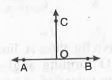
If ray OC stands on line AB such that an...

If ray OC stands on line AB such that `angleAOC = angleBOC` (see fig.
) show that `angleAOC = 90^@`.

Promotional Banner

Topper's Solved these Questions

  • Linear Equations In Two Variables

    MBD|Exercise Exercise|92 Videos
  • Number Systems

    MBD|Exercise Exercise|111 Videos

Similar Questions

Explore conceptually related problems

In the fig. show that AB||EF

D is a point on side BC of Delta ABC such that AD = AC (see Fig. 7.47). Show that AB > AD.

In an isosceles triangle ABC with AB = AC, D and E are points on BC such that BE = CD (see Fig. 7.29). Show that AD = AE.

In given fig. Rays OA, OB, OC, OD and OE have common initial point O. Show that angleAOB + angleBOC + angleCOD + angleDOE + angleEOA = 360^@ .

In given fig. , Rays OA, OB, OC, OD and OE have common initial point O. Show that angleAOB + angleBOC + angleCOD + angleDOE + angleEOA = 360^@ .

In fig. AB and CD intersect each other at point O. If angleAOC + angleBOE = 70^@ and angleBOD = 40^@ then the value of angleBOE and reflex angleCOE are :

In fig. AB and CD intersect each other at point O. If angleAOC + angleBOE = 70^@ and angleBOD = 40^@ then the value of angleBOE and reflex angleCOE are :

In the given Fig , Sides AB and AC of a DeltaABC are produced to E and D respectively. If respective bisectors BO and CO of angleCBE and angleBCD intersect each other at point O, prove that angleBOC = 90^@-1/2 angleBAC .

In the given Fig , Sides AB and AC of a DeltaABC are produced to E and D respectively. If respective bisectors BO and CO of angleCBE and angleBCD intersect each other at point O, prove that angleBOC = 90^@-1/2 angleBAC .

AB and CD are respectively the smallest and longest sides of a quadrilateral ABCD (see Fig. 7.50). Show that angle A > angle C and angle B > angle D .

MBD-Lines and Angles-Exercise
  1. In given fig. if n - x = 3^@ find x and n.

    Text Solution

    |

  2. In fig. if a is greater than b by one third of right angle. Find th...

    Text Solution

    |

  3. If ray OC stands on line AB such that angleAOC = angleBOC (see fig. )...

    Text Solution

    |

  4. In given fig. Rays OA, OB, OC, OD and OE have common initial point ...

    Text Solution

    |

  5. In the given Fig , lines, PQ and RS intersect each other at point O. ...

    Text Solution

    |

  6. In the given fig. , ray OS is on POQ. Rays OR and OT are the bisector...

    Text Solution

    |

  7. In fig. angleAOF and angleFOG form linear pair. angleEOB = angle FOC...

    Text Solution

    |

  8. Match the following : .

    Text Solution

    |

  9. In fig. angleAOF and angleFOG form linear pair. angleEOB = angle FOC...

    Text Solution

    |

  10. In fig. angleAOF and angleFOG form linear pair. angleEOB = angle FOC...

    Text Solution

    |

  11. In fig. angleAOF and angleFOG form linear pair. angleEOB = angle FOC...

    Text Solution

    |

  12. In fig. angleAOF and angleFOG form linear pair. angleEOB = angle FOC...

    Text Solution

    |

  13. In fig. angleAOF and angleFOG form linear pair. angleEOB = angle FOC...

    Text Solution

    |

  14. In given fig. AB and CD are two intersecting lines. OP and OQ are re...

    Text Solution

    |

  15. Angles forming a linear pair are supplementary.

    Text Solution

    |

  16. If two adjacent angles are equal, then each angle measures 90^@.

    Text Solution

    |

  17. Angles forming a linear pair can both the acute angles.

    Text Solution

    |

  18. Two distinct lines in a plane can have two points in common.

    Text Solution

    |

  19. If angles forming a linear pair are equal, then each of these angles i...

    Text Solution

    |

  20. If two lines intersect and if one pair of vertically opposite angles i...

    Text Solution

    |

