

Home
Class 11
PHYSICS
A disc rotating about its axis with angu...

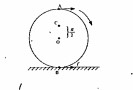
A disc rotating about its axis with angular speed ?Qis placed lightly (without any translational push) on a perfectly frictionless table. The radius of the disc is R. What are the linear velocities of the points A, B and C on the disc shown in Fig. 7.41? Will the disc roll in the direction indicated?

Promotional Banner

Similar Questions

Explore conceptually related problems

Two discs of moments of inertia /, and l2 about their respective axes (normal to the disc and passing through the centre), and rotating with angular speeds omega and omega are brought into contact face to face with their axes of rotation coincident, (a) What is the angular speed of the two-disc system? (b) Show that the kinetic energy of the combined system is less than the sum of the initial kinetic energies of the two discs. How do you account for this loss in energy? Take . omega ne omega

MI of a thin circular disc about an axis passing through its centre and perpendicular to its plane is 1/2 MR^2 , where M is the mass of the disc and R is its radius. Find an expression for radius of gyratiuon of the disc about an axis tangential to the edge and peerpendicular to the plane of rotation.

Explain why friction is necessary to make the disc in Fig. 7.41 roll in the direction indicated. (a) Give the direction of frictional force at B, and the sense of frictional torque, before perfect rolling begins. (b) What is the force of friction after perfect rolling begins?

(a) Find the moment of inertia of a sphere about a tangent to the sphere, given the moment of inertia of the sphere about any of its diameters to be 2MR^2IS, where M is the mass of the sphere and R is the radius of the sphere(b) Given the moment of inertia of a disc of mass M and radius R about any of its diameters to be MR2I4, find its moment of inertia about an axis normal to the' disc and passing through a point on its edge.

Prove the result that the velocity v of translation of a rolling body (like a ring, disc, cylinder or sphere) at the bottom of an inclined plane of a height h is given by v^2=(2gh)/ (i+k^2^l R^3 Using dynamical consideration (i.e. by consideration of forces and torques). Note k is the radius of gyration of the body about its symmetry axis, and R is the radius of the body. The body starts from rest at the top of the plane.