

Home
Class 11
PHYSICS
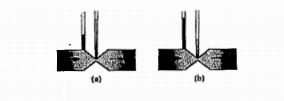
(a) and (b) refer to the steady flow of ...

(a) and (b) refer to the steady flow of a (nonviscous) liquid. Which of the two figures is incorrect? Why?

Promotional Banner

Similar Questions

Explore conceptually related problems

A ball is projected horizontally from certain height. At the same time another ball is dropped? Which of the two will land on the ground first? Why?

Explain how this figure is a trapezium. Which of its two sides are parallel?

Two identical ball bearings in contact with each other and resting on a frictionless table are hit head-on by another ball bearing of the same mass moving initially with a speed VL If the collision is elastic, which of the following figure is a possible result after collision?

Which of the two is paramagnetic V(IV) and V(V) and why?

In figure. shows the distance-time graph of three objects A, B and C. Study the graph and answer the following question: (a) Which of the three is travelling the fastest?

Can two streamlines cross each other in a flowing liquid?

Why does a gas exert pressure on the wall of its container?What are the two factors on which this pressure depends?

A plot is obtained for two volatile liquids A & B as follows. From the plot answer the following. Which of the liquids have higher boiling point?

The shells of crabs found around a particular coastal location in Japan seem mostly to resemble theÿ legendary face of a Samurai. Given below are two explanations of this observed fact. Which of these strike you a scientific explanation (a) A tragic sea accident several centuries ago drowned a young Samura As a tribute to his bravery, nature through.its inscrutable ways immortalized his face by imprinting it on the crab shells in that area. (b) After the sea tragedy,,fisherman in that area, in a gesture of honour of their dead hero, let free crab shell caught by them which accidentally hadj a shape resembling the face of a Samurai. Consequently, the particular! shape of the crab shell survived longer and therefore in course of time the shape was genetically propagated. This is an example of evolution by artificial! selections.