Home
Class 12
PHYSICS
Two communicating vessels contain mercur...

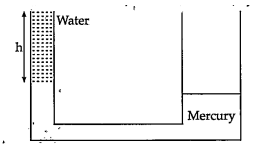
Two communicating vessels contain mercury. The diameter of one vessel is n times larger than the diameter of the other. A column of water of height h is poured into the left vessel (s=relate density of mercury and `rho_1= density of water`) by

A

`frac(n^2h)((n+1)^2) s`

B

`frac(h)((n^2+1)) s`

C

`frac(h)((n+1)^2) s`

D

`frac(h)((n^2)) s`

Text Solution

Verified by Experts

Promotional Banner

Similar Questions

Explore conceptually related problems

A open U- tube contains mercury. When 11.2 cm of water is poured into one of the arms of the tube, to how much height does the mercury rise in the other arm from its initial level?

Two vessels have different base area. They are filled with water to the same height. If the amount of water in one be 6 times that in the other, then the ratio of pressure on their botton will be

A vessel is filled with water and kerosence oil. The vessel has a small hole in the bottom. Neglecting viscosity if the thickness of water layer is h_(1) and kerosens layer is h_(2) then the velocity v of flow of water will be (density of water is rho_(1) b g/c c and that of kerosense is rho_(2) g/c c

A U-tube in which the croos - sectional area of the limb on the left is one quarter that of the limb on the right contains mercury (density 13.6 g//cm^3 ) The level of mercury in the narrow limb is at a distance of 36 cm form the upper end of the tube. What will be the rise in the level of mercury in the right limb if filled to the top with water?

A vertical U-tube of uniform inner cross section contains mercury in both sides of its arms. A glycerin (density =1.3 g//cm ^(3)) column of length 10 cm is introduced into one of its arms. Oil of density 0.8 gm //cm^(3) is poured into the other arm until the upper surfaces of the oil and glycerin are in the same horizontal level. Find the length of the same horizontal level. Find the length of the oil column, Density of mercury =13.6 g//cm^(3)

A verticle U-tube of uniform inner cross section contains mercury in both sides of its arms. A glycerine (density =1.3g//cm^3) column of length 10 cm is introduced into one of its arms. Oil of density 0.8 gm//cm^3 is poured into the other arm until the upper surfaces of the oil and glycerine are at the same horizontal level. Find the length of the oil column, density of mercury =13.6 g//cm^3

Water is being poured into a vessel in the form of an inverted right circular cone of semi vertical angle 45^@ in such a way that the rate of change of volume at any moment is proportional to the area of the curved surfaces which is wet at that moment.Initially the vessel is full to a height of 1 cm and after 1 second the height is 3 cm.Show that the height of the water after 3 seconds will be 7 cm.

The surface tension of water is 0.072 N/m. The height to which water will rise in a capillary tube of bore diameter 0.048 cm will be (Angle of contact of water is zero , acceleration due to gravity is 10 m//s^2 and density of water =1000 kg//m^3 ).

When glass capillary tube of radius 0.4 mm is dipped into mercury, the level inside the capillary stands 1.24 cm lower than that outside. Calculate the surface tension of mercury. (Angle of contact of mercury with glass = 135^@ , g = 9.8 m//s^2 , density of mercury = 13.6 xx 10^3 kg//m^3 )

A capillary tube of diameter 0.6 mm dipped vertically into water. It rises to height of 6 cm in capillary tube, find the surface tension of water. (Given: density of water = 1000 kg//m^3, g = 9.8 m//s^2 ).

