Home
Class 12
BIOLOGY
(a) Draw a diagrammatic sectional view o...

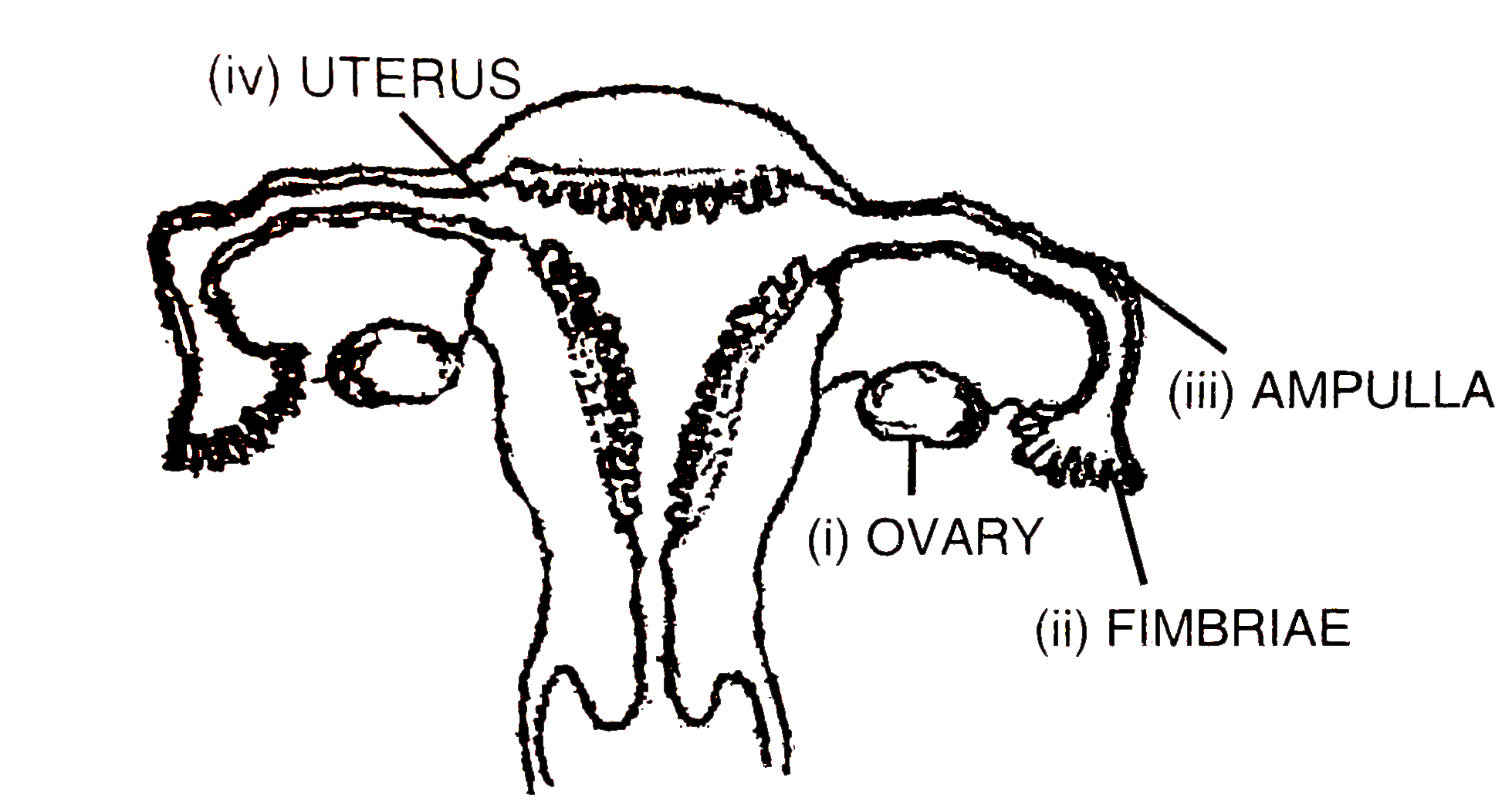
(a) Draw a diagrammatic sectional view of the female reproductive system of human and label the parts
(i) where the secondary oocytes develop
(ii) which helps in collection of ovum after ovulation
(iii) where fertilization occurs
(iv) where implantation of embryo occurs.
(b) Explain the role of pituitary and the ovarian hormones in menstrual cycle in human females.

Text Solution

Verified by Experts

(b) Role of pituitary hormones in menstrual cycle. The secretion of gonadotropins (LH and FSH) stimulates follicular development as well as secretion of estrogens by the growing ovarian follicles. Both LH and FSH attain a peak level in the middle of the cycle (about 14 day). Rapid secretion of LH leading to its maximum level during the mid-cycle called LH surge induces rupture of Graafian follicle and thereby the release of ovum (ovulation) The ovulation is followed by the luteal phase during which the remaining parts of Graafian follicle transform as the corpus luteum. LH maintains the corpus luteum as well as secretion of progesterone by the corpus luteum.
Promotional Banner

Topper's Solved these Questions

  • REPRODUCTION

    TRUEMAN BIOLOGY|Exercise SECTION -C|22 Videos
  • Protista

    TRUEMAN BIOLOGY|Exercise ASSERTION AND REASON|6 Videos
  • Reproduction In Organisms

    TRUEMAN BIOLOGY|Exercise MULTIPLE CHOICE QUESTION|131 Videos

Similar Questions

Explore conceptually related problems

(a) Draw a diagrammatic sectional view of a mature anatropous ovule and label the following parts in it : (i) that develops into seed coat. (ii) that develops into an embryo after fertilization. (iii) that develops into an endosperm in an albuminous seed. (iv) through which the pollen tube gains entry into the embryo sac. (v) that attaches the ovule to the placenta. (b) Describe the characteristic features of wind pollinated flowers.

(a) In which part of the human female reproductive system do the following events take place ? I-Release of 1st polar body II-Release of 2nd polar body (b) From where do signals for parturition originate and what does material pituitary release for stimulating uterine contrations for child birth ?

Which of the following statements about he female reproductive system are true (+) or false (-)? 1. Both FSH and LH are necessary for ovulation to take place. 2. Oestrogen tends to inhibit the production of FSH b the anterior pituitary gland. 3. Fertilization of the ovum by the spermatozoon normally takes place in the uterus. 4. Progesterone production is largely under the control of LH 5. Throughout the part of the menstrual cycle that follows ovulation, there is a slight risein body temperature.

Go through the following statements (i) The secodnary oocyte undergoes meiosis II which proceeds only till metaphase until a sperm enters it. (ii) Ovulation occurs about 36-38 hours after the start of LH surge at midcycle. (iii) In humans, it takes about 74 hours to form a mature sperm from a primitive germ cells. (iv). About 70% of the human ejaculate is contributed by bulbourethral glands Which of these are correct?

The following is the illustration of the sequence of ovarian events (a - 1) in a human female. (a) Identify the figure that illustrates ovulation and mention the stage of oogenesis it represents. (b) Name the pituitary hormone that has caused the above mentioned event. (c) Explain the changes that occur in the uterus simultaneously in anticipation (d) Write the differences between 'c and 'h'. (e ) Draw a labelled sketch of the structure of a human ovum prior to fertilization.

TRUEMAN BIOLOGY-REPRODUCTION-SECTION-D
  1. When and where in the body is oogenesis completed?

    Text Solution

    |

  2. (a) How is the placenta connected to the embryo? (b ) Placenta acts ...

    Text Solution

    |

  3. Give reasons why: (i) Most zygotes in angiosperms divide only afte...

    Text Solution

    |

  4. 2 difference between cross pollination and self pollination

    Text Solution

    |

  5. Draw a labelled diagram of the structure of mature dicot embryo.

    Text Solution

    |

  6. (a ) Draw a labelled longisectional view of an albuminous 'seed'·

    Text Solution

    |

  7. Describe the post-zygotic events leading to implantation and placenta ...

    Text Solution

    |

  8. Although sexual reproduction is a long drawn, energy-intensive complex...

    Text Solution

    |

  9. Embryo sacs of some apomitic species appear normal but contain diploid...

    Text Solution

    |

  10. Meiotic division during oogenesis is different from that in spermatoge...

    Text Solution

    |

  11. Enumerate and describe any five reasons for introducing sex education ...

    Text Solution

    |

  12. The following is the illustration of the sequence of ovarian events (a...

    Text Solution

    |

  13. Describe the stage in embryo development in a dicot plant.

    Text Solution

    |

  14. Where is morula formed in humans? Explain the process of its developme...

    Text Solution

    |

  15. Mention the fate of all the components of the embryo sac after fertili...

    Text Solution

    |

  16. (a) Draw a diagrammatic sectional view of a mature anatropous ovule an...

    Text Solution

    |

  17. (a) Draw a diagrammatic sectional view of the female reproductive syst...

    Text Solution

    |

  18. (a) Draw a labelled schematic diagram of the transverse section of a m...

    Text Solution

    |

  19. Write two differences between spermtogenesis and oogenesis

    Text Solution

    |

  20. (a) Draw a diagram of a mature embryo sac of an angiosperm and label t...

    Text Solution

    |

