Home
Class 12
BIOLOGY
The graph shows the relation between lig...

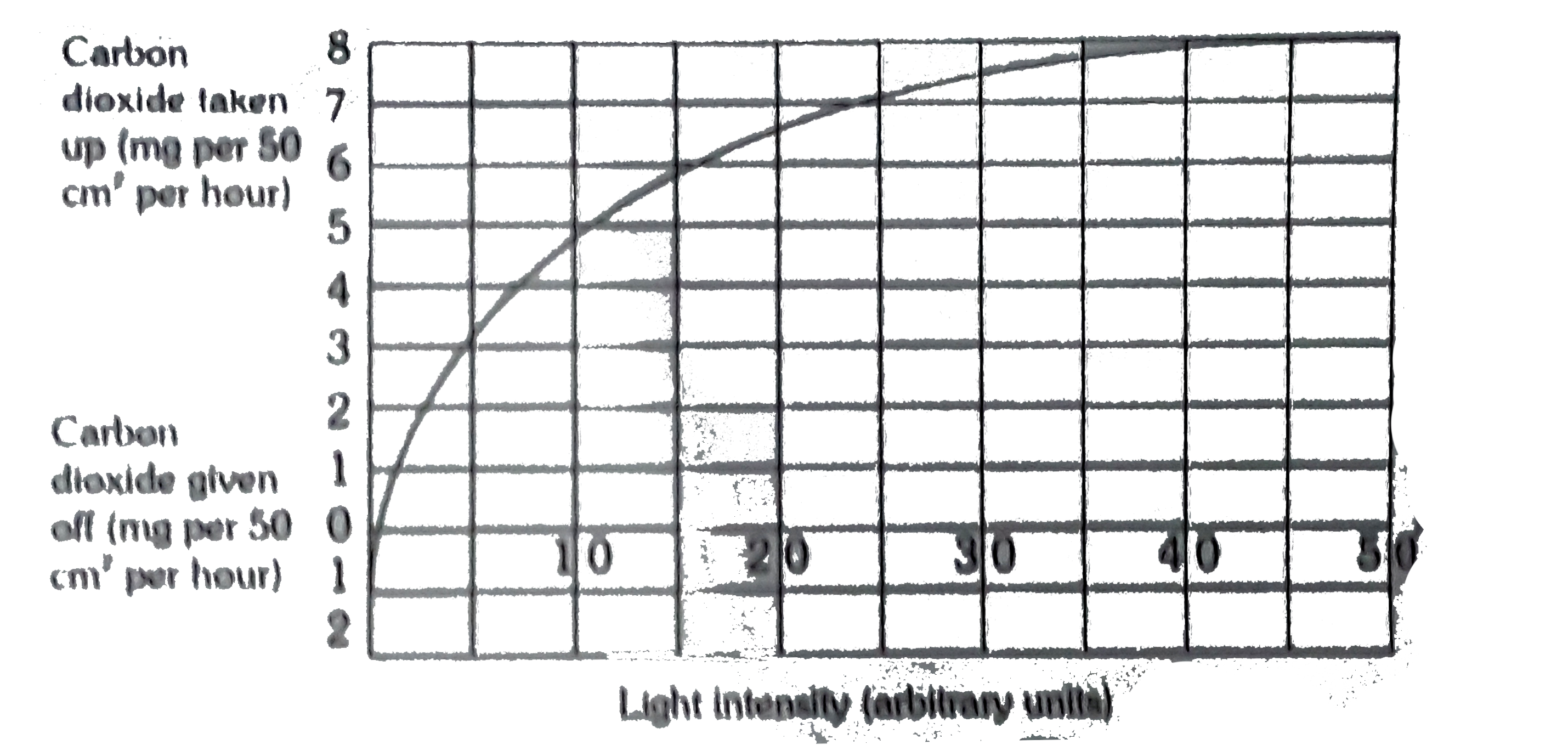
The graph shows the relation between light intensity and the giving off and taking up of carbon dioxide by the leaves of a plant. Why is most carbon dioxide given off when the light intensity is zero units.

A

because it is just the start of the experiment

B

only respiration is taking place at this intensity of light

C

the rate of photosynthesis is equivalent to the rate of respiration

D

the rate of photosynthesis is more than the rate of respiration

Text Solution

Verified by Experts

The correct Answer is:

B
Promotional Banner

Topper's Solved these Questions

  • REPRODUCTIVE HEALTH

    TRUEMAN BIOLOGY|Exercise Multiple Choice Questions|112 Videos
  • SEXUAL REPRODUCTION IN FLOWERING PLANTS

    TRUEMAN BIOLOGY|Exercise MULTIPLE CHOICE QUESTIONS|199 Videos

Similar Questions

Explore conceptually related problems

When waves from two coherent source of amplitudes a and b superimpose , the amplitude R of the resultant wave is given by R = sqrt(a^(2)+b^(2)+2ab cos phi). where phi is the constant phase angle between the two waves. The resultant intensity I is directly proportional to the square of the amplitude of the resultant wave i.e I prop R^(2) i.e, I prop (a^(2) +b^(2) +2ab cos phi ) For constructive interference , phi = 2n pi " ""and"" " I _("max") = (a+b)^(2) For destructive interference , phi = (2n-1) pi "and" I_("min") = (a-b)^(2) If I_(1) I_(2) are intensities from two slits of width w_(1) "and" w_(2) then I_(1)/I_(2)=w_(1)/w_(2)=a^(2)/b^(2) Light waves from two coherent sources of intensity ratio 81 : 1 produce interference. With the help of the passage choose the most appropriate alternative for each of the following questions If two slits in Young's experiment have width ratio 1:4 the ratio of maximum and minimum intensity in the interference pattern would be

When waves from two coherent source of amplitudes a and b superimpose , the amplitude R of the resultant wave is given by R = sqrt(a^(2)+b^(2)+2ab cos phi). where phi is the constant phase angle between the two waves. The resultant intensity I is directly proportional to the square of the amplitude of the resultant wave i.e I prop R^(2) i.e, I prop (a^(2) +b^(2) +2ab cos phi ) For constructive interference , phi = 2n pi " ""and"" " I _("max") = (a+b)^(2) For destructive interference , phi = (2n-1) pi "and" I_("min") = (a-b)^(2) If I_(1) I_(2) are intensities from two slits of width w_(1) "and" w_(2) then I_(1)/I_(2)=w_(1)/w_(2)=a^(2)/b^(2) Light waves from two coherent sources of intensity ratio 81 : 1 produce interference. With the help of the passage choose the most appropriate alternative for each of the following questions The ratio of slit widths of the two sources is

When waves from two coherent source of amplitudes a and b superimpose , the amplitude R of the resultant wave is given by R = sqrt(a^(2)+b^(2)+2ab cos phi). where phi is the constant phase angle between the two waves. The resultant intensity I is directly proportional to the square of the amplitude of the resultant wave i.e I prop R^(2) i.e, I prop (a^(2) +b^(2) +2ab cos phi ) For constructive interference , phi = 2n pi " ""and"" " I _("max") = (a+b)^(2) For destructive interference , phi = (2n-1) pi "and" I_("min") = (a-b)^(2) If I_(1) I_(2) are intensities from two slits of width w_(1) "and" w_(2) then I_(1)/I_(2)=w_(1)/w_(2)=a^(2)/b^(2) Light waves from two coherent sources of intensity ratio 81 : 1 produce interference. With the help of the passage choose the most appropriate alternative for each of the following questions The ratio of amplitudes of two sources is

Why does unpolarised light from a source show no variation in intensity when viewed through a polariod which is rotated? Show with the help of a diagram, how unpolarised light from sun gets linearly polarised by scattering.

Einstein established the idea of photons on the basis of Planck's quantum theory. According to his idea, the light of frequency f or wavelength lamda is infact a stream of photons. The rest mass of each photon is zero and velocity is equal to the velocity of light (c) = 3 xx 10^(8) m.s^(-1) . Energy, E = hf, where h = Planck's constant = 6.625 xx 10^(-34)J.s . Each photon has a momentum p = (hf)/(c) , although its rest mass is zero. The number of photons increase when the intensity of incident light increases and vice-versa. On the other hand, according to de Broglie any stream of moving particles may be represented by progressive waves. The wavelength of the wave (de Broglie wavelength) is lamda = (h)/(p) , where p is the momentum of the particle. When a particle having charge e is accelerated with a potential difference of V, the kinetic energy gained by the particle is K= eV. Thus as the applied potential difference is increased, the kinetic energy of the particle and hence the momentum increase resulting in a decrease in the de Broglie wavelength. Given, charge of electron, e = 1.6 xx 10^(-19)C and mass = 9.1 xx 10^(-31) kg . The number of photons emitted per second from a light source of power 40 W and wavelength 5893 Å

When waves from two coherent source of amplitudes a and b superimpose , the amplitude R of the resultant wave is given by R = sqrt(a^(2)+b^(2)+2ab cos phi). where phi is the constant phase angle between the two waves. The resultant intensity I is directly proportional to the square of the amplitude of the resultant wave i.e I prop R^(2) i.e, I prop (a^(2) +b^(2) +2ab cos phi ) For constructive interference , phi = 2n pi " ""and"" " I _("max") = (a+b)^(2) For destructive interference , phi = (2n-1) pi "and" I_("min") = (a-b)^(2) If I_(1) I_(2) are intensities from two slits of width w_(1) "and" w_(2) then I_(1)/I_(2)=w_(1)/w_(2)=a^(2)/b^(2) Light waves from two coherent sources of intensity ratio 81 : 1 produce interference. With the help of the passage choose the most appropriate alternative for each of the following questions The ratio of maxima and minima in the interference pattern is

Einstein established the idea of photons on the basis of Planck's quantum theory. According to his idea, the light of frequency f or wavelength lamda is infact a stream of photons. The rest mass of each photon is zero and velocity is equal to the velocity of light (c) = 3 xx 10^(8) m.s^(-1) . Energy, E = hf, where h = Planck's constant = 6.625 xx 10^(-34)J.s . Each photon has a momentum p = (hf)/(c) , although its rest mass is zero. The number of photons increase when the intensity of incident light increases and vice-versa. On the other hand, according to de Broglie any stream of moving particles may be represented by progressive waves. The wavelength of the wave (de Broglie wavelength) is lamda = (h)/(p) , where p is the momentum of the particle. When a particle having charge e is accelerated with a potential difference of V, the kinetic energy gained by the particle is K= eV. Thus as the applied potential difference is increased, the kinetic energy of the particle and hence the momentum increase resulting in a decrease in the de Broglie wavelength. Given, charge of electron, e = 1.6 xx 10^(-19)C and mass = 9.1 xx 10^(-31) kg . The number of photons emitted per second by a source of light of power 30 W is 10^(20) , the momentum of each photon (in kg.m.s^(-1) )

Einstein established the idea of photons on the basis of Planck's quantum theory. According to his idea, the light of frequency f or wavelength lamda is infact a stream of photons. The rest mass of each photon is zero and velocity is equal to the velocity of light (c) = 3 xx 10^(8) m.s^(-1) . Energy, E = hf, where h = Planck's constant = 6.625 xx 10^(-34)J.s . Each photon has a momentum p = (hf)/(c) , although its rest mass is zero. The number of photons increase when the intensity of incident light increases and vice-versa. On the other hand, according to de Broglie any stream of moving particles may be represented by progressive waves. The wavelength of the wave (de Broglie wavelength) is lamda = (h)/(p) , where p is the momentum of the particle. When a particle having charge e is accelerated with a potential difference of V, the kinetic energy gained by the particle is K= eV. Thus as the applied potential difference is increased, the kinetic energy of the particle and hence the momentum increase resulting in a decrease in the de Broglie wavelength. Given, charge of electron, e = 1.6 xx 10^(-19)C and mass = 9.1 xx 10^(-31) kg . Two stationary electrons are accelerated with potential difference V_(1) and V_(2) respectively such that V_(1) : V_(2) = n . The ratio of their de Broglie wavelength

In the atmosphere, carbon dioxide is found in two forms, i.e., ^12CO_2 and ^14CO_2 . Plants absord CO_2 during photosynthesis in presence of chlorophyll, plants synthesise glucose 6CO_2 +6 H_2O rarr C_6H_12O_6 + 6O_2uarr Half life of ^14CO_2 is 5760 years. The analysis of wooden artifacts for ^14C and ^12C gives useful information for determination of its age. All living organisms, because of their constant exchange of Carbon dioxide with the surroundings have the same ratio of C-14 to C-12, i.e. 1.3xx10^-12 . When an organism dies, the C-14 in it keeps on decaying as follows: 6^14Crarr7^14N+(-1)^0e +Energy Thus, the ratio of C-14 and C-12 decreases with the passage of time. We can measure the proportion of C-14 in the remains of dead organism and determine how long ago it died. The method of carbon dating can be used to date anything made or organic matter, e.g., bone, skeleton, wood, etc. Using carbon dating, materials have been dated to about 50,000 years with accuracy. C-14 exists in atmosphere due to:

TRUEMAN BIOLOGY-RESPIRATION IN PLANTS-MULTIPLE CHOICE QUESTIONS
  1. The production of ATP by oxidative phosphorylation is driven by energy...

    Text Solution

    |

  2. Both mitochondria and chloroplasts

    Text Solution

    |

  3. The graph shows the relation between light intensity and the giving of...

    Text Solution

    |

  4. Chemiosmosis is

    Text Solution

    |

  5. Which of the following process makes direct use of oxygen ?

    Text Solution

    |

  6. The following is a simplified scheme showing the fate of glucose durin...

    Text Solution

    |

  7. Ganong's respiroscope is used to demonstrate………………… 1. evolution of O2...

    Text Solution

    |

  8. During which stage in the complete oxidation of glucose are the greate...

    Text Solution

    |

  9. In glycolysis ultimately (or end product of glycolysis is) 1. Acetyl C...

    Text Solution

    |

  10. Choose the correct combination of labelling the number of carbon compo...

    Text Solution

    |

  11. Which is not true for glycolysis 1. End product is CO2 and H2O 2. Sub...

    Text Solution

    |

  12. How many ATP molecules could maximally be generated from one molecule ...

    Text Solution

    |

  13. All enzymes of TCA cycle are located in the mitochondrial matrix excep...

    Text Solution

    |

  14. Which one of the following mammalian cells is not capable of metaboliz...

    Text Solution

    |

  15. The overall goal of glycolysis, Krebs cycle and the electron transport...

    Text Solution

    |

  16. A competitive inhibitor of succinic dehydrogenase is

    Text Solution

    |

  17. In Krebs cycle, the following reactions are involved in the production...

    Text Solution

    |

  18. Carbon monoxide inhibits mitochondrial electron transport by

    Text Solution

    |

  19. Out of the following, which is the rate limiting enzyme in glycolysis?

    Text Solution

    |

  20. Match list-l with list-II and select the correct answer using the code...

    Text Solution

    |
