Home
Class 12
BIOLOGY
What would be Psi(P) in cell A and cell ...


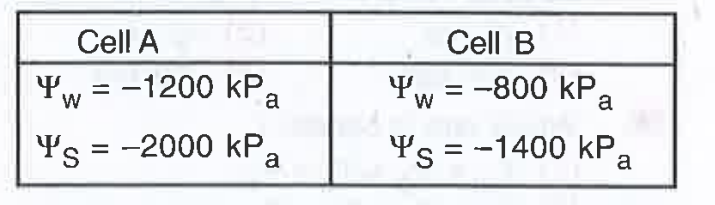
What would be `Psi_(P)` in cell A and cell B respectively ?

A

`+ 800,+600 kP_(a)`

B

`-1000,-600 kP_(a)`

C

`+3200,+2200 kP_(a)`

D

`-800,-600 kP_(a)`

Text Solution

Verified by Experts

The correct Answer is:

A

Cell `A,Psi_(P)=Psi_(W)-Psi_(S)=-1200-(-2000)=+800kP_(a)`
Cell `B ,Psi_(P)=Psi_(W)-Psi_(S)=-800-(-1400)=-800+1400=+600kP_(a)`
Promotional Banner

Topper's Solved these Questions

  • THE LIVING WORLD

    TRUEMAN BIOLOGY|Exercise MULTIPLE CHOICE QUESTIONS|124 Videos
  • Viruses

    TRUEMAN BIOLOGY|Exercise ASSERTION AND REASON|21 Videos

Similar Questions

Explore conceptually related problems

Glycolysis occurs in mitochondria and cytoplasm in case of eukaryotic cell and prokaryotic cell respectively.

Two cells A and B ofe.m.f. 2V and 1.5V respectively, are connected as shown in figure through an external resistance 10 ohm. The internal resistance of each cell is 5 ohm. The potential difference E_(A) and E_(B) across the terminals of the cells A and B respectively are

What is cell?

alpha-" and" beta -cells in the islets of Langerhans are respectively defunctioned by

Where would you find mast cells?

Where would you find mast cells?

A crystalline compound formed by elements A and B has facecentred cubic unit cell. The corners and the face-centred of the unit cell are occupied by A and B atoms, respectively. If one of the corner-atoms is found to be missing, then what would the formula of the compound be?

A compound consists of element A and B. It crystallises in a cubic crystal structure with unit cell having A atoms at the corners of the cell and B atom at the face centres of the cell. If the edge-length of the unit cell is 5Å, and the atomic masses of A and B are 60 and 90 respectively, then calculate the density of the compound.

The edge lengths of the unit cells in terms of the radius of spheres constituting bcc , fcc and simple cubic unit cell are respectively

TRUEMAN BIOLOGY-TRANSPORT IN PLANTS-Multiple Choice Questions
  1. Addition of a solute to pure water causes

    Text Solution

    |

  2. Water potential and osmotic potential of pure water are

    Text Solution

    |

  3. What would be Psi(P) in cell A and cell B respectively ?

    Text Solution

    |

  4. Cell A has osmotic potential of -18 bars and pressure potential of 8 b...

    Text Solution

    |

  5. If a cell loses water its D.P.D.

    Text Solution

    |

  6. A cell 'A' has Psi(W)=-18 bars and its adjacent cell 'B' has a water p...

    Text Solution

    |

  7. Water potential of a solution is always

    Text Solution

    |

  8. When the cell is turgid

    Text Solution

    |

  9. Reduction of water potential due to presence of solute is

    Text Solution

    |

  10. If a plant cell has Psi(S) value of -10 bar and Psi(P) value of +5 bar...

    Text Solution

    |

  11. Which one is correct ?

    Text Solution

    |

  12. Plant cells do not burst in distilled water because

    Text Solution

    |

  13. If cell (A) with OP =5 and TP=4 is surrounded by cells with OP =3 and ...

    Text Solution

    |

  14. The actual pressure with which water enters into the cell is called

    Text Solution

    |

  15. If the plant cell is immersed in water , the water continues to enter ...

    Text Solution

    |

  16. A cleaned goat bladder is filled with a syrup tied and immersed in wat...

    Text Solution

    |

  17. Bacteria can not survive in a highly salted pickle because

    Text Solution

    |

  18. Purple cabbage leaves do not loose their colour in cold water but do s...

    Text Solution

    |

  19. Which is possible for a fully turgid cell ?

    Text Solution

    |

  20. The plants that send their roots upto fringe of the water table due to...

    Text Solution

    |
