Home
Class 11
BIOLOGY
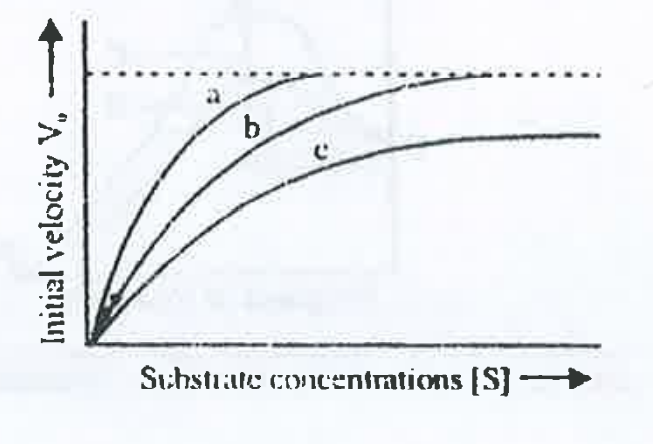
The figure given below shows three ve...

The figure given below shows three velocity -substrate concentration curves for an enzyme reaction. What do the curves a,b and c depit respectively ?

A

a-normal enzyme reaction, b-competitive inhibtion, c-non-competitive inhibition .

B

a-enzyme with an allosteric modulator added, b-normal enzyme activity, c-competitive inhibition .

C

a-enzyme with an allosteric stimulator, b-competitive inhibition added, c-normal enzyme reaction

D

a-normal enzyme reaction, b-non-copetitive inhibitor added, c-allosteric inhibitior added

Text Solution

Verified by Experts

The correct Answer is:

A
Promotional Banner

Topper's Solved these Questions

  • ANIMAL TISSUES

    TRUEMAN BIOLOGY|Exercise MULTIPLE CHOICE QUESTIONS|193 Videos
  • CELL- THE BASIC UNIT OF LIFE ( CELL AND ITS STRUCTURAL ORGANISATION )

    TRUEMAN BIOLOGY|Exercise MULTIPLE CHOICE ANSWER TYPE|312 Videos

Similar Questions

Explore conceptually related problems

What does the graph indicate ? The graph given below shows the effect of substrate concentration on the rate of reaction of the enzyme green- gram-phos-phatase.

The figure given below shows the conversion of a substrate into product by an enzyme . In which one of the four options (a-d) the components of reaction labelled as A,B,C and D are identified correctly ?

The curve below showns enzymatic acitvity in relation to three conditions (pH, temperature and substrate concentration). What do the axises (x and y) represent ?

The curve given below show enzymatic activity with relation to three conditions (pH, temperature and substrate concentration) What do the two axises (x and y) represent

In the figure related to human ear, what do A, B and C stand for respectively

The velocity V of a particle at time t is given by V = at + b/(t+c) . The dimensions of a, b and c are respectively--------.

For a reaction A to B , the rate of reaction becomes twenty seven times when the concentration of A is increased three times. What is the order of the reaction?

Examine the figure given below and select the right option given all the four parts (a,b,c,d) correctly identified.

Examine the figures (A-D) given below and select the right option out of 1-4 in which all the four structure A,B,C,D are identified correctly

Examine the figures (A-D) given below and select the right option out of 1-4 in which all the four structure A,B,C,D are identified correctly

TRUEMAN BIOLOGY-BIOMOLECULES -MULTIPLE CHOICE QUESTIONS
  1. An enzyme that stimulates germination of barley seeds is

    Text Solution

    |

  2. An organic substance bound to an enzyme and essential for its activ...

    Text Solution

    |

  3. The figure given below shows three velocity -substrate concentratio...

    Text Solution

    |

  4. Purines are generally abbreviated as

    Text Solution

    |

  5. Quaternary structure is present in

    Text Solution

    |

  6. Inulin is a polymer of

    Text Solution

    |

  7. Three of the following statements about enzymes are correct and one is...

    Text Solution

    |

  8. The figure given below shows the conversion of a substrate into pro...

    Text Solution

    |

  9. Which one fo the following structural formulae of two orgainc compo...

    Text Solution

    |

  10. The curve below showns enzymatic acitvity in relation to three con...

    Text Solution

    |

  11. Select the types of enzyme involved in the following reaction:

    Text Solution

    |

  12. Most abundant RNA in a cell is :

    Text Solution

    |

  13. For its activity, carboxypeptidase requires

    Text Solution

    |

  14. which one of the following biomolecules is correctly characterize...

    Text Solution

    |

  15. Which one out of A- D given below correctly represents the structur...

    Text Solution

    |

  16. Which one is the most abundant protein in the animal world

    Text Solution

    |

  17. Macro molecule chitin is

    Text Solution

    |

  18. A phosphoglyceride is always made up of

    Text Solution

    |

  19. Transition state structure of the substrate formed during an enzymatic...

    Text Solution

    |

  20. Which one of the following is a non-reducing carbohydrate?

    Text Solution

    |
