Home
Class 6
PHYSICS
Three torches A, B and C shown in Fig. 1...

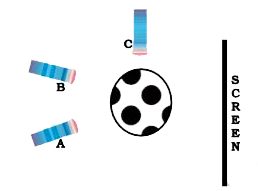
Three torches A, B and C shown in Fig. 11.7 are switched on one by one. The light from which of the torches will not form a shadow of the ball on the screen.

A

Torch C

B

Torch B

C

Torch A

D

Both B and C

Text Solution

Verified by Experts

The correct Answer is:

A

Torch A and B are placed in front of the screen so they will form image. As torch C is placed parallel to the screen, it will not form a shadow of the ball because light travels in straight line.
Promotional Banner

Topper's Solved these Questions

  • LIGHT

    NCERT EXEMPLAR|Exercise SHORT ANSWER QUESTIONS|10 Videos
  • LIGHT

    NCERT EXEMPLAR|Exercise LONG ANSWER QUESTIONS|3 Videos
  • FUN WITH MAGNETS

    NCERT EXEMPLAR|Exercise LONG ANSWER QUESTIONS|7 Videos
  • MOTION AND MEASUREMENT OF DISTANCES

    NCERT EXEMPLAR|Exercise LONG ANSWER QUESTIONS|4 Videos

Similar Questions

Explore conceptually related problems

A torch is placed at two different positions A and B, one by one, as shown in Fig. 11.9. The shape of the shadow obtained in two positions is shown in Fig. 11.10 Match the position of the torch and shape of the shadow of the ball.

A sheet of plywood, a piece of muslin cloth and that of a transparent glass, all of the same size and shape were placed at A one by one in the arrangement shown in Fig. 11.12. Will the shadow be formed in each case. If yes, how will the shadow on the screen be different in each case? Give reasons for your answer.

A small hole P is made in a piece of cardboard. The hole is illuminated by a torch as shown in Fig. 16.3. The pencil of light coming out of the hole falls on a mirror. At which point should the eye be placed so that the hole can be seen?

Three blocks A,B, and C are suspended as shown in fig. Mass of each of blocks A and B is m. If the system is in equilibrium, and mass of C is M then

Which one is not formed from ectoderm?

Which one is not formed from ectoderm?

A charged metallic sphere A is suspended by a nylon thread. Another charged metallic sphere B held by an insulating handle is brought close to A such that the distance between their centres is 10 cm, as shown in Fig. 1.7(a). The resulting repulsion of A is noted (for example, by shining a beam of light and measuring the deflection of its shadow on a screen). Spheres A and B are touched by uncharged spheres C and D respectively, as shown in Fig. 1.7(b). C and D are then removed and B is brought closer to A to a distance of 5.0 cm between their centres, as shown in Fig. 1.7(c). What is the expected repulsion of A on the basis of Coulomb’s law? Spheres A and C and spheres B and D have identical sizes. Ignore the sizes of A and B in comparison to the separation between their centres.

A student had a ball, a screen and a torch in working condition. He tried to form a shadow of the ball on the screen by placing them at different positions. Sometimes the shadow was not obtained. Explain.

Observe the picture given in Fig. 11.1 carefully. A patch of light is obtained at B, when the torch is lighted as shown. Which of the following is kept at position A to get this patch of light?
