Text Solution
Verified by Experts



Topper's Solved these Questions
HUMAN REPRODUCTION
ARIHANT PUBLICATION|Exercise ODISHA BUREAU.S TEXTBOOK SOLUTIONS (D Long Answer Type Questions)|7 VideosHUMAN REPRODUCTION
ARIHANT PUBLICATION|Exercise CHAPTER PRACTICE (Very Short Answer Type Questions)(Choose the correct option)|3 VideosHUMAN REPRODUCTION
ARIHANT PUBLICATION|Exercise ODISHA BUREAU.S TEXTBOOK SOLUTIONS (B Short Answer Type Questions)(Write brief notes on the following)|16 VideosHEREDITY AND VARIATION
ARIHANT PUBLICATION|Exercise Chapter Practice ( Short Answer Type -II Questions )|1 VideosIMPROVEMENT IN FOOD PRODUCTION
ARIHANT PUBLICATION|Exercise CHAPTER PRACTICE (Short Answer Type -ll Questions)|4 Videos
Similar Questions
Explore conceptually related problems
ARIHANT PUBLICATION-HUMAN REPRODUCTION -ODISHA BUREAU.S TEXTBOOK SOLUTIONS (C Differentiate between two words in the following pairs of words )
- Differentiate between Leydig.s cells and Sertoli cells.
Text Solution
|
- Corpus haemorrhagicum and Corpus luteum
Text Solution
|
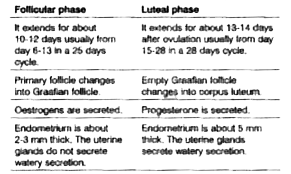
- Follicular phase and Luteal phase
Text Solution
|
- Antral follicle and Graafian follicle
Text Solution
|
- Differentiate between granulosa and theca cells.
Text Solution
|
- First maturation division and Second maturation division.
Text Solution
|
- Differentiate between : Spermatogenesis and oogeneis
Text Solution
|