Home
Class 12
CHEMISTRY
Classify each of the following solids as...

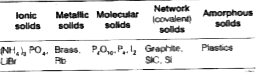
Classify each of the following solids as ionic, metallic, molecular, network (covalent) or amorphous.
(i) Tetraphosphorus decaoxide `(P_(4)O_(10))`
(ii) Ammonium phosphate `(NH_(4))_(3) PO_(4)`
(iii) SiC (iv) `I_(2)` (v) `P_(4)`
(vi) Graphite (vii) Brass (viii) Rb
(ix) LiBr (x) Si (xi) Plastics

Text Solution

Verified by Experts
Promotional Banner

Topper's Solved these Questions

  • THE SOLID STATE

    ARIHANT PUBLICATION|Exercise PART I (QUESTION FOR PRACTICE) (Long Answer Type Questions)|2 Videos
  • THE SOLID STATE

    ARIHANT PUBLICATION|Exercise PART I (QUESTION FOR ASSESSMENT) (Multiple Choice Type Questions)|1 Videos
  • THE SOLID STATE

    ARIHANT PUBLICATION|Exercise PART I (QUESTION FOR PRACTICE) (Short Answer Type I Questions)|7 Videos
  • SURFACE CHEMISTRY

    ARIHANT PUBLICATION|Exercise CHAPTER PRACTICE ( LONG ANSWER TYPE QUESTIONS)|1 Videos

Similar Questions

Explore conceptually related problems

Which of the following is not a molecular crystal ? ( I_2 , P_4 , Solid CO_2 , ice, brass)

Identify the following as element , compound or mixture : (i) Brass (ii) Marble (iii) Helium (iv) Honey (v) nitre (vi) Gasoline (vii) Table salt (viii) Air (ix) Caustic soda (x) Gold

Amongst the following, the most stable complex is (i) Fe(H_(2)O)_(6)]^(3+) (ii) [Fe(NH_(3))_(6)]^(3+) (iii) [Fe(C_(2)O_(4))_(3)]^(3-) (iv) [FeCl_(6)]^(3-)

A random variable X has the following probability distribution Determine (i) R (ii) P(X lt 2) (iii) P(X ge 4) (iv) P(2 le X le 5)

Complete the following reaction giving the names of the products: (i) C_6H_5 OH+ Zn dust rarr (ii) C_6H_5 OH+ Br_2 water rarr (iii) C_6H_5OH+HNO_3overset("conc.H_2SO_4)rarr (iv) C_6H_5OH+HNO_2 rarr (v) C_6H_5OH+CHCl_3+KOH rarr (vi) C_6H_5OH+CCCl_4+KOHrarr (vii) C_6H_5OH+CO_2rarr

Given, A = {2,3,4), B = (2, 5, 6, 7). Construct an example of each of following: (i) An injective mapping from A to B. (ii) A mapping from A to B, which is not injective. (iii) A mapping from B to A. (iv) A surjective mapping from A to B.

