Home
Class 12
CHEMISTRY
The rate constant for the decomposition ...

The rate constant for the decomposition of `N_(2) O_(5)` at various temperatures is given below.

Draw a graph between ln `k and 1//T` and calculate the values of `A and E_a`. Predict the rate constant at 30°C and 50°C.

Text Solution

Verified by Experts
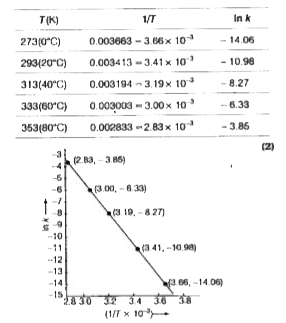
(i) To draw the graph between In `k` versus 1/T, we rewrite the data as follows:

(ii) From the graph, we find the slope
Slope` = (-2.4)/( 0.00047) = (-E_a)/( 2.303 R)`
`therefore` Activation energy,
`E_a = (2.4 xx 2.303 xx 8.314" J mol"^(-1) )/( 0.00047)`
`= 97772" J mol"^(-1) = 97.772" kJ mol"^(-1)`
`rArr E_a = 97.772" kJ mol"^(-1)`
(iii) We know that, In `k = "In" A + (-E_a)/( RT)`
On comparing it `y= mx + c`. The equation of line in intercept form,
`"In" k = (- (E_a)/( R) ) (1)/( T) + "In" A`
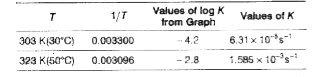
log A `=` value of intercept on `Y-` axis, i.e. on the `log k -` axis `= (-1 + 7.2)= 6.2 [y_(2) - y_(1) = -1 - (7.2) ]`
Frequency factor, `A = " antilog" 6.2 = 1585000`
or, `A = 1.585 xx 10^(6)` collisions `"s^(-1)`
(iv) Value of rate constant k can be find by the study of graph.
Promotional Banner

Topper's Solved these Questions

  • CHEMICAL KINETICS

    ARIHANT PUBLICATION|Exercise QUESTIONS FOR ASSESSMENT (Part IV Activation Energy and Collision Theory of Chemical Reactions ) Multiple Choice Type Questions|3 Videos
  • CHEMICAL KINETICS

    ARIHANT PUBLICATION|Exercise QUESTIONS FOR ASSESSMENT (Part IV Activation Energy and Collision Theory of Chemical Reactions ) Very Short Answer Type Questions|2 Videos
  • CHEMICAL KINETICS

    ARIHANT PUBLICATION|Exercise QUESTIONS FOR PRACTICE (Part IV Activation Energy and Collision Theory of Chemical Reactions ) Short Answer Type II Questions|6 Videos
  • CARBOXYLIC ACIDS

    ARIHANT PUBLICATION|Exercise CHAPTER PRACTICE (LONG ANSWER TYPE QUESTIONS) |3 Videos
  • CHEMISTRY IN EVERYDAY LIFE

    ARIHANT PUBLICATION|Exercise CHAPTER PRACTICE (LONG ANSWER TYPE QUESTIONS) |2 Videos

Similar Questions

Explore conceptually related problems

The experimental data for the decomposition of N_(2) O_(5) , [2N_(2) O_(5) to 4NO_(2) + O_(2)] in gas phase of 318 K are given below: Draw a graph between log [N_(2) O_(5)] and t .

The experimental data for the decomposition of N_(2) O_(5) , [2N_(2) O_(5) to 4NO_(2) + O_(2)] in gas phase of 318 K are given below: Calculate the rate constant.

Mention the factors that affect the rate of chemical reaction. For a reaction, the rate law is k[A]^(1//2)[B] . Can this reaction be an elementary reaction? The rate constant for the first-order decomposition of H_(2)O_(2) is given by the following equation log K =14.2 -(1.0 xx 10^(4)K)/(T) Calculate E_(a) for this reaction and rate constant k if its half life period be 200 min. (R=8.314 JK^(-1)"mol"^(-1))

The experimental data for the decomposition of N_(2) O_(5) , [2N_(2) O_(5) to 4NO_(2) + O_(2)] in gas phase of 318 K are given below: Calculate the half-life period from k and compare it with above.

The rate constant for the first order decomposition of H_(2) O_(2) is given by the following equation, log k = 14.34 - (1.25 xx 10^(4) K)/( T) Calculate E_a for this reaction and at what temperature will its half period be 256 min?

The experimental data for the decomposition of N_(2) O_(5) , [2N_(2) O_(5) to 4NO_(2) + O_(2)] in gas phase of 318 K are given below: What is the rate law?

Calculate the half-life of a first order reaction, from their rate constants given below. 2 min

The rate constant of the decomposition of N_(2)O_(5) is 6.0 X10^(-4) s^(-1) .At what time will the initial concentration of 1M be reduced to 0.2 M is the reaction of the first order ?

The experimental data for the decomposition of N_(2) O_(5) , [2N_(2) O_(5) to 4NO_(2) + O_(2)] in gas phase of 318 K are given below: Plot [N_(2) O_(5) ] against t .