Home
Class 12
CHEMISTRY
A hydrocarbon A(C(4)H(8)) on reaction w...

A hydrocarbon `A(C_(4)H_(8))` on reaction with HCl gives a compound 'B' `(C_(4)H_(9)Cl)` which on reaction with 1 mole of `NH_3` gives compound `'C' (C_(4)H_(11)N)` . On reacting with NaN02 and HC1 followed by the'treatment with water, compound 'C yields an optically active alcohol, 'D'. Ozonolysis of 'A gives 2 moles of acetaldehyde. Identify compounds 'A to 'D'. Explain the reactions involved.

Text Solution

Verified by Experts
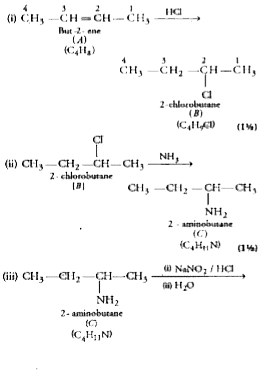
Addition of HCl to compound CA. shows that compound .A. is alkene because compound .B. is:
`C_(4)H_(9)Cl`
(ii) Compound .B. reacts with `NH_3`, to form amine .C..
`C_(4)H_(8)overset(HCl) to underset(B)(C_(4)H_(9)Cl) overset(NH_(3)) to underset(C )(C_(4)H_(11)N` or `C_(4)H_(9)NH_(2)`
(iii) .C gives diazonium salt with `NaNO_(2)//HCl`, which yields an optically active alcohol. So, .C is an aliphatic amine.
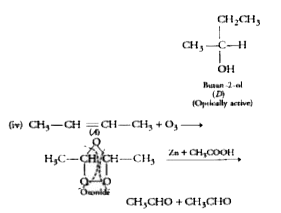
(iv) .A. on ozonolysis produces 2 moles of `CH_(3)CHO`.
So, .A. is `CH_(3) - CH =CH -CH_(3)` (but-2-ene) (1)
Therefore, overall reaction sequence look like:

Promotional Banner

Topper's Solved these Questions

  • ARYL DIAZONIUM SALTS

    ARIHANT PUBLICATION|Exercise ODISHA BUREAU.S TEXTBOOK SOLUTIONS (MULTIPLE CHOICE TYPE QUESTIONS) |12 Videos
  • ARYL DIAZONIUM SALTS

    ARIHANT PUBLICATION|Exercise ODISHA BUREAU.S TEXTBOOK SOLUTIONS (VERY SHORT ANSWER TYPE QUESTIONS) |4 Videos
  • ARYL DIAZONIUM SALTS

    ARIHANT PUBLICATION|Exercise QUESTIONS FOR PRACTICE (SHORT ANSWER TYPE II QUESTIONS 3 MARK) |5 Videos
  • AMINES

    ARIHANT PUBLICATION|Exercise Chapter Practice (Long Answer Type Questions)|2 Videos
  • CARBOXYLIC ACIDS

    ARIHANT PUBLICATION|Exercise CHAPTER PRACTICE (LONG ANSWER TYPE QUESTIONS) |3 Videos

Similar Questions

Explore conceptually related problems

An organic compound A (C_(4)H_(10)O ) reacts with HI giving a compound B( C_(4)H_(9)l ), which on reduction gives n-butane. On oxidation 'A' gives a compound C(C_(4)H_(8)O ) and then an acid D(C_(4)H_(8)O_(2)) . Deduce the structures of A, B, C and D and mention their IUPAC names.

C_(5)H_(13)N reacts with HNO_(2) to give an optically active alcohol. What is this compounds ? Give its IUPAC name.

A hydrocarbon C_(5)H_(10) does not react with chlorine in dark but gives a single monochloro compound, C_(5)H_(9)Cl in bright sunlight. Identify the hydrocarbon.

Write the name of the compound : [(C_(2)H_(5))_(5)N]_(2)[ZnCl_(4)]

A violet compound of manganese 'A' decomposes on heating to liberate oxygen and compounds B and C of manganese are formed. Compound C reacts with KOH in the presence of potassium nitrate to give a compound B. On heating compound C with conc. H_(2)SO_(4) and NaCl, chlorine gas is liberated and compound D of manganese alongwith other products is formed. Identify compounds A to D and also explain the reactions involved.

Benzoic acid on treatment with Br_2 and FeBr_3 gives the compound (A), which on tratment with NH_3 gives the compound(B). The compound (B) on heating gives the compound (C ). Write the structures of compounds (A), (B) and (C ) in the above sequence of reactions.

An organic compound has C and H percenatage in the ratio 6 : 1 and C and O percentage in the ratio 3 : 4 .The compound is :