Home
Class 10
MATHS
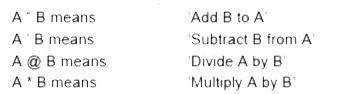
In this question, the symbols are used a...

In this question, the symbols are used as follows: A B means

The total airfare is calculated by adding 15% of basic fare as fuel surcharge, 2% of the basic fare as IATA charges and Rs 200 as airport tax to the basic fare. If the basic fare of a sector is B, which of the following will represent the total fare?

A

B' (B* 15) @ 100" (B * 2) @ 100 200

B

B" (B* 15) @ 100" (B 2) @ 100 200

C

B'' (B* 15) @ 100(B* 2) @ 100'' 200

D

B" (B* 15) @ 100" (B * 2) @ 200" 100

Text Solution

Verified by Experts

The correct Answer is:

C

Total airfare as given in the question is calculated as below: Replacing the symbols with the sings as instructed, we get B" (B* 15) @ 100" `( B^(*) 2 )` @ 100" 200 Hence, option (c) is the correct answer.
Promotional Banner

Similar Questions

Explore conceptually related problems

Hannah placed an online order for shirts that cost $24.50 per shirt. A tax of 7% is added to the cost of the shirts, before a flat, untaxed shipping rate of $6 is charged. Which of the following represents Hannah's total cost for s shirts, in dollars?

In which of the following situations, does the list of numbers involved make an arithmetic progression, and why? (i) The taxi fare after each km when the fare is Rs 15 for the first km and Rs 8 for each additional km. (ii) The amount of air present in a cylinder when a vacuum pump removes 1/4 of the air remaining in the cylinder at a time. (iii) The cost of digging a well after every metre of digging, when it costs Rs.150 for the first metre and rises by Rs. 50 for each subsequent metre. (iv) The amount of money in the account every year, when 10000 is deposited at compound interest at 8 % per annum.

In a conservative force field we can find the radial component of force from the potential energy function by using F = -(dU)/(dr) . Here, a positive force means repulsion and a negative force means attraction. From the given potential energy function U(r ) we can find the equilibrium position where force is zero. We can also find the ionisation energy which is the work done to move the particle from a certain position to infinity. Let us consider a case in which a particle is bound to a certain point at a distance r from the centre of the force. The potential energy of the particle is : U(r )=(A)/(r^(2))-(B)/(r ) where r is the distance from the centre of the force and A andB are positive constants. Answer the following questions. If the total energy of the particle is E=-(3B^(2))/(16A) , and it is known that the motion is radial only then the velocity is zero at
