Home
Class 11
CHEMISTRY
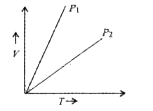
V vs T curves at different pressures P(1...

V vs T curves at different pressures `P_(1)` and `P_(2)`
for an ideal gas are shown below:

Which one of the following is correct? : `P_(1) gt P_(2)`, `P_(1) lt P_(2)`, `P_(1) = P_(2)`, `P_(2)"/"P_(1)= 1"/"2`

A

`P_(1) gt P_(2)`

B

`P_(1) lt P_(2)`

C

`P_(1) = P_(2)`

D

`P_(2)"/"P_(1)= 1"/"2`

Text Solution

Verified by Experts

The correct Answer is:

B
Promotional Banner

Similar Questions

Explore conceptually related problems

For an ideal gas, an illustration of three different paths A, (B +C) and (D+E) from an initial state P _(1) , V _(1), T _(1) to a final state P _(2), V _(2), T _(1) is shown in the given Path A represents a reversible isothermal expansion from P _(1), V _(1), to P _(2), V _(2) Path (B +C) represents a reversible adiabatic expansion (B) from P _(1), V _(1), T _(1) to P _(3), V _(2) , T _(2) followed by reversible heating the gas at constant volume (C) from P _(3), V _(2), T _(2) to P _(2), V _(2), T _(1). Path (D+E) represents a reversible expansion at constant pressure P _(1) from P _(1) , V _(1), T _(1) to P _(1), V _(2), T _(3) followed by a reversible cooling at constant volume V _(2) (E) frm V _(1) , V _(2) T _(3) to P _(2) , V _(2), T _(1). What is Delta S for path A ?

For an ideal gas, an illustration of three different paths A, (B +C) and (D+E) from an initial state P _(1) , V _(1), T _(1) to a final state P _(2), V _(2), T _(1) is shown in the given Path A represents a reversible isothermal expansion from P _(1), V _(1), to P _(2), V _(2) Path (B +C) represents a reversible adiabatic expansion (B) from P _(1), V _(1), T _(1) to P _(3), V _(2) , T _(2) followed by reversible heating the gas at constant volume (C) from P _(3), V _(2), T _(2) to P _(2), V _(2), T _(1). Path (D+E) represents a reversible expansion at constant pressure P _(1) from P _(1) , V _(1), T _(1) to P _(1), V _(2), T _(3) followed by a reversible cooling at constant volume V _(2) (E) frm V _(1) , V _(2) T _(3) to P _(2) , V _(2), T _(1). What is q _(rav), for path (A) ?

For an ideal gas, an illustration of three different paths A, (B +C) and (D+E) from an initial state P _(1) , V _(1), T _(1) to a final state P _(2), V _(2), T _(1) is shown in the given Path A represents a reversible isothermal expansion from P _(1), V _(1), to P _(2), V _(2) Path (B +C) represents a reversible adiabatic expansion (B) from P _(1), V _(1), T _(1) to P _(3), V _(2) , T _(2) followed by reversible heating the gas at constant volume (C) from P _(3), V _(2), T _(2) to P _(2), V _(2), T _(1). Path (D+E) represents a reversible expansion at constant pressure P _(1) from P _(1) , V _(1), T _(1) to P _(1), V _(2), T _(3) followed by a reversible cooling at constant volume V _(2) (E) frm V _(1) , V _(2) T _(3) to P _(2) , V _(2), T _(1). What is Delta S for path A ?

Which of the following is not representing the power of an electric circuit: ? [ P=I^2R , P=VI , P=IR^2 , P=V^2/R^2 ]

Choose the correct answer.If P (A)=1/2, " " P(B)=0, " " then " " P(A/B)is

The vaues of ""^(2) P_(1) + ""^(3) P _(1) + ...+ ""^(n) P _(1) is equal to

Consider the G.P 2,1,1/2,1/4 …Which term of the given G.P is 1/(128)
