Home
Class 12
CHEMISTRY
Assertion: Bromobenzene upon reaction wi...

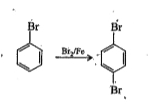
Assertion: Bromobenzene upon reaction with `Br_2//Fe` gives 1,4-dibromobenzene as the major product.
Reason : In bromobenzene, the inductive effect of the bromo group is more dominant than the mesomeric effect in directing the incoming electrophile.

A

If both (A) and (R) are correct and (R) is the correct explanation of (A).

B

If both (A) and (R) are correct, but (R) is not the correct explanation of (A).

C

If (A) is correct, but (R) is incorrect.

D

If both (A) and (R) are incorrect.

Text Solution

Verified by Experts

The correct Answer is:
A


. Bromine orientation is controlled by its mesomerdc effect Its stabilisation ofarenium ion by +M activity.

In bromobenzene, the inductive effect of the bromo group is more dominant than themesomeric effect in the activity of ring:
Promotional Banner

Similar Questions

Explore conceptually related problems

Assertion: 2-Bromobutane on reaction with sodium ethoxide in ethanol gives 1-butene as a majorproduct. Reason : 1-Butene is more stable than 2-butene.

Assertion : Controlled nitration of aniline at low temperature gives m-nitroaniline as one of the major product.s Reason : In acidic medium, -NH_(2) group is converted to overset(+)(-N)H_(3) group which is m-directing.

Which of the following statements are correct about electrophilic substitution reactions of chlorobenzene 1) Chlorine is meta directing deactivator ? 2) 3) Chlorine is an o,p- directing deactivator 4) 5) Reactivity of the ring is controlled by strong-I effect of chlorine and orientation of the electrophile is controlled by its weak + R effect

Assertion : Carboxylic acids contain a carbonyl group but do not give characteristic reaction of the carbonyl group. Reason : The electrophilicity of the carbonyl carbon is more in carbocylic acids than in aldehydes and ketones.

Paragraph Carboxylic acids are distinctly acidic because they ionize in water to give hydronium ions: RCOOH+H_(2)O hArr RCOO^(-) +H_(3)O^(+) The acidic strength depends upon the extent of ionizations of the acid and the stability of the anion formed. The acidic strength can also be expressed in terms of dissociation constant K_(a) or pK_(a) which are related as pK_(a)= -log K_(a) . Most unsubstituted carboxylic acids have K_(a) values in the range of 10^(-4) to 10^(-5) (pK_(a) =4-5) . The substitutents have marked effect on the acidic strength of carboxylic acids. Any group that stabilizes the carboxylate ion more than the carboxylic acid group will increase the acidic strength, and the group which destabilizes the carboxylate group more than the carboxylic acid group will decrease the acidic strength. In a similar manner, the electron-releasing groups makes benzoic acid weaker, while the electron-withdrawing groups make benzoic acid stronger. The ortho isomer of every substituted benzoic acid (whether electron releasing or electron withdrawing) is the strongest among the three isomers due to ortho effect. Which of the following is the weakest acid?

Paragraph Carboxylic acids are distinctly acidic because they ionize in water to give hydronium ions: RCOOH+H_(2)O hArr RCOO^(-) +H_(3)O^(+) The acidic strength depends upon the extent of ionizations of the acid and the stability of the anion formed. The acidic strength can also be expressed in terms of dissociation constant K_(a) or pK_(a) which are related as pK_(a)= -log K_(a) . Most unsubstituted carboxylic acids have K_(a) values in the range of 10^(-4) to 10^(-5) (pK_(a) =4-5) . The substitutents have marked effect on the acidic strength of carboxylic acids. Any group that stabilizes the carboxylate ion more than the carboxylic acid group will increase the acidic strength, and the group which destabilizes the carboxylate group more than the carboxylic acid group will decrease the acidic strength. In a similar manner, the electron-releasing groups makes benzoic acid weaker, while the electron-withdrawing groups make benzoic acid stronger. The ortho isomer of every substituted benzoic acid (whether electron releasing or electron withdrawing) is the strongest among the three isomers due to ortho effect. Which of the following statement is not correct?

