A
B
C
D
Text Solution
Verified by Experts
The correct Answer is:



Topper's Solved these Questions
CHEMICAL KINETICS
BRILLIANT PUBLICATION|Exercise LEVEL II|75 VideosCHEMICAL KINETICS
BRILLIANT PUBLICATION|Exercise QUESTION|19 VideosCARBOXYLIC ACIDS
BRILLIANT PUBLICATION|Exercise LEVEL-II (Assertion -Reason)|4 VideosCO-ORDINATION COMPOUNDS AND ORGANOMETALLICS
BRILLIANT PUBLICATION|Exercise Level-II (Assertion- Reason)|4 Videos
Similar Questions
Explore conceptually related problems
BRILLIANT PUBLICATION-CHEMICAL KINETICS -LEVEL I
- The half-life period of a first-order reaction is 15 minutes. The amou...
Text Solution
|
- The rate of a chemical reaction doubles for every 10^(@) C Lrise of te...
Text Solution
|
- In respect of the eqaution k=Ae^(-E//RT) in chemial kinetics which one...
Text Solution
|
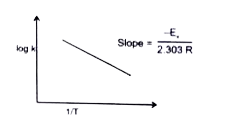
- The activation energy E(a) of a reaction can be calculated by plottin...
Text Solution
|
- Under the same reaction conditions intital concentration of 1.386 mol ...
Text Solution
|
- Plots showing the variation of rate constant (k) with temperature (T) ...
Text Solution
|
- In the reaction, P + Q rarr R + S, the time taken for 75% reaction of...
Text Solution
|
- The activation energy for a reaction which doubles the rate when the t...
Text Solution
|
- Ammonia reacts with oxygen giving nitrogen and water. If the rate of f...
Text Solution
|
- The half-life for the thermal decomposition of acetone 80sand is indep...
Text Solution
|
- The reaction NH(4)^(+)+ OCN^(-) rarr OC (NH(2))(2) , proceeds throug...
Text Solution
|
- Which of the following statements is not correct?
Text Solution
|
- A catalyst lowers the activation energy from 20 kJ mol^(-1) to 15 kJ ...
Text Solution
|
- For a chemical reaction X rarr Y , the rate of reaction increases by a...
Text Solution
|
- The reaction A + 2B + C rarr D occurs by the following mechanism. A ...
Text Solution
|
- The rate equation for 2N(2)O(5) rarr 4NO(2) + O(2) is r = (6.3xx10^(...
Text Solution
|
- A reaction Aoverset(k)rarr product follows half-order kinetics with...
Text Solution
|
- The reaction 2N(2)O(5)((g)rarr4NO(2)(g)+O(2)(g) provides a linear pl...
Text Solution
|
- For a reaction 2NO(g)+H(2)(g)rarrN(2)O(g)+H(2)O(g) the rate law is ...
Text Solution
|
- In the Haber's process of the synthesis of ammonia, the use of catalys...
Text Solution
|