Home
Class 12
CHEMISTRY
The kinetic data for the given reaction ...

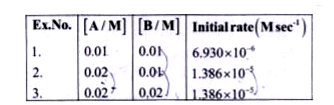
The kinetic data for the given reaction A (g) + 2 B (g) `overset(k)rarr` C (g) is provided in the following table for three experiments at 300 K

In another experiment starting with initial concentration of 0.5 and 1 M respectively for A and B at 300 K, find the rate of reaction after 50 minutes from start of experiment (in M/sec).

A

`6.93xx10^(-4)`

B

`0.25xx10^(-7)`

C

`4.33 xx10^(-5)`

D

`3.46 xx10^(-4)`

Text Solution

Verified by Experts

The correct Answer is:

C

`r_(1)=k[0.01]^(a)[0.01]^(b)=6.93xx10^(-6)` (i)
`r_(2)=k[0.02]^(a)[0.01^(b)=1.386xx10^(-5)` (ii)
`r_(3)k[0.02]^(a)[0.02]^(b)=1.386xx10^(-5)` (iii)
rate of reaction =`6.93 xx10^(-4) xx0.0625 =4.33 xx10^(-5) xx0.0625 =4.33 xx10^(-5) Ms^(-1)`
Promotional Banner

Topper's Solved these Questions

  • CHEMICAL KINETICS

    BRILLIANT PUBLICATION|Exercise LEVEL I|55 Videos
  • CARBOXYLIC ACIDS

    BRILLIANT PUBLICATION|Exercise LEVEL-II (Assertion -Reason)|4 Videos
  • CO-ORDINATION COMPOUNDS AND ORGANOMETALLICS

    BRILLIANT PUBLICATION|Exercise Level-II (Assertion- Reason)|4 Videos

Similar Questions

Explore conceptually related problems

The rate expression for the reaction A (g) + B (g) rarr C (g) is rate = kC_(A)^(2)C_(B)^(1//2) . What changes in the initial concentrations of A and B will cause the rate of reaction to increase by a factor of eight?

For the zero order reaction A to B + C , initial concentration of Ais 0.1 M. lf[A] = 0.08 M after 10 minutes, then its half-life and completion time are respectively:

The reaction A(g)+2B(g) rarrC(g)+D(g) is an elementary process In an experiment the initial partial pressure of A and B are p_(A) =0.60 and p_(B) =0.80 atm when p_(c )=0.2 atm the rate of the reaction relative to the initial rate is

In a first order reaction mathbf(A) rarr (B) if (k) is rate con stant and initial concentration of the reactant A. is 0.5 . M then the.half life is

The rate law for the reaction below is given by the expression k[A][B] A + B to product. If the concentration of B is increased from 0.1 to 0.3 mol, keeping the value of A at 0.1 mol, the rate constant will be

BRILLIANT PUBLICATION-CHEMICAL KINETICS -LEVEL II
  1. For the equilibrium, A(g)rarrB(g), triangleH is - 40 kJ mol^(-1) . If ...

    Text Solution

    |

  2. The rate law for a reaction between the substances A and B is given by...

    Text Solution

    |

  3. The kinetic data for the given reaction A (g) + 2 B (g) overset(k)rarr...

    Text Solution

    |

  4. Reaction A + B rarr C + D follows rate law, r = k[A]^(1//2) [B]^(1//2)...

    Text Solution

    |

  5. The reaction A(g) rarr B(g) + 2C(g) is a first order reaction with ra...

    Text Solution

    |

  6. For a first order homogenous gaseous reaction A rarr2B +C if the tota...

    Text Solution

    |

  7. The gaseous decomposition reaction, A(g) rarr 2B(g) + C(g) is observed...

    Text Solution

    |

  8. A gaseous compound A reacts by three independent first order processes...

    Text Solution

    |

  9. A compound 'A' dissociate by two parallel first order paths atcertain ...

    Text Solution

    |

  10. The reaction cis- X underset(k(b))⇌overset(k(f)) trans-X is first o...

    Text Solution

    |

  11. For first order parallel reactions k(1) and k(2) are 4 and 2 min^(- ...

    Text Solution

    |

  12. Consider the following first order competing reactions: X overset(k(...

    Text Solution

    |

  13. A reactant (A) forms two products (Assume that A(1) = A(2) , which are...

    Text Solution

    |

  14. Which of the following graphs is correct for the following reaction? ...

    Text Solution

    |

  15. A reaction takes place in three steps with individual rate constant an...

    Text Solution

    |

  16. A drug becomes ineffective after 30% decomposition. The original conce...

    Text Solution

    |

  17. On introducing a catalyst at 500 K, the rate of a first order reaction...

    Text Solution

    |

  18. For a reaction A + B rarr C + D,if the concentration of A is doubled w...

    Text Solution

    |

  19. The bromination of acetone that occurs in acid solution is represen...

    Text Solution

    |

  20. The decomposition of N(2)O(5) according to the equation, 2N(2)O(5) (g...

    Text Solution

    |
