Home
Class 12
CHEMISTRY
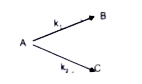
For first order parallel reactions k(1) ...

For first order parallel reactions `k_(1)` and `k_(2)` are 4 and 2 `min^(- 1)` respectively at 300 K.. If the activation energies for the formation of B and C are respectively 30,000 and 38,314 joule/mol respectively. The temperature at which B and C will be obtained in equimolar ratio is:

A

757.48 k

B

378.74 k

C

600 k

D

450 k

Text Solution

Verified by Experts

The correct Answer is:

B

`In (k_(1))/(k_(1))=(E_(1))/(R )[(1)/(T_(1))-(1)/(T_(2))]`
(for equimolar formation of B and C `k_(2)=k_(1))`
In `(k_(1))/(k_(2))=(8314)/(8.314)(T_(2)-300)/(300xxT_(2)) In 2=(1000)(T_(2)-300)/(300xxT_(2)) T_(2)=378.74 k`
Promotional Banner

Topper's Solved these Questions

  • CHEMICAL KINETICS

    BRILLIANT PUBLICATION|Exercise LEVEL I|55 Videos
  • CARBOXYLIC ACIDS

    BRILLIANT PUBLICATION|Exercise LEVEL-II (Assertion -Reason)|4 Videos
  • CO-ORDINATION COMPOUNDS AND ORGANOMETALLICS

    BRILLIANT PUBLICATION|Exercise Level-II (Assertion- Reason)|4 Videos

Similar Questions

Explore conceptually related problems

For the first order reaction A to B + C , carried out at 27°C, 3.8 xx 10^(-16) % of the reactant molecules exists in the activated state. The E_a (activation energy) of the reaction is:

Critical temperatures of ammonia and CO_2 are 405.5K and 304K respectively. On cooling these gases from 500K, which gas will liquify first?

Rate contant k_2 of a reaction at 310 K is two time of its rate constant k_1 at 300 K.Calculate activation energy of the reaction.(log 2=0.3010,log 1=0)

For the reaction Ag_2O -> 2Ag+ frac{1}{2} O_2 (g) DeltaS and Delta H are 6.66J K^-1mol^-1 and 30.56 kJ mol^-1 respectively. The reaction will not be spontaneous at what temperature

For a reaction A + Brarr C + D . The order with respect to A is 1 and that of B is 2. How is the rate affected when the concentration of both A and B are doubled?

The position vectors of three points A,B,C are given to be i+3j+3k , 4i+4k , -2i+4j+2k respectively.Find vec(AB) and vec(AC)

A reaction has value of Delta H = -40 kcal mol^(-1) at 400 K. Below 400 K the reaction is spontaneous and above 400 K it is not. The value of DeltaG and Delta S at 400 K are respectively

BRILLIANT PUBLICATION-CHEMICAL KINETICS -LEVEL II
  1. A compound 'A' dissociate by two parallel first order paths atcertain ...

    Text Solution

    |

  2. The reaction cis- X underset(k(b))⇌overset(k(f)) trans-X is first o...

    Text Solution

    |

  3. For first order parallel reactions k(1) and k(2) are 4 and 2 min^(- ...

    Text Solution

    |

  4. Consider the following first order competing reactions: X overset(k(...

    Text Solution

    |

  5. A reactant (A) forms two products (Assume that A(1) = A(2) , which are...

    Text Solution

    |

  6. Which of the following graphs is correct for the following reaction? ...

    Text Solution

    |

  7. A reaction takes place in three steps with individual rate constant an...

    Text Solution

    |

  8. A drug becomes ineffective after 30% decomposition. The original conce...

    Text Solution

    |

  9. On introducing a catalyst at 500 K, the rate of a first order reaction...

    Text Solution

    |

  10. For a reaction A + B rarr C + D,if the concentration of A is doubled w...

    Text Solution

    |

  11. The bromination of acetone that occurs in acid solution is represen...

    Text Solution

    |

  12. The decomposition of N(2)O(5) according to the equation, 2N(2)O(5) (g...

    Text Solution

    |

  13. At 500 K, the half life period of a gaseous reaction at an initial pre...

    Text Solution

    |

  14. At a certain temperature, the half change period for the catalytic dec...

    Text Solution

    |

  15. According to the collision model of kinetics, certain activtion energy...

    Text Solution

    |

  16. The radioactive element, Thallium-201, is used medicinally as a radiot...

    Text Solution

    |

  17. For a reaction A rarr Product half-life measured for two different ...

    Text Solution

    |

  18. The metabolism of an antibiotic, A,is a first-order rate process. The ...

    Text Solution

    |

  19. 80% of a first order reaction was completed in 70 min. How much it wil...

    Text Solution

    |

  20. A first order reaction: A rarr Products and a second order reaction: ...

    Text Solution

    |
