

Home
Class 11
PHYSICS
Figure 3.24 gives the x-t plot of a part...

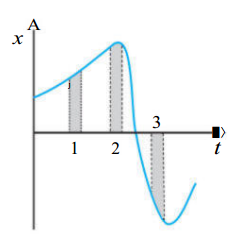
Figure 3.24 gives the x-t plot of a particle in one-dimensional motion. Three different equal intervals of time are shown. In which interval is the average speed greatest, and in which is it the least ? Give the sign of average velocity for each interval.

Promotional Banner

Topper's Solved these Questions

  • MOTION IN A STRAIGHT LINE

    MBD|Exercise EXERCISE|14 Videos
  • MOTION IN A PLANE

    MBD|Exercise EXERCISE|17 Videos
  • MOTION OF SYSTEM OF PARTICLES AND RIGID BODY

    MBD|Exercise EXERCISE|15 Videos

Similar Questions

Explore conceptually related problems

In the figure gives a speed-time graph of a particle in motion along a constant direction. Three equal intervals of time are shwon. In which interval is the average acceleration greatest in magnitude ? In which interval is the average speed greatest ? Choosing the positive direction as the constant direction of motion, give the signs of v and a in the three intervals. What are the acceleration at the points A,B,C and D?

Figure 3.23 gives the x-t plot of a particle executing one-dimensional simple harmonic motion. (You will learn about this motion in more detail in Cliapterl4). Give the signs of position, velocity and acceleration variables of the particle at t = 0.3 s, 1.2 s, - 1.2 s.

Read each statement below carefully and state with reasons, if it is true or false: the average speed of a particle is either greater than or equal to the magnitude of average velocity of the particle over the same interval of time.

In the figure gives the (x-t) plot of a particle executign one-dimensional simple harmonic motion. Give the signs of position, velocity and acceleration variables of the particle at t = 0.3 s, 1.2 s, - 1.2 s.

Read each statement below carefully and state with reasons, if it is true or false :- the average speed of a particle (defined as total path length divided by the time taken to cover the path) is either greater or equal to the magnitude of average velocity of the particle over the same interval of time,

Figure 3.21 shows the x-t plot of one-dimensional 4 motion of a particle. Is it correct to say from the graph that the particle moves in a straight line for t 0 ? If not, suggest a suitable physical context for this graph.

The velocity-time graph of a particle in one-dimensional motion is shown in Fig. 3.29 :- Which of the following formulae are correct for describing the motion of the particle over the time-interval:- v(t_2)=v(t_1) + a (t_2 - t_1)

Define displacement of a particle in linear motion in one dimension. Does it depend upon the origin? Can actual distance travelled by object in the time interval t to t' be greater than or equal to the magnitude of the displacement?