

Home
Class 11
PHYSICS
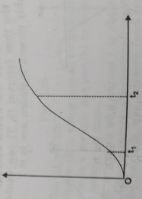
The velocity-time graph of particle in o...

The velocity-time graph of particle in one dimensional motion is shown in the fig.

Which if the following formulae are correct for describing the motion of the pawrticle over the time interval `t_1 to t_2`
`v(t_2) = v(t_1) + a(t_2 - t_2)`, `v_(average) = ([x(t_2) - x(t_1)])/((t_2 - t_1))`, ` x(t_2) - x(t_1) `= area under the v - t curve. bounded by the t-axis and the dotted line shown.

Promotional Banner

Topper's Solved these Questions

  • MOTION IN A STRAIGHT LINE

    MBD|Exercise EXERCISE|14 Videos
  • MOTION IN A PLANE

    MBD|Exercise EXERCISE|17 Videos
  • MOTION OF SYSTEM OF PARTICLES AND RIGID BODY

    MBD|Exercise EXERCISE|15 Videos

Similar Questions

Explore conceptually related problems

The velocity-time graph of a particle in one-dimensional motion is shown in Fig. 3.29 :- Which of the following formulae are correct for describing the motion of the particle over the time-interval:- v(t_2)=v(t_1) + a (t_2 - t_1)

The velocity-time graph of a particle in one-dimensional motion is shown in Fig. 3.29 :- Which of the following formulae are correct for describing the motion of the particle over the time-interval:- v_average=(x(t_2) - x(t_1))/(t_2 - t_1)

The velocity-time graph of a particle in one-dimensional motion is shown in Fig. 3.29 :-Which of the following formulae are correct for describing the motion of the particle over the time-interval t_1 to t_2 :- x(t_2)=x(t_1)+v(t_1)(t_2-t_1)+(1/2)a(t_2-t_1)^2

The velocity-time graph of a particle in one-dimensional motion is shown in Fig. 3.29 :- Which of the following formulae are correct for describing the motion of the particle over the time-interval:- x(t_2)=x(t_1)+v_average(t_2-t_1)+(1/2) a_average(t_2-t_1)^2

The velocity-time graph of a particle in one-dimensional motion is shown in Fig. 3.29 :- Which of the following formulae are correct for describing the motion of the particle over the time-interval:- x(t_2)-x(t_1) area under the v-t curve bounded by the t-axis and the dotted line shown.

For any arbitrary motion in space, which of the following relations are true :- v(t)=v(O)+a t (The ‘average’ stands for average of the quantity over the time interval t_1 to t_2 )

For any arbitrary motion in space, which of the following relations are true :- a_averag[v(t_2)-v(t_1)]/(t_2-t_1) (The ‘average’ stands for average of the quantity over the time interval t_1 to t_2 )

For any arbitrary motion in space, which of the following relations are true :- v_average=(1/2) (v(t_1))+(v(t_2)) (The ‘average’ stands for average of the quantity over the time interval t_1 to t_2 )

For any arbitrary motion in space, which of the following relations are true :- v_average=[r(t_2)-r(t_1)/(t_2-t_1) (The ‘average’ stands for average of the quantity over the time interval t_1 to t_2 )

For any arbitrary motion in space, which of the following relations are true :- r(t)=r (O)+v(O) t+(1/2) a t^2 (The ‘average’ stands for average of the quantity over the time interval t_1 to t_2 )