

Home
Class 11
PHYSICS
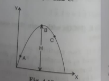
A particle is projected in air at some a...

A particle is projected in air at some angle to the horizontal , moves along parabola shown in the figure where x and y indicate horizontal and verticle diections, respectively. Shown in the diagram, direction of velocity and acceleration at point A,B and C.

Promotional Banner

Topper's Solved these Questions

Similar Questions

Explore conceptually related problems

A mass M of 100 kg is suspended with the use of strings A,B and C as shown in the figure,where W is the vertical wall and R is a rigid horizontal rod.The tension in the sttring B is : .

Two identical plane metallic surfaces A and B are kept parallel to each other in air separated by a distance of 10 cm as shown in Figure. Surface A is given a positive Potential of 10 V and outer surface of B is earthed. What is the magnitude and directions of uniform electric field between points Y and Z?

In the figure gives a speed-time graph of a particle in motion along a constant direction. Three equal intervals of time are shwon. In which interval is the average acceleration greatest in magnitude ? In which interval is the average speed greatest ? Choosing the positive direction as the constant direction of motion, give the signs of v and a in the three intervals. What are the acceleration at the points A,B,C and D?

An electron moves along x direction. It enters into a region of uniform magnetic field B directed along -z direction as shown in the figure. Draw the shape of trajectory followed by the electron after entering the field.

If a particle of charge q is moving with velocity v along x-axis and the magnetic field B is acting along Y-axis, use the expression vecF=q(vecv xx vecB) to find the direction of force vecF acting on it.

A cyclist starats from centre O of a circular park of radius 1 km and moves along the path OPRQO as shown in the figure.If he maintains constant speed of 10 ms^(-1) , what is his acceleration at point R in magnitude and direction?

A uniform electric field of strength 2xx10^3NC^-1 is established between two parallel plates of length 0.1 m held horizontally at a distance 0.02 m apart. An electron is projected at a speed of 6xx10^6 ms^-1 making an angle 45^@ as shown in the figure The field is directed vertically upwards. Will the electron strike the either plate? If it strikes the plate, where does it do so?

A man leaves his home early in the morning to have a walk. He arrives at a junction of roads A and B as shown in figure. He takes the following steps in later journies : (i) 1 km in North direction. (ii) Changes direction and moves in North-East direction for 2 sqrt(2) km. (iii) Changes direction and moves Southwards for distance of 2 km. (iv) Finally he changes the direction and moves in South-East direction to reach road A again. Now if roads A and B are taken as X-axis and y-axis ,then visible point representing the graph of y=f(x) Then the value of x at which function f(x) is discontinous

A man leaves his home early in the morning to have a walk. He arrives at a junction of roads A and B as shown in figure. He takes the following steps in later journies : (i) 1 km in North direction. (ii) Changes direction and moves in North-East direction for 2 sqrt(2) km. (iii) Changes direction and moves Southwards for distance of 2 km. (iv) Finally he changes the direction and moves in South-East direction to reach road A again. Now if roads A and B are taken as X-asix and Y-axis, then visible point representing the graph of y = f(x). Then the value of x at which function f(x) is discontionous

A man leaves his home early in the morning to have a walk. He arrives at a junction of roads A and B as shown in figure. He takes the following steps in later journies : (i) 1 km in North direction. (ii) Changes direction and moves in North-East direction for 2 sqrt(2) km. (iii) Changes direction and moves Southwards for distance of 2 km. (iv) Finally he changes the direction and moves in South-East direction to reach road A again. Now if roads A and B are taken as X-asix and Y-axis, then visible point representing the graph of y = f(x). Then the value of x at which function f(x) is discontionous