

Home
Class 11
PHYSICS
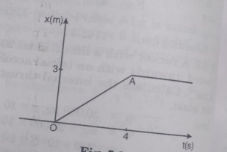
The fig shows the position the position-...

The fig shows the position the position- time graph of a particle of mass 4 kg. What is the

Impulse at t = 0 and t = 4 s : (consider one-dimensional motion only).

Promotional Banner

Topper's Solved these Questions

Similar Questions

Explore conceptually related problems

Figure shows the position-time graph of a particle of mass 4 kg. What is the:- mpulse at t = 0 and t = 4 s ? (Consider one-dimensional motion only).

The fig shows the position the position- time graph of a particle of mass 4 kg. What is the Force on the particle for t 4s, impulse 0 < t < 4 s ?

Figure shows the position-time graph of a particle of mass 4 kg. What is the:-force on the particle for t 4 s, 0

The position time graph of a body of mass 2 kg is as given in the figure. What iws the impulse on the body at t = 0 s and t = 4 s.

What is common among two position - time graphs in fig.? .

Explain clearly, with examples, the distinction between :- magnitude of average velocity over an interval of time, and the average speed over the same interval. [Average speed of a particle over an interval of time is defined as the total path length divided by the time interval]. Show in both (a) and (b) that the second quantity is either greater than or equal to the first. When is the equality sign true ? [For simplicity, consider one-dimensional motion only].

Figure 5.17 shows the position-time graph of a body of mass 0.04 kg. Suggest a suitable physical context for this motion. What is the time between two consecutive impulses received by the body ? What is the magnitude of each impulse ?

The motion of a particle of mass m is given by x = 0 for t 0), and x = 0 for t > (1/4) s. which of the following statements is true?/

MBD-LAWS OF MOTION-EXAMPLE
  1. A man of mass 70 kg stands on a weighing scale in a lift which is movi...

    Text Solution

    |

  2. The fig shows the position the position- time graph of a particle of m...

    Text Solution

    |

  3. The fig shows the position the position- time graph of a particle of m...

    Text Solution

    |

  4. Two bodies of masses 10 kg and 20 kg respectively kept on a smooth, ho...

    Text Solution

    |

  5. Two bodies of masses 10 kg and 20 kg respectively kept on a smooth, ho...

    Text Solution

    |

  6. Two masses 8 kg and 12 kg are connected at the two ends of a light ine...

    Text Solution

    |

  7. A nucleus is at rest in the laboratory frame of reference. Show that i...

    Text Solution

    |

  8. Two billiard balls each of mass 0.05 kg moving in opposite directions ...

    Text Solution

    |

  9. A shell of mass 0.020 kg is fired by a gun of mass 100 kg. If the muzz...

    Text Solution

    |

  10. A batsman deflects a ball by an angle of 45^@ without changing its ini...

    Text Solution

    |

  11. A stone of mass 0.25 kg tied to the end of a string is whirled round i...

    Text Solution

    |

  12. If, in Exercise 5.21, the speed of the stone is increased beyond the m...

    Text Solution

    |

  13. If, in Exercise 5.21, the speed of the stone is increased beyond the m...

    Text Solution

    |

  14. If, in Exercise 5.21, the speed of the stone is increased beyond the m...

    Text Solution

    |

  15. Explain why:- a horse cannot pull a cart and run in empty space.

    Text Solution

    |

  16. Explain why:- passengers are thrown forward from their seats when a sp...

    Text Solution

    |

  17. Explain why:- it is easier to pull a lawn mower than to push it.

    Text Solution

    |

  18. Explain why:- a cricketer moves his hands backwards while holding a ca...

    Text Solution

    |

  19. Figure 5.17 shows the position-time graph of a body of mass 0.04 kg. S...

    Text Solution

    |

  20. A helicopter of mass 1000 kg rises with a vertical acceleration of 15 ...

    Text Solution

    |