

Home
Class 11
PHYSICS
A stone of mass mtied to the end of a st...

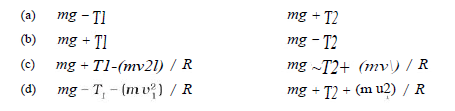
A stone of mass mtied to the end of a string revolves in a vertical circle of radius R. The net forces at the lowest and highest points of the circle directed vertically downwards are : [Choose the correct alternative] `T_1 and v_1` denote the tension and speed at the lowest point. `T_2 and v_2` denote corresponding values at the highest point.

Promotional Banner

Topper's Solved these Questions

Similar Questions

Explore conceptually related problems

A 14.5 kg mass, fastened to the end of a steel wire of unstretched length 1.0 m, is whirled in a vertical circle with an angular velocity of 2 rev//s at the bottom of the circle. The cross-sectional area of the wire is 0.065 cm^2 . Calculate the elongation of the wire when the mass is at the lowest point of its path.

A small stone of mass 200 g is tied to one end of a string of length 80 cm . Holding the other end in hand , the stone is whirled into a vertical circle What is the minimum speed that needs to be imparted at the lowest point of the circular path , so that the stone is just able to complete the vertical circle ? what would be the tension at the lowest point of circular path ? (Take g = 10 m//s^(2) ) .

One end of a string of length t is connected to a particle of mass m and the other to a small peg on a smooth horizontal table. If the particle moves in a circle with speed v the net force on the particle (directed towards the centre) is : T is the tension in the string. [Choose the correct alternative].

A small stone, of mass 0.2 kg, tied to a massless, inextensible string, is rotated in vertical circle of radius 2 m. if the particle is just able to complete the vertical circle, what is its speed at the highest point of its circular path? How would this speed get effected if the mass of the stone is increased by 50%? (Take g = 10 ms^(-2) )

A particle of mass 150 g is attached to one end of a massless inextensible string It is made to describe a vertical circle of radius 1 m When the string is making an angle of 48.2^(@) with the vertical , its instantaneous speed is 2 m//s What is the tension in the string in this position ? Would this particle be able to complte its circular path?(Take g=10 m s^(-2) ).

The stone of mass 100 g is suspended from the end of a weightless string of length 100 cm and is allowed to swing in a vertical plane.The speed of the mass is 2 m s^-1 when the string makes an angle of 60^@ with the vertical .Calculate the tension in the string at theta = 60^@ .Also,caculate the speed of the stone when it is in the lowest poition. (g=9.8 m s^(-2) ) .

A massless string of length 1.2 m, has a breaking strength of 2 kg wt. A stone of mass 0.4 kg, tied to one end of the string, is made to move in a vertical circle, by holding the other end in the hand. Can the particle describe the vertical circle? (Take g = 10 m s^-2 )

O is the origin and A is a fixed point on the circle of radius 'a' with centre O.The vector vec O A is denoted by vec a . A variable point P lie on the tangent at A and vec OP=vec r. Show that vec a vec r=a^2. Hence if P(x, y) and A(x_1, y_1), deduce the equation of tangent at A to this circle.

Two parallel vertical metallic rails AB and CD are separated by 1m. They are connected at the two ends by resistances R_1 and R_2 as shown in the figure. A horizontal metallic bar 1 of mass 0.2 kg slides without friction, vertically down the rails under the action of gravity. There is a uniform horizontal magnetic field of 0.6 T perpendicular to the plane of the rails. It is observed that when the terminal velocity is attained, the powers dissipated in R_1 and R_2 are 0.76W and 1.2W respectively (g=9.8m//s^2) The value of R_2 is

ABCD is a square of side length 2 units. C_(1) is the circle touching all the sides of the square ABCD and C_(2) is the circumcircle of square ABCD. L is a fixed line in the same plane and R is fixed point. A line L' through a is drawn parallel to BD. Point S moves scuh that its distances from the line BD and the vertex A are equal. If loucs S cuts L' at T_(2)andT_(3) and AC at T_(1) , then area of DeltaT_(1)T_(2)T_(3) is

MBD-LAWS OF MOTION-EXAMPLE
  1. What is a simple pendulum? Obtin expression for its angular accelerati...

    Text Solution

    |

  2. Derive the expression for acceleration and tension in a string in a co...

    Text Solution

    |

  3. A stone of mass mtied to the end of a string revolves in a vertical ci...

    Text Solution

    |

  4. A bullet of mass 0.04 kg moving with a speed of 90 ms^-1 enters a heav...

    Text Solution

    |

  5. A rocket of initial mass 6000 kg ejects mass at a constant rate of 16 ...

    Text Solution

    |

  6. A mass of 4 kg rests on a horizontal plane. The plane is gradually inc...

    Text Solution

    |

  7. What is the acceleration of the block and trolley system shown in the ...

    Text Solution

    |

  8. The upper half of an inclined plane with inclination theta is perfectl...

    Text Solution

    |

  9. A piece of uniform string hangs vertically so that its free end just t...

    Text Solution

    |

  10. Two particles of equal masses m and m are connected by a light string ...

    Text Solution

    |

  11. The total mass of an elevator with a 80 kg man in it is 1000 kg. This ...

    Text Solution

    |

  12. The total mass of an elevator with a 80 kg man in it is 1000 kg. This ...

    Text Solution

    |

  13. A truck starts from rest and accelerates uniformly at 2.0 m s^-2. At t...

    Text Solution

    |

  14. A truck starts from rest and accelerates uniformly at 2.0 m s^-2. At t...

    Text Solution

    |

  15. Is linear momentum a scalar or a vector quantity?

    Text Solution

    |

  16. Rockets can move in airfree space but jet planes cannot. Why?

    Text Solution

    |

  17. Is earth an inertial frame of reference?

    Text Solution

    |

  18. Why are tyres made circular?

    Text Solution

    |

  19. Is friction independent of actual area orf contact?

    Text Solution

    |

  20. Carts with rubber wheels are easier to ply than those with iron wheels...

    Text Solution

    |