

Home
Class 11
PHYSICS
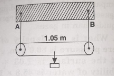
A rod of length 1.05 m having negligible...

A rod of length 1.05 m having negligible mass is supported at its ends by two wires of steel (wire A) and aluminium (wire B) of equal length as shown in the figure The cross sectional area of wires A and B are `1.0 mm^2` and `2.0 mm^2`, respectivley. AT wat point along the rod should a mass m be suspended in order to produce .equal stresses.

Promotional Banner

Topper's Solved these Questions

  • MECHANICAL PROPERTIES OF SOLIDS

    MBD|Exercise EXERCISE|14 Videos
  • MECHANICAL PROPERTIES OF FLUID

    MBD|Exercise EXERCISE|14 Videos
  • MODEL PAPER 1

    MBD|Exercise EXERCISE|49 Videos

Similar Questions

Explore conceptually related problems

A rod of length 1.05 m having negligible mass is supported at its ends by two wires of steel (wire A) and aluminium (wire B) of equal length as shown in the figureThe cross sectional area of wires A and B are 1.0 mm^2 and 2.0 mm^2 , respectivley. AT wat point along the rod should a mass m be suspended in order to produce equal strains in both steel and aluminium wires?

A rod of length 1.05 m having negligible mass is supported at its ends by two wires of steel (wire A) and aluminium (wire B) of equal lengths as shown in Fig. 9.15. The cross-sectional areas of wires A and B are 1.0 mm^2 and 2.0 mm^2 , respectively. At what point along the rod should a mass m be suspended in order to produce equal strains in both steel and aluminium wires.:

A rod of length 1.05 m having negligible mass is supported at its ends by two wires of steel (wire A) and aluminium (wire B) of equal lengths as shown in Fig. 9.15. The cross-sectional areas of wires A and B are 1.0 mm^2 and 2.0 mm^2 , respectively. At what point along the rod should a mass m be suspended in order to produce (a) equal stresses :

A rod of length l and negligible mass is suspended at its two ends by two wires of steel (wire A ) and aluminium (wire B) of equal length (shown in the figure) The cross-sectional areas of wires A and B are 1.0 mm^2 and 2.0 mm^2 , respectively. (Y_(AL) = 70 xx 10^9 N m^-2 and y _(steel) = 200 xx 10^9 N m^-2)

A 14.5 kg mass, fastened to the end of a steel wire of unstretched length 1.0 m, is whirled in a vertical circle with an angular velocity of 2 rev//s at the bottom of the circle. The cross-sectional area of the wire is 0.065 cm^2 . Calculate the elongation of the wire when the mass is at the lowest point of its path.

A stell wire of length 4 m ,is stretched through 2 mm ,.The corss - sectional area of the wire is 2.0 mm^2 .If young's modulus of steel si 2.0 xx 10 ^11 N//^2 find the energy density of the wire

A stell wire of length 4 m ,is stretched through 2 mm ,.The corss - sectional area of the wire is 2.0 mm^2 .If young's modulus of steel si 2.0 xx 10 ^11 N//^2 find The elastic potential energy stored in the wire.

A thin rod having length L_0 at 0^@C and coefficient of lineare expansion alpha has its two ends maintained at temperatures theta_1 and theta_2 , respectivley. Find its new length.

A mild steel wire of length 2L and cross-sectional area A is stretched, well within elastic limit, horizontally between two pilars show in the figure A mass m is suspended from the mid point of the wire. Strain in the wire is .

Two wires of diameter 0.25 cm, one made of steel and the other made of brass are loaded as shown in Fig. 9.13. The unloaded length of steel wire is 1.5 m and that of brass wire is 1.0 m. Compute the elongations of the steel and the brass wires: