

Home
Class 11
PHYSICS
Consider a long steel bar under a tensil...

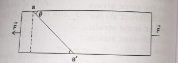
Consider a long steel bar under a tensile stress due to forces `vecF` acting at the edge a along the length of the bar (show in the figure)

Consider a plane making an angle `theta` with the length. What are the tensile and shearing stresses on this plane?
For what angle is the shearing stress a maximum?

Promotional Banner

Topper's Solved these Questions

  • MECHANICAL PROPERTIES OF SOLIDS

    MBD|Exercise EXERCISE|14 Videos
  • MECHANICAL PROPERTIES OF FLUID

    MBD|Exercise EXERCISE|14 Videos
  • MODEL PAPER 1

    MBD|Exercise EXERCISE|49 Videos

Similar Questions

Explore conceptually related problems

Consider a long steel bar under a tensile stress due to forces vecF acting at the edge a along the length of the bar (show in the figure) Consider a plane making an angle theta with the length. What are the tensile and shearing stresses on this plane? For what angle is the tensile stress a maximum?

Consider a uniform electric field vecE = 3 xx 10^3 hati N C^-1 What is the flux through the same square, if the normal to its plane makes a 60^@ angle with the X-axis?

Consider a uniform electric field E = 3 xx 10^3 hat 1 N//C . - What is the flux through the square of 10 cm if the normal to its plane makes a 60^@ angle with the x-axis?

A straight segment OC(of length L meter) of a circuit carrying a current I amp is placed along the x- axis ( fig.). Two infinitely long straight wires A and B , each extending from z = -oo to +oo , are fixed at y = -a meter and y = +a meter respectively, as shown in the figure. If the wires A and B each carry a current I amp into the plane of the paper, obtain the expression for the force acting on the segment OC. What will be the force on OC if the current in the wire B is reversed?

What is the force on a wire of length 4.0 cm placed inside a solenoid near its centre, making an angle 30^@ with its axis? The wire carries a current of 12 A and the magnetic field due to the solenoid has a magntiude of 0.25 T.

A short bar magnet placed in a horizontal plane has its axis aligned along the magnetic north-south direction. Null points are found on the axis of the magnet at 14 cm from the centre of the magnet. The earth’s magnetic field at the place is 0.36 G and the angle of dip is zero. What is the total magnetic field on the normal bisector of the magnet at the same distance as the null-point (i.e., 14 cm) from the centre of the magnet? (At null points, field due to a magnet is equal and opposite to the horizontal component of earth’s magnetic field.)

A current of 10 A flow around a closed path in a circuit which is in the horizontal plane as shown in the figure. The circuit consists of eight alternative arcs of radii r_(1)=0.08m and r_(2)=0.12m . Each subtends the same angle at the centre. An infinitely long straight wire carrying a current of 10 A is passing throgh the entre of the above circuit vertically with the direction of the current being into the plane of the circuit. What is the force acting on the wire at the centre due to the current in the circuit? What is the force acting on the arc AC and the straight segment CD due to the current at the centre?

A rectangular box lies on a rough inclined surface at theta . The co-efficient of friction between the surface and the box is mu. Let the mass of the box is m. What is the force acting on the box down the plane, if the angle of inclination of the plane is increased to alpha>theta ?

A short bar magnet is placed in a horizontal plane with its axis in the magnetic merdian . Null points are found on its equitorial line (i.e., its normal bisector) at 12.5 cm and the earth's magnetic field at the place is 0.38 G the angle of dip is zero. (i) What is the total magnetic field at points on the axis of the magnet located by the same distance (12.5 cm) as the null-points from the centre? (ii) Locate the null points when the magnet is turned around by 180^(@) . Assume that the length of the magnet is negligible as compared to the distance of the null-point from the centre of the magnet.