

Home
Class 11
PHYSICS
A spring having with a spring constant 1...

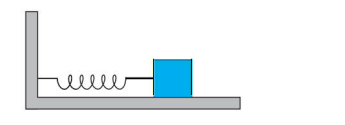
A spring having with a spring constant `1200 N m^-1` is mounted on a horizontal table as shown in Fig. 14.24. A mass of 3 kg is attached to the free end of the spring. The mass is then pulled sideways to a distance of 2.0 cm and released.Determine the frequency of oscillations,

Promotional Banner

Topper's Solved these Questions

  • OSCILLATIONS

    MBD|Exercise EXERCISE|11 Videos
  • MOTION OF SYSTEM OF PARTICLES AND RIGID BODY

    MBD|Exercise EXERCISE|15 Videos
  • PHYSICAL WORLD

    MBD|Exercise EXERCISE|19 Videos

Similar Questions

Explore conceptually related problems

A spring having with a spring constant 1200 N m^-1 is mounted on a horizontal table as shown in Fig. 14.24. A mass of 3 kg is attached to the free end of the spring. The mass is then pulled sideways to a distance of 2.0 cm and released.Determine the maximum speed of the mass

A spring having with a spring constant 1200 N m^-1 is mounted on a horizontal table as shown in Fig. 14.24. A mass of 3 kg is attached to the free end of the spring. The mass is then pulled sideways to a distance of 2.0 cm and released.Determine maximum acceleration of the mass,

Two bodies of masses 1 kg and 3 kg respectively are connected rigidly by a vertical spring. The body of mass 3 kg rests on a smooth horizontal surface. The force constant of the spring is 484Nm^(-1) . From the equilibrium position, the mass of 1 kg is displaced vertically through a distance of 0.02 m and then released. calculate (i) and frequency of oscillation of the mass of 1 kg (ii) the maximum velocity of this mass (iii) its oscillation energy and (iv) the reaction of the table on the mass of 3 kg, when mass 1 kg is having harmonic oscillations.

Figure 14.26 (a) shows a spring of force constant k clamped rigidly at one end and a mass m attached to its free end. A force F applied at the free end stretches the spring. Figure 14.26 (b) shows the same spring with both endsfree and attached to a mass m at either end. Each end of the spring in Fig. 14.26(b) is stretched by the same force F If the mass in Fig. (a) and the two masses in Fig. (b) are released, what is the period of oscillation in each case ?

A steel wire of mass mu per unit length with a circular cross section has a radius of 0.1 cm. The wire is of length 10 m when measured lying horizontal, and hangs from a hook on the wall. A mass of 25 kg is hung from the free end of the wire. Assuming the wire to be uniform and lateral strains < < longitudinal strains, find the extension in the length of the wire. The density of steel is 7860 kg m^-3 (Young's modulues Y = 2 xx 10^11 N m^-2)

Two springs are joined and connected to a mass m . If the spring force constants are k_1 and k_2 show that the frequency of oscillation of mass m is

A 1 kg block situated on a rough incline is connected to a spring of spring constant 100N m^-1 as shown in Fig. 6.17. The block is released from rest with the spring in the unstretched position. The block moves 10 cm down the incline before coming to rest. Find the coefficient of friction between the block and the incline. Assume that the spring has a negligible mass and the pulley is frictionless.