

Home
Class 11
PHYSICS
A spring having with a spring constant 1...

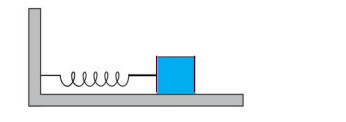
A spring having with a spring constant `1200 N m^-1` is mounted on a horizontal table as shown in Fig. 14.24. A mass of 3 kg is attached to the free end of the spring. The mass is then pulled sideways to a distance of 2.0 cm and released.Determine the maximum speed of the mass

Promotional Banner

Topper's Solved these Questions

  • OSCILLATIONS

    MBD|Exercise EXERCISE|11 Videos
  • MOTION OF SYSTEM OF PARTICLES AND RIGID BODY

    MBD|Exercise EXERCISE|15 Videos
  • PHYSICAL WORLD

    MBD|Exercise EXERCISE|19 Videos

Similar Questions

Explore conceptually related problems

A spring having with a spring constant 1200 N m^-1 is mounted on a horizontal table as shown in Fig. 14.24. A mass of 3 kg is attached to the free end of the spring. The mass is then pulled sideways to a distance of 2.0 cm and released.Determine maximum acceleration of the mass,

A spring having with a spring constant 1200 N m^-1 is mounted on a horizontal table as shown in Fig. 14.24. A mass of 3 kg is attached to the free end of the spring. The mass is then pulled sideways to a distance of 2.0 cm and released.Determine the frequency of oscillations,

A steel wire of mass mu per unit length with a circular cross section has a radius of 0.1 cm. The wire is of length 10 m when measured lying horizontal, and hangs from a hook on the wall. A mass of 25 kg is hung from the free end of the wire. Assuming the wire to be uniform and lateral strains < < longitudinal strains, find the extension in the length of the wire. The density of steel is 7860 kg m^-3 (Young's modulues Y = 2 xx 10^11 N m^-2)

Figure 14.26 (a) shows a spring of force constant k clamped rigidly at one end and a mass m attached to its free end. A force F applied at the free end stretches the spring. Figure 14.26 (b) shows the same spring with both endsfree and attached to a mass m at either end. Each end of the spring in Fig. 14.26(b) is stretched by the same force F If the mass in Fig. (a) and the two masses in Fig. (b) are released, what is the period of oscillation in each case ?

When a mass is attached to a spring, its length is increased by 20 cm. It is now further lowered and releases. The time period is

A long straight wire carrying current of 25 A rests on a table as shown in Fig. EP 4.22. Another wire PQ of length 1m, mass 2.5 g carries the same current but in the opposite direction. The wire PQ is free to slide up and down. To what height will PQ rise?

Figure 14.26 (a) shows a spring of force constant k clamped rigidly at one end and a mass m attached to its free end. A force F applied at the free end stretches the spring. Figure 14.26 (b) shows the same spring with both endsfree and attached to a mass m at either end. Each end of the spring in Fig. 14.26(b) is stretched by the same force F What is the maximum extension of the spring in the two cases ?