Home
Class 12
PHYSICS
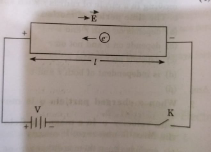
Drift velocity in a metallic conductor: ...

Drift velocity in a metallic conductor:
At room temperature there are large number of free electrons having zero average velocity, but when electric field is applied, the free electrons start moving in a direction opposite to the direction of the applied field with a velocity called drift velocity.

The magnitude of drift velocity is

A

`10^5 to 10^6ms^-1`

B

`0.1 ms^-1`

C

zero

D

unknown.

Text Solution

Verified by Experts

Promotional Banner

Similar Questions

Explore conceptually related problems

Drift velocity in a metallic conductor: At room temperature there are large number of free electrons having zero average velocity, but when electric field is applied, the free electrons start moving in a direction opposite to the direction of the applied field with a velocity called drift velocity. The magnitude of electric field set up across the ends of the conductor is given by

Drift velocity in a metallic conductor: At room temperature there are large number of free electrons having zero average velocity, but when electric field is applied, the free electrons start moving in a direction opposite to the direction of the applied field with a velocity called drift velocity. Magnitude of acceleration produced in each electron by the electric field is

Drift velocity in a metallic conductor: At room temperature there are large number of free electrons having zero average velocity, but when electric field is applied, the free electrons start moving in a direction opposite to the direction of the applied field with a velocity called drift velocity. Mobility of free electron is

A large number of free electrons are present in metals.Why is there no current in the absence of electric field across it ?

A uniform electric field and a uniform magnetic field are acting along the same direction in a certain region. If an electron is projected along the direction of the fields with a certain velocity then

Give the order of magnitude of drift velocity of electrons in a metal.

A proton having charge e enters a magnetic field of strength B with a velocity v in a direction making angle theta with the direction of the field. The force on proton is

