Home
Class 12
PHYSICS
Photoelectric effect When light of suffi...

Photoelectric effect
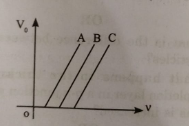
When light of sufficeintly small wavelength is incident on a metal cathode, it may emit electons called photoelectrons. Above threshold frequency the stopping potenital and hence the energy of the photoelectrons are directly proportional to the frequency. in the given figure, we see the variation of stopping potential with the frequency of incident radiation for three metals A, B and C.

Slope of graph is given by

A

he

B

`e/h`

C

`h/e`

D

`1/(he)`

Text Solution

Verified by Experts

Promotional Banner

Similar Questions

Explore conceptually related problems

Photoelectric effect When light of sufficeintly small wavelength is incident on a metal cathode, it may emit electons called photoelectrons. Above threshold frequency the stopping potenital and hence the energy of the photoelectrons are directly proportional to the frequency. in the given figure, we see the variation of stopping potential with the frequency of incident radiation for three metals A, B and C. Which of these metals A, B or C are suitable for photoelectric cell?

Photoelectric effect When light of sufficeintly small wavelength is incident on a metal cathode, it may emit electons called photoelectrons. Above threshold frequency the stopping potenital and hence the energy of the photoelectrons are directly proportional to the frequency. in the given figure, we see the variation of stopping potential with the frequency of incident radiation for three metals A, B and C. Which metal has the largest threshold wavelenght?

Photoelectric effect When light of sufficiently small wavelength is incident on a metal cathode, it may emit electsons called photoelectrons. This is called photoelectric effect. Above threshold frequency, the stopping potential and hence the energy of the photoelectrons is directly proportional to the frequency. In the given figure, we see the variation of stopping potential with the frquency of incident radiation for three metals A, B and C Which metal has the largest threshold wavelength?

Photoelectric effect When light of sufficiently small wavelength is incident on a metal cathode, it may emit electsons called photoelectrons. This is called photoelectric effect. Above threshold frequency, the stopping potential and hence the energy of the photoelectrons is directly proportional to the frequency. In the given figure, we see the variation of stopping potential with the frquency of incident radiation for three metals A, B and C Which of these metals A, B or C are suitable for photoelectric cell?

Photoelectric effect When light of sufficiently small wavelength is incident on a metal cathode, it may emit electsons called photoelectrons. This is called photoelectric effect. Above threshold frequency, the stopping potential and hence the energy of the photoelectrons is directly proportional to the frequency. Slope of graph is given by

Write Einstein's photoelectrical equation in terms of the stopping potential and the threshold frequency for a given photosensitive material. Draw a plot showing the variation of stopping potential vs the frequency of incident radiation.

Draw a graph showing the variation of stopping potential with frequency of incident raditions in relation to photoelectric effect. Deduce an expression for the slope of this graph using Einstein's photoelectric equation.

For photoelectric effect in a metal, the figure shows the plot of cut off voltage versus frequency of incident radiations. Calculate (a) the threshold frequency (b) the work function for given metal.

Sketch a graphs showing the variation of stopping potential with frequency of incident radiations for two photosensitive materials A and B having threshold frequencies v_0>v_0' respectively? What information do you get from the slope of the graphs?

Plot a graph showing the variation of stopping potential with the frequency of incident radiation for two different photosensitive materials having work functions W_1 and W_2 (W_1>W_2). On what factors does the slope and intercept of the lines depends.

